Alaska permit test: sharing the road
Pedestrians, bicyclists, motorcyclists, trucks, buses and slow vehicles. 6 questions.
According to research cited in the Alaska manual, at what collision speed do fewer than half of pedestrians survive being hit by a car?
Keyboard: press 1–4 or A–D to answer, Enter for the next question, S to save, R to read aloud, P to pause reading, L to listen and answer.
Sample sharing the road questions
According to research cited in the Alaska manual, at what collision speed do fewer than half of pedestrians survive being hit by a car?
- A 12 mph
- B 50 mph
- C 25 mph
- D 35 mph
Show answer
B. 50 mph
Nearly all pedestrians survive at 12 mph and about 90% at 25 mph, but fewer than 50% survive at 50 mph and only 10% at 62 mph. Slowing down around people is the best protection you can give them.
Under Alaska law, what happens to your driving record if you get a traffic ticket while riding a bicycle?
- A The same points as in a car are added
- B Half the usual points are added
- C No points are added
- D Your license is suspended automatically
Show answer
C. No points are added
Alaska Law AS 28.15.231(b) says no points are assessed for traffic violations committed on a bicycle. Bicyclists must still obey all traffic laws.
A motorcyclist is riding near one side of a wide lane. May you drive alongside in the same lane?
- A Yes, if the motorcyclist is riding to one side
- B Yes, if you stay below the speed limit
- C No, it is illegal and dangerous
- D Yes, on multi-lane highways only
Show answer
C. No, it is illegal and dangerous
Motorcycles need a full lane width like other vehicles, and skilled riders constantly change position within the lane. Never move into the same lane as a motorcycle, even if the lane is wide.
View diagram
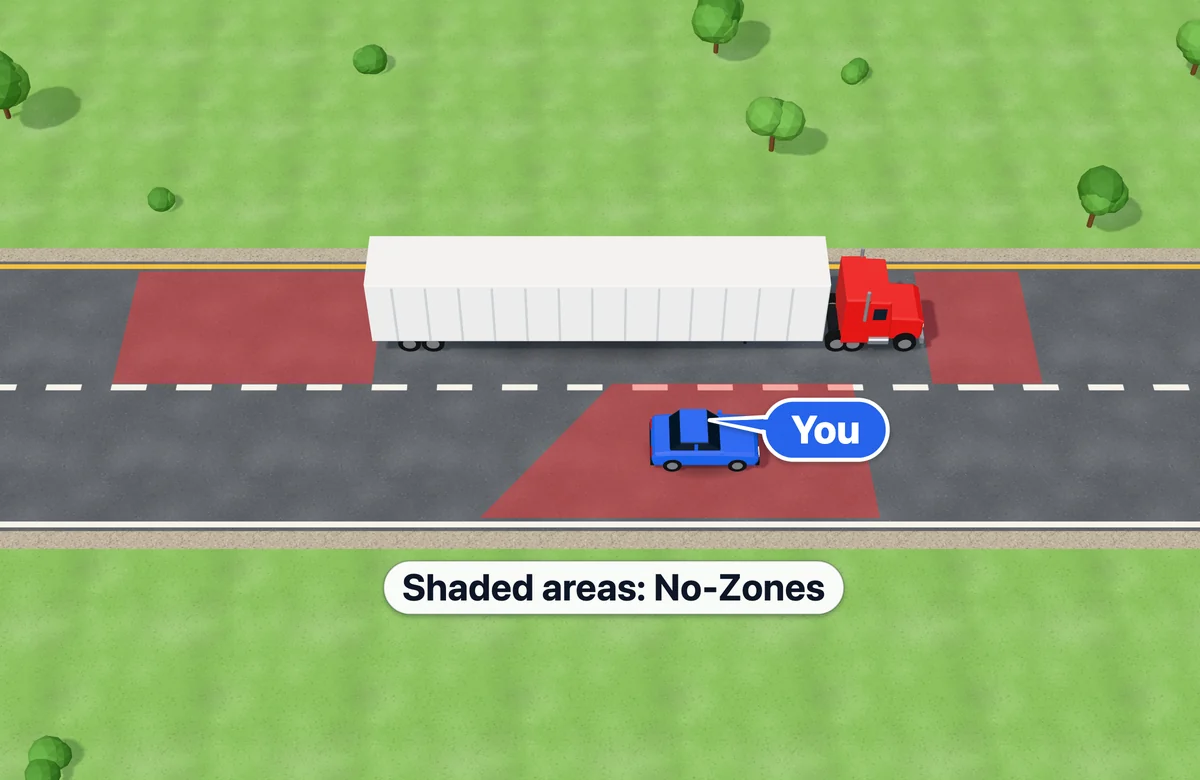
When driving near a large truck, how can you tell if you are in its blind spot (No-Zone)?
- A The truck's turn signal is on
- B You are more than 100 feet behind it
- C You cannot see the driver in the truck's side mirrors
- D You can see the truck's license plate
Show answer
C. You cannot see the driver in the truck's side mirrors
The No-Zone is the blind area around the front, back, and sides of trucks and buses. If you cannot see the driver in their side mirrors, they cannot see you, so move out of that area.