Study sheet for before your test. Notes aren’t allowed in the DMV test room. Source: Massachusetts Driver's Manual (Class D Passenger Vehicles) (Revised April 2026), mass.gov · Checked September 22, 2026 · Printed Oct 11, 2026 · drivingtestpal.com/massachusetts/cheat-sheet/ |
Massachusetts · Study sheet Massachusetts permit test cheat sheetThe 41 Massachusetts rules, 12 numbers and 12 signs worth knowing cold. Page numbers point to the handbook. Test format25 questions Passing score18 of 25 correct (72%) Permit and test fees$30 total Minimum age for a permit16 years Supervised driving40 hours Hold your permit6 months minimum Numbers to know
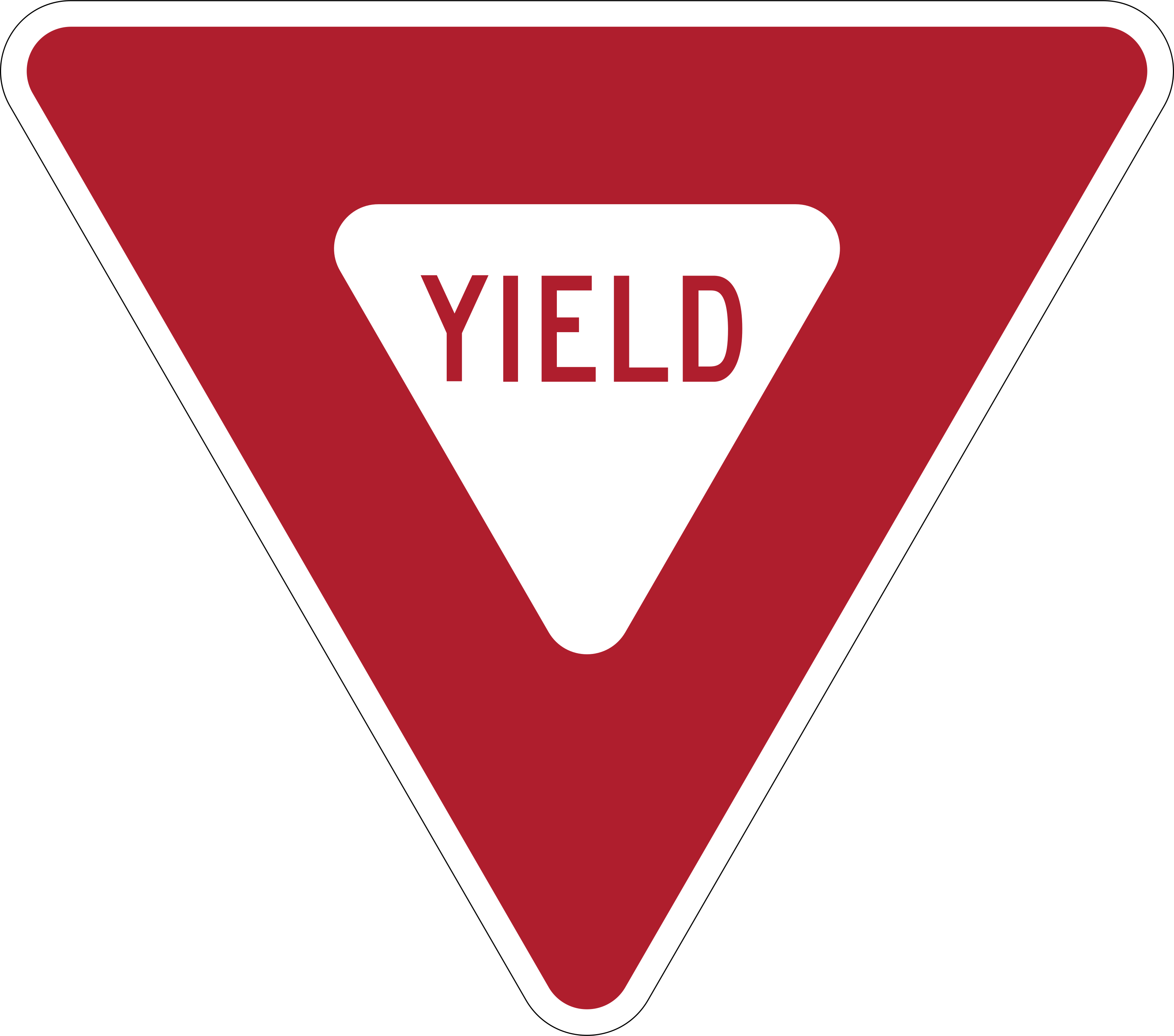
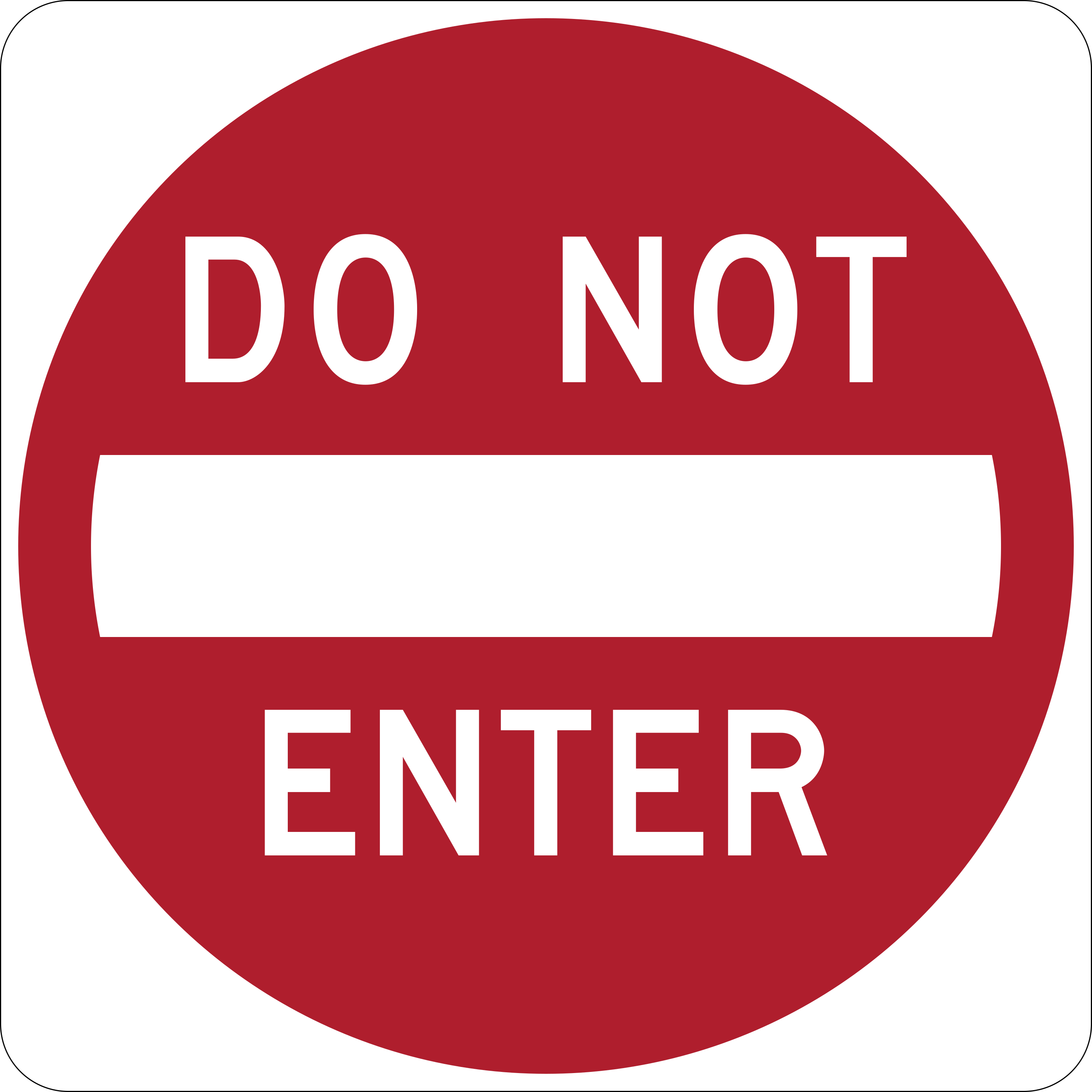
Signs to know
Permits & licensing
Laws, points & insurance
Alcohol & drugs
Speed limits & control
Sharing the road
School buses & emergency vehicles
Emergencies & crashes
Right of way & intersections
Distracted & drowsy driving
Seat belts & equipment
Following distance & space
Highways & freeways
Night, weather & hazards
Traffic signals
Pavement markings
Turning & signaling
Lanes, passing & merging
Parking & stopping
Road signs
Railroad crossings
Work zones
|
Massachusetts permit test cheat sheet
Massachusetts-specific rules from our question bank, condensed to one line each with the handbook page. Read it the night before; don’t use it instead of practicing.
Study sheet for before your test. Notes aren’t allowed in the DMV test room. See the study sheets to print.
- Test format
- 25 questions
- Passing score
- 18 of 25 correct (72%)
- Permit and test fees
- $30 total
- Minimum age for a permit
- 16 years
- Supervised driving
- 40 hours
- Hold your permit
- 6 months minimum
Permits & licensing
- You must be at least 16 to apply for a Class D or Class M learner's permit in Massachusetts. p. 11
- Permit holders must be accompanied by a licensed driver who sits in the front passenger seat, is at least 21, holds a valid license from Massachusetts or another state, and has at least one year of driving experience. p. 26
- A permit holder under 18 may not drive between midnight and 5:00 a.m. unless accompanied by a parent or legal guardian who is a licensed driver with at least one year of experience. p. 26
- To get a JOL you must hold a valid learner's permit for at least six consecutive months before the road test, with a clean record over that time. p. 17
- Teens applying for a JOL must log 40 hours of driving supervised by a parent or guardian, but the RMV accepts 30 hours if the applicant completed a driver skills development program. p. 18
- Massachusetts driver education includes 30 hours of classroom instruction, 12 hours of behind-the-wheel training and 6 hours observing other student drivers. p. 18
- For the first six months after you get a JOL, you may not drive with anyone under 18 in the car other than immediate family members, unless a licensed driver 21 or older with a year of experience sits beside you. p. 18
- JOL holders may not drive between 12:30 a.m. and 5:00 a.m. unless a parent or legal guardian is with them. p. 18
- Breaking the JOL passenger or night restriction brings a 60-day suspension for a first offense, 180 days for a second and one year for later offenses. p. 19
- Each Massachusetts learner's permit exam has 25 multiple-choice questions, and you must get 18 right within the 25-minute time limit. p. 24
- Using a manual, notes or any electronic device during the exam counts as cheating. p. 24
Laws, points & insurance
- In Massachusetts, three speeding violations within a 12-month period bring an automatic 30-day suspension. p. 67
- A Junior Operator loses the license for 90 days on a first speeding conviction and for one year on any later one. p. 67
- Three surchargeable events in two years mean you must complete the Massachusetts Driver Retraining Course within 90 days, or your license is suspended until you do. p. 67
- Seven surchargeable events (moving violations and at-fault crashes) within a three-year period bring an automatic 60-day suspension. p. 67
- The base speeding fine plus surcharge covers the first 10 mph over ($105), and every mph beyond that adds $10. p. 65
- For a civil infraction such as speeding, you must pay the fine or request a hearing within 20 days. p. 64
- Massachusetts minimum limits are $25,000 per person and $50,000 per crash for bodily injury, plus $30,000 for property damage. p. 32
Alcohol & drugs
- Massachusetts has a zero-tolerance law: any driver under 21 with a BAC of 0.02 or higher faces penalties, including license loss. p. 81
- By driving in Massachusetts you agree to a breath or blood test if arrested for OUI. p. 81
- Refusing a chemical test brings much longer suspensions for young drivers. p. 78
- Drivers under 18 who fail a chemical test lose their license for 30 days plus an additional year under M.G.L. c.90, s.24P. p. 77
- A first OUI conviction carries a fine of $500 to $5,000, up to 2 1/2 years in prison and a one-year license suspension. p. 76
- You may not drink while driving or have an open alcoholic drink in the vehicle, even if a passenger is holding it. p. 82
Speed limits & control
- Unless posted otherwise, 30 mph is the most you should drive in a thickly settled or business district. p. 87
- The school zone speed limit is 20 mph. p. 88
- Unless posted otherwise, the reasonable limits are 20 mph in school zones, 30 mph in thickly settled or business districts, 40 mph outside them, and 50 mph on a highway outside them. p. 87
- Unless a sign says otherwise, 50 mph is the most you should drive on a highway outside a thickly settled or business district. p. 87
- A thickly settled district is an area where buildings are fewer than 200 feet apart for a quarter mile or more. p. 88
Sharing the road
- When passing a vulnerable road user, such as a pedestrian, bicyclist, roadside worker or wheelchair user, you must leave at least four feet. p. 57
- Drivers and passengers can be fined up to $100 for opening a door into an oncoming bicycle. p. 123
- State law forbids driving closer than eight feet to a trolley's passenger step while passengers are getting on or off. p. 115
- Under M.G.L. c.85, s.14A, if you are not part of a funeral procession you may not drive between its vehicles unless directed by police, and you may not join it. p. 116
- On a multiple-lane highway, trucks and buses may drive only in the two right-hand lanes: the far right for normal travel and the second for passing. p. 114
School buses & emergency vehicles
- If a school bus has red lights flashing and its stop sign extended, you must stop, from either direction. p. 113
- The only exception is a school bus stopped on the other side of a divided highway with a barrier between the directions. p. 113
- Passing a stopped school bus with its lights flashing is a serious offense. p. 113
- It is illegal in Massachusetts to follow closer than 300 feet behind an emergency vehicle responding to an alarm. p. 128
- Massachusetts' move-over law requires you to slow down for a stopped emergency, highway maintenance or recovery vehicle with flashing lights. p. 128
Emergencies & crashes
- Under M.G.L. c.90 s.26, you must report in writing to the RMV, with a copy to the local police, within five days of any crash that kills or injures someone or causes more than $1,000 damage to any one vehicle or other property. source
- File a written crash report with the RMV and the local police within five days. p. 139
- If there are no injuries, the Driver Removal Law requires that vehicles be moved out of travel lanes to a safe location. p. 137
- On a two-lane road or undivided highway, place triangles or flares 10 feet behind, 100 feet behind and 100 feet in front of your vehicle. p. 134
- Tie a white cloth to your antenna or door handle to show your car is disabled, but use a red cloth when it is snowing so it stands out. p. 134
Right of way & intersections
- Rotaries are common in Massachusetts. p. 109
- With no signs, a three-quarter turn or U-turn in a multi-lane rotary means entering from the left lane, traveling in the middle or inner lane, and exiting onto the right lane. p. 109
- If you are on a single or two-lane road and come to a divided highway or a road with three or more lanes, you must yield the right-of-way. p. 109
- The White Cane Law requires you to come to a complete stop when a blind pedestrian, using a white cane or guide dog, is crossing. p. 108
Parking & stopping
- In Massachusetts you may not park within ten feet of a fire hydrant or fire lane. p. 119
- You may not park within 20 feet of an intersection in Massachusetts. p. 118
- In a business or residential district, your vehicle must be no more than 12 inches from the curb, unless angled parking is allowed. p. 117
- Whenever you stop or park, you must leave at least a 12-foot-wide clear roadway so traffic can get by. p. 117
Distracted & drowsy driving
- Massachusetts drivers under 18 may not use any mobile electronic device for any reason while driving, even hands-free. p. 48
- Drivers 18 and older may use a device only in hands-free mode, mounted and touched only to activate hands-free. p. 47
- Handheld device fines climb with each offense: $100 for a first, $250 plus a mandatory distracted driving program for a second, and $500 plus an insurance surcharge and the program for third and later offenses. p. 48
- It is illegal to wear headphones or any headset that limits your attention to the environment while driving. p. 47
Seat belts & equipment
- Children must ride in an approved child restraint until they are at least eight years old or at least 57 inches tall. p. 44
- Massachusetts fines a driver $25 for each passenger aged 12 through 15 who is not buckled up. p. 43
- Massachusetts enforces its safety belt law as a secondary offense: you can be fined only when stopped for another traffic violation. p. 43
- Massachusetts allows tinting of side and rear windows up to 35 percent, but tinting the windshield is illegal. p. 42
Turning & signaling
Following distance & space
Highways & freeways
- The Massachusetts Turnpike has a minimum speed of 40 mph, and the Boston Harbor tunnels have a minimum of 20 mph. p. 87
- Signal your exit at least 500 feet before the exit ramp, then slow to the posted ramp speed once you are on it. p. 103
- As a general rule, do not use a highway breakdown lane for travel or passing. p. 102
Night, weather & hazards
- Massachusetts law requires headlights and taillights whenever your windshield wipers are on. p. 55
- Dim to low beams within 500 feet of an oncoming vehicle and within 200 feet of a vehicle you are following. p. 54
- Before driving, remove all ice and snow from your vehicle, including the roof, hood and trunk. p. 56
Traffic signals
Pavement markings
Lanes, passing & merging
Road signs
- In Massachusetts, numbered state routes appear on white rectangular signs with black letters and borders, while Interstate highways use blue, red and white shields. p. 94
Railroad crossings
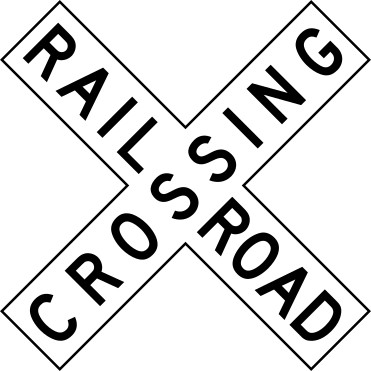
- When the lights flash at a railroad crossing, stop at least 15 feet before the light post or gate. p. 95
Work zones
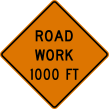
- Speeding fines are doubled in a posted work zone. p. 65