Study sheet for before your test. Notes aren’t allowed in the DMV test room. Source: Washington Driver Guide, dol.wa.gov · Checked September 22, 2026 · Printed Oct 11, 2026 · drivingtestpal.com/washington/cheat-sheet/ |
Washington · Study sheet Washington permit test cheat sheetThe 42 Washington rules, 12 numbers and 12 signs worth knowing cold. Page numbers point to the handbook. Test format40 questions Passing score32 of 40 correct (80%) Permit and test fees$35 total Minimum age for a permit15 years Supervised driving50 hours (10 at night) Hold your permit6 months minimum Numbers to know
Signs to know
Permits & licensing
Alcohol & drugs
Laws, points & insurance
Traffic signals
School buses & emergency vehicles
Speed limits & control
Parking & stopping
Sharing the road
Distracted & drowsy driving
Seat belts & equipment
Railroad crossings
Night, weather & hazards
Emergencies & crashes
Pavement markings
Right of way & intersections
Turning & signaling
Highways & freeways
Work zones
Road signs
Following distance & space
|
Washington permit test cheat sheet
Washington-specific rules from our question bank, condensed to one line each with the handbook page. Read it the night before; don’t use it instead of practicing.
Study sheet for before your test. Notes aren’t allowed in the DMV test room. See the study sheets to print.
- Test format
- 40 questions
- Passing score
- 32 of 40 correct (80%)
- Permit and test fees
- $35 total
- Minimum age for a permit
- 15 years
- Supervised driving
- 50 hours (10 at night)
- Hold your permit
- 6 months minimum
Permits & licensing
- If you are enrolling in an approved driver training course, you can apply for your instruction permit as early as age 15. p. 25
- Without a driver training course, you can take the knowledge exam once you turn 15½, and you get your permit after you pass. p. 25
- Teens who skip driver training can still hold a permit and practice, but they must wait until they are 18 to take the skills exam and get a license. p. 25
- Teens must hold the instruction permit for at least 6 months before getting a license. p. 26
- Teens need at least 40 hours of day driving and 10 hours of night driving, 50 hours in all, and a parent or guardian must attest to it. p. 26
- Washington's approved traffic safety course standard is 30 hours of classroom and 6 hours of behind-the-wheel instruction. p. 26
- Adults who learn on a permit must practice with a licensed driver who has 5 or more years of experience. p. 28
- For the first 6 months, an intermediate license holder may not carry passengers under age 20 unless they are immediate family. p. 28
- From 6 months until age 18 or one year of safe driving, an intermediate driver may carry no more than 3 passengers under 20 who are not immediate family. p. 28
- Intermediate license holders may not drive between 1 a.m. and 5 a.m. unless they are with a licensed driver who is at least 25 (or a parent or guardian). source
- Intermediate penalties step up: a first violation keeps restrictions in place until 18, a second brings a 6-month suspension (or until 18, if sooner), and a third suspends the license until 18. p. 29
Alcohol & drugs
- A BAC of 0.08% or more is a DUI for drivers 21 and older. p. 37
- Drivers under 21 face DUI consequences at a BAC of just 0.02%. p. 37
- For adults 21 and older, an active THC level of 5 nanograms per milliliter of blood or more is a DUI. p. 38
- For drivers under 21, any active THC above 0 nanograms per milliliter of blood brings DUI consequences. p. 37
- Under Washington's implied consent law, a first refusal within seven years means your license is revoked or denied for one year. source
- Washington's DUI law covers being in physical control of a vehicle, even a parked one. p. 37
- Open alcohol and cannabis products may be carried only in the trunk or a truck bed. p. 39
- Cannabis use is legal at 21, but driving after consuming any cannabis is illegal for all ages. p. 73
Laws, points & insurance
- Washington requires liability coverage of at least $25,000 for one person's injury or death, $50,000 for two or more people, and $10,000 for property damage. p. 43
- Property damage coverage must be at least $10,000 per collision. p. 43
- Follow the instructions on the back of a ticket within 15 days, or your driving privileges can be suspended. p. 182
- File a Vehicle Report of Sale within 5 days of selling, trading, gifting or disposing of a vehicle. p. 42
- New residents licensed in another state have 30 days to get a Washington driver license. p. 20
- Update your address in License Express within 10 days of moving. p. 39
- Aggressive driving is a traffic offense, but road rage, an angry response that leads to violent behavior with a vehicle or other weapon, is a criminal offense. p. 78
Traffic signals
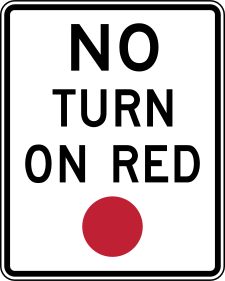
- After a complete stop at a red light, you may turn left onto a one-way street if no 'no turn on red' sign is posted and there is room to enter traffic. p. 110
- After coming to a complete stop at a red light, you may turn right if no sign prohibits it and you have plenty of room to enter traffic. p. 110
- If you are already in the intersection when the light turns yellow, continue through at the posted speed. p. 111
- You won't see a flashing green light in Washington. p. 112
- If a signal isn't working, treat the intersection like a four-way stop: come to a complete stop, yield to traffic on your right, and proceed cautiously when it is safe. p. 109
Parking & stopping
- Do not park within 15 feet of a fire hydrant. p. 144
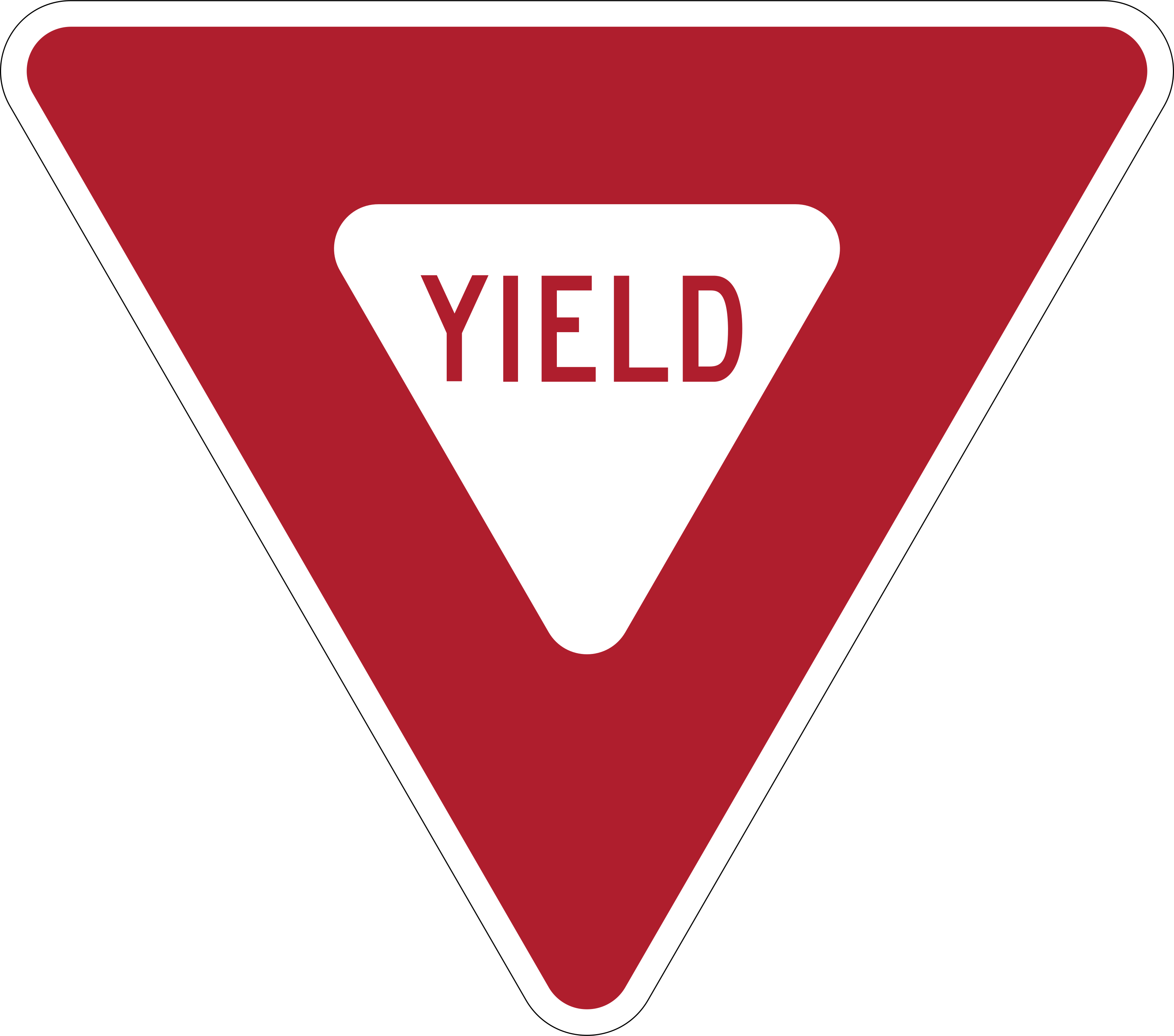
- Don't park within 30 feet of a traffic signal, stop sign or yield sign. p. 143
- Do not park within 75 feet of a fire station driveway on the opposite side of the street. p. 143
- Do not park on railroad tracks or within 50 feet of a railroad crossing. p. 144
- It is a crime to leave a child under 12 unattended in a parked vehicle, and a crime to leave a child under 16 unattended while the motor is running. p. 145
School buses & emergency vehicles
- On a 2-lane road, all vehicles must stop when the bus's red lights flash and the stop sign extends. p. 96
- On a multilane road, drivers going the opposite way don't need to stop for a school bus if there are three or more lanes or the lanes are separated by a median or barrier. p. 97
- Don't use a center turn lane to pass a school bus; drivers in all turn lanes must stop. p. 95
- When you see a roadside response vehicle with flashing lights, you must move over into a farther lane or slow down to at least 10 mph below the posted limit, and never drive faster than 50 mph in an emergency zone. p. 143
- Washington's Move Over, Slow Down message says to move over 200 feet before and after an emergency scene and slow down to 10 mph below the posted speed limit. p. 3
Pavement markings
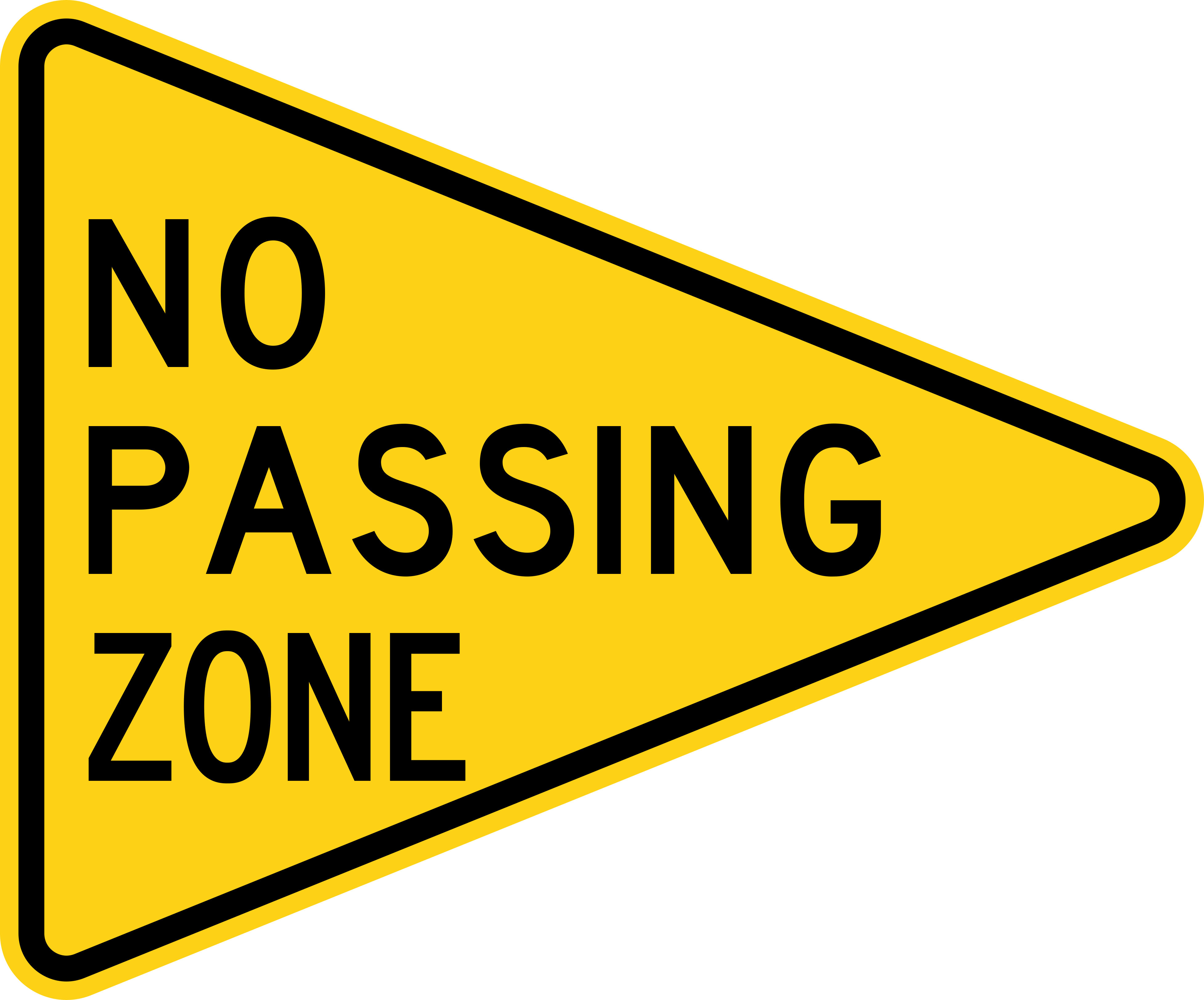
- Shared center lanes are only for left turns (or permitted U-turns) from either direction. p. 134
- Medians divide roadways and can be open spaces, cement dividers or 18-inch solid yellow pavement markings with stripes. p. 131
- Fire lanes are usually marked with red stripes or a red curb. p. 138
- At a bicycle box, cyclists wait ahead of cars and cross first on green. p. 140
Speed limits & control
- The school zone speed limit is 20 mph because higher speeds increase the risk of fatal crashes. p. 140
- The beach is considered a state highway, so all driving laws apply. p. 152
- The posted maximum is for ideal conditions. p. 114
- Unless a different limit is posted, Washington law sets maximum speeds of 25 mph on city and town streets, 50 mph on county roads and 60 mph on state highways. source
Sharing the road
- Leave at least 3 feet between the bicyclist and the widest part of your vehicle. p. 103
- A loaded truck at 55 mph needs about 450 feet to stop. p. 98
- Agricultural vehicles designed to go 25 mph or less display a triangle sign on the back. p. 106
- Yield to any transit vehicle traveling in your direction that has signaled and is pulling back onto the roadway. p. 98
Distracted & drowsy driving
- Washington law bans holding any electronic device while driving, including phones, tablets and gaming devices, for every driver regardless of age or experience. p. 85
- Permit and intermediate drivers cannot use a cell phone or any mobile electronic device while driving, even hands-free. p. 70
- It is illegal to drive while wearing earbuds, earphones, headphones or headsets that broadcast sound or cancel noise. p. 70
- An officer can ticket you for violating the distracted driving law, and fines after your first violation can be doubled. p. 86
Seat belts & equipment
- Every person in a moving vehicle must wear a seat belt or be secured in an approved child restraint. p. 52
- Children up to age 2 must ride in a rear-facing car seat. p. 53
- Children 4 and older stay in a car or booster seat until the vehicle's lap and shoulder belts fit properly, usually between ages 8 and 12 or a height of about 4'9". p. 54
- Tire tread should not be less than 2/32 of an inch. p. 48
Turning & signaling
Railroad crossings
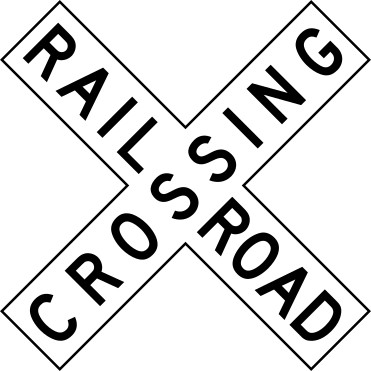
- Stop between 15 and 50 feet from the nearest rail when signals flash, gates are lowering or down, a flagger signals, a train is near, you hear its horn, or a stop sign is posted. p. 105
- Call the number on the blue and white Emergency Notification System sign and give the dispatcher the crossing ID number, your location and the details. p. 106
- Near light rail, pay attention to signs and markings, watch for trains, and leave at least one car length between you and the train. p. 106
Night, weather & hazards
- Washington law requires headlights from a half hour after sunset to a half hour before sunrise. p. 49
- Dim your high beams when you are within 500 feet of an oncoming vehicle and within 300 feet of a vehicle you are following. p. 50
- Switch back to regular headlights when you are within 300 feet of a vehicle you are following. p. 50
Emergencies & crashes
- Warn other road users by placing flares 200 to 300 feet behind your vehicle. p. 173
- Washington requires a written report of any crash that injures or kills someone, or that causes property damage above the state's reporting threshold. p. 176
- If there's a fire, jump clear without touching the vehicle, land with both feet together, and shuffle 35 feet away. p. 178
Right of way & intersections
Highways & freeways
Work zones
Road signs
- Automated cameras record drivers who run red lights, ignore railroad signals or speed in school zones. p. 115
Following distance & space
- The guide says to leave a distance at least twice the length of your vehicle between you and the vehicle ahead. p. 159