Washington permit test: railroad crossings
Crossing signs and signals, when to stop and what to do if stuck. 5 questions.
When you must stop at a railroad crossing, how far from the nearest rail should you stop?
Keyboard: press 1–4 or A–D to answer, Enter for the next question, S to save, R to read aloud, P to pause reading, L to listen and answer.
Sample railroad crossings questions
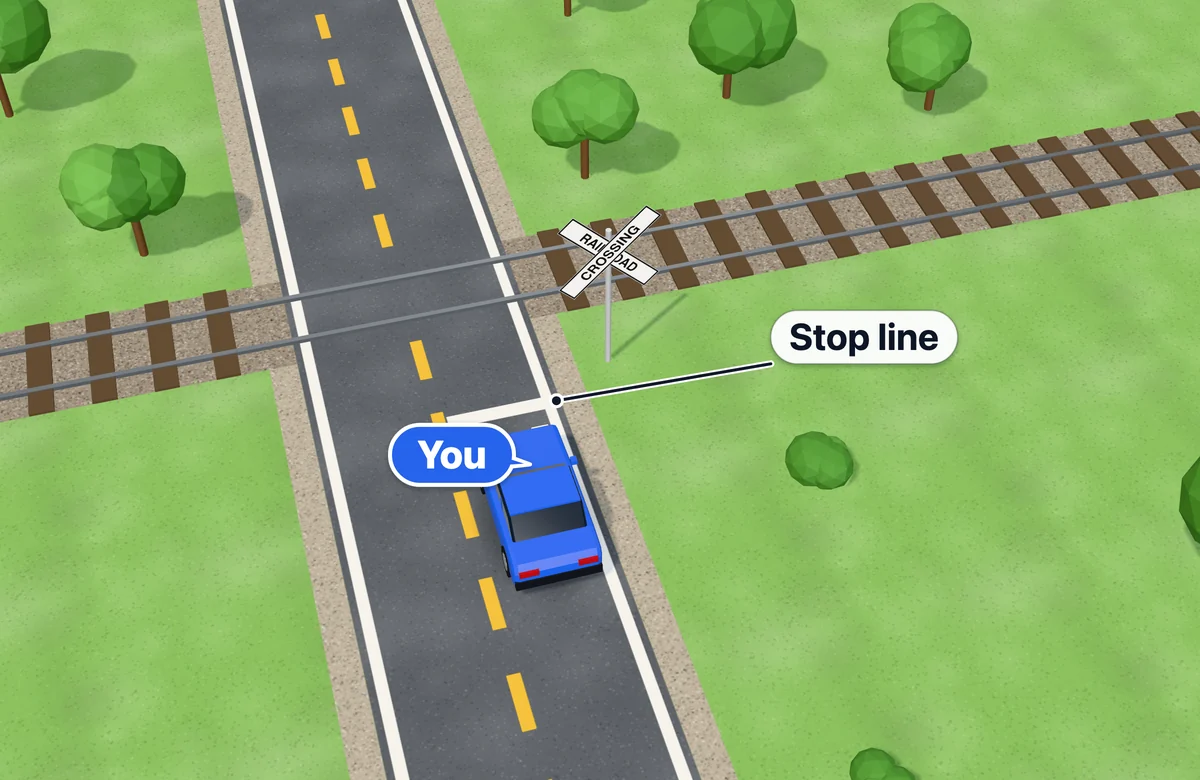
View diagram
When you must stop at a railroad crossing, how far from the nearest rail should you stop?
- A Between 5 and 10 feet
- B Between 60 and 100 feet
- C Between 15 and 50 feet
- D Right at the edge of the tracks
Show answer
C. Between 15 and 50 feet
Stop between 15 and 50 feet from the nearest rail when signals flash, gates are lowering or down, a flagger signals, a train is near, you hear its horn, or a stop sign is posted.
At a railroad crossing the lights are flashing and bells are ringing, but the gate is still up. What must you do?
- A Cross quickly before the gate lowers
- B Slow down and cross if you don't see a train
- C Go around the gate when it comes down
- D Stop, whether the gate is down or not
Show answer
D. Stop, whether the gate is down or not
When lights flash and bells ring at a crossing, you must stop whether the gate is down or not, and never drive around the gate. Trains may be closer and faster than they appear.
How far can it take a train to come to a full stop?
- A Up to a mile
- B About 100 feet
- C About 450 feet
- D About two car lengths
Show answer
A. Up to a mile
Trains always have the right-of-way. They are heavy and can take up to a mile to stop, even at low speeds.
Something is blocking the railroad tracks at a crossing. Whom should you call first?
- A The local transit agency
- B The number on the blue and white Emergency Notification System sign
- C DOL customer service
- D No one; trains can see obstacles in time
Show answer
B. The number on the blue and white Emergency Notification System sign
Call the number on the blue and white Emergency Notification System sign and give the dispatcher the crossing ID number, your location and the details. If there is no sign, dial 911.