Study sheet for before your test. Notes aren’t allowed in the DMV test room. Source: Alabama Driver Manual (November 2024), alea.gov · Checked September 22, 2026 · Printed Oct 11, 2026 · drivingtestpal.com/alabama/cheat-sheet/ |
Alabama · Study sheet Alabama permit test cheat sheetThe 39 Alabama rules, 12 numbers and 12 signs worth knowing cold. Page numbers point to the handbook. Permit and test fees$41.25 total Minimum age for a permit15 years Supervised driving50 hours Hold your permit6 months minimum Numbers to know
Signs to know
Permits & licensing
Laws, points & insurance
School buses & emergency vehicles
Alcohol & drugs
Speed limits & control
Night, weather & hazards
Seat belts & equipment
Parking & stopping
Sharing the road
Railroad crossings
Distracted & drowsy driving
Right of way & intersections
Turning & signaling
Lanes, passing & merging
Emergencies & crashes
Following distance & space
Highways & freeways
|
Alabama permit test cheat sheet
Alabama-specific rules from our question bank, condensed to one line each with the handbook page. Read it the night before; don’t use it instead of practicing.
Study sheet for before your test. Notes aren’t allowed in the DMV test room. See the study sheets to print.
- Test format
- Not published
- Passing score
- Not published
- Permit and test fees
- $41.25 total
- Minimum age for a permit
- 15 years
- Supervised driving
- 50 hours
- Hold your permit
- 6 months minimum
Permits & licensing
- Alabama lets anyone 15 years old get a restricted learner license after passing the knowledge test. p. 11
- The "Y" restriction on a 15-year-old's learner license allows driving only with a licensed driver who is 21 or older, or a licensed or certified driving instructor, in the seat beside the driver. p. 11
- An Alabama Stage I learner license lets you drive only with a parent, legal guardian, a licensed driver age 21 or older, or a licensed or certified driving instructor in the front seat beside you. source
- A driver aged 16 or 17 must hold a learner license for six months, or until their 18th birthday, before the road test. p. 12
- Under Alabama's graduated license law, a 16-year-old (or a 17-year-old licensed less than 6 months) may carry no more than one non-family passenger, other than a parent, guardian or supervising licensed driver at least 21. p. 86
- A 16-year-old (or a 17-year-old licensed less than 6 months) may not drive between 12 midnight and 6 a.m. unless with a parent or legal guardian, or under an exception such as driving to or from work or a school or religious event. p. 86
- Breaking a GDL restriction keeps you in the restricted stage longer: the restricted period is extended by 6 months or until you turn 18. p. 86
- To move from the learner stage to a Stage II restricted license, a teen must hold the learner license at least 6 months and either log 50 hours of behind-the-wheel practice or complete a driver education course approved by the State Department of Education. source
Laws, points & insurance
- Alabama's Mandatory Liability Insurance Law requires at least $25,000 for injury or death of one person, $50,000 for two or more people, and $25,000 for property damage. p. 70
- A first mandatory liability insurance violation can bring a fine of up to $500, and a second or later violation up to $1,000. p. 70
- When a crash causes injury, death, or $500 or more in damage and the at-fault party was uninsured, a written SR-31 form must be sent within 30 days. p. 40
- Alabama suspends licenses on a sliding scale: 12-14 points in two years brings 60 days, 15-17 points 90 days, and so on up to 365 days for 24 or more. p. 21
- For a GDL driver, a conviction for offenses such as reckless driving, illegal passing, driving on the wrong side of the road, or any offense worth four or more points brings an automatic 60-day suspension. p. 86
- Anyone whose license was canceled, suspended, revoked or disqualified must pay a reinstatement fee of at least $100, plus meet other legal requirements. p. 19
- After you change your address within Alabama, you have 30 days to notify the Driver License Division. p. 16
School buses & emergency vehicles
- When a school bus displays flashing red lights and an extended stop arm, traffic from either direction must stop at least 20 feet from the bus. p. 64
- On a divided highway with four or more lanes, drivers meeting a school or church bus stopped in the opposing roadway do not have to stop. p. 63
- In Alabama you must stop when following or meeting a school bus or church bus stopped with its stop arm extended and red lights flashing. p. 63
- Alabama's Move Over Act covers stopped police and emergency vehicles, wreckers, utility service vehicles, maintenance, construction and survey vehicles with flashing lights, and garbage trucks collecting on the roadside. source
- On a two-lane road, move as far as you can within your lane from a stopped emergency vehicle, wrecker, utility, maintenance or garbage vehicle, and slow down: to 15 mph under the limit when it is 25 mph or more, or to 10 mph when the limit is 20 mph or less. p. 70
- Only vehicles on necessary official business may follow within 500 feet of an emergency vehicle on an emergency run. p. 67
Alcohol & drugs
- In Alabama it is unlawful to drive with a blood alcohol concentration of .08 percent or more, or while under the influence at any level. p. 35
- Drivers under 21 may not drive with a blood alcohol content of .02 percent or more. p. 35
- Commercial vehicle operators may not drive with a blood alcohol content of .04 percent or more, half the adult limit. p. 35
- A first DUI conviction brings a fine of $600 to $2,100, up to one year in jail, and a 90-day license suspension. p. 35
- A second DUI conviction within 10 years brings a fine of $1,100 to $5,100, a mandatory 48 hours in jail or 20 days of community service, and a one-year license revocation. p. 35
- Anyone who drives on Alabama's public highways is considered to have consented to chemical tests of blood, breath or urine. p. 36
Speed limits & control
- Alabama's statutory limit in an urban district is 30 mph unless a different limit is posted. p. 62
- Alabama sets a statutory limit of 35 mph on unpaved roads, unless a different limit is posted. p. 62
- On county paved roads, the statutory limit is 45 mph unless another limit is posted. p. 62
- Alabama's statutory limits top out at 70 mph where posted on interstates. p. 62
- Alabama's basic speed law says you must never drive faster than is reasonable under existing conditions. p. 61
Night, weather & hazards
- Headlights, not just parking lights, must be on from a half-hour after sunset to a half-hour before sunrise, and any time you cannot see clearly for at least 500 feet. p. 71
- You must dim your headlights within 500 feet of an oncoming vehicle and within 200 feet when following another vehicle. p. 71
- When following another vehicle, dim your headlights within 200 feet so you do not blind the driver through their mirrors. p. 71
- Alabama law requires headlights whenever the windshield wipers are in use because of rain, sleet or snow. p. 73
- The wiper-headlight law applies when wipers are in use because of rain, sleet or snow, but intermittent wiper use does not require headlights. p. 73
Seat belts & equipment
- Alabama's safety belt law requires that every person in the vehicle be restrained, whatever their age. p. 32
- Alabama requires a rear-facing infant or convertible seat until the child is at least 1 year old or 20 pounds. p. 32
- Alabama's law requires a booster seat until a child is 6 years old, and a seat belt after that until age 15. p. 32
- On passenger cars such as sedans and coupes, all side and rear windows must allow at least 32 percent light transmission. p. 70
- A tire is illegal in Alabama if its tread is less than 1/16 inch deep. p. 82
Parking & stopping
- You may not park within 15 feet of a fire hydrant. p. 31
- Parking is not allowed within 20 feet of a crosswalk at an uncontrolled intersection. p. 31
- Do not park within 30 feet of a flashing beacon, stop sign or traffic signal at the side of the road. p. 31
- You may not park within 50 feet of the nearest rail of a railroad crossing. p. 31
Turning & signaling
- Signal at least 100 feet before you turn and keep signaling until you make the turn. p. 23
- Three-point turns are not permitted on interstate freeways, on curves, or near the top of hills where drivers from either direction cannot see you within 500 feet. p. 25
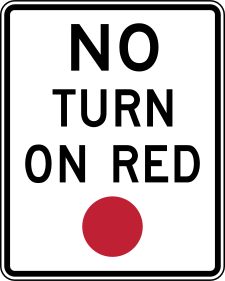
- After a full stop, you may turn left on red only if you are on a one-way street turning onto another one-way street whose traffic moves from right to left. p. 63
Sharing the road
- Alabama law requires at least three feet between your vehicle and a person on a bicycle when you pass. p. 26
- People on bicycles under 16 must wear a securely fastened protective helmet on public roads, rights-of-way, bicycle paths and in public parks. p. 26
- In Alabama it is illegal for people on bicycles to ride on the sidewalk. p. 26
Railroad crossings
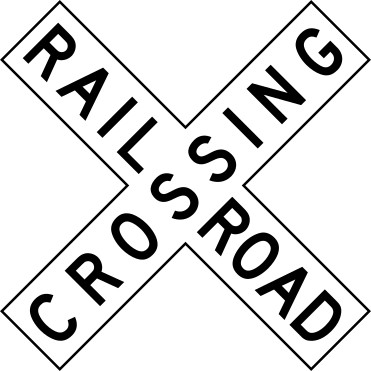
- The round yellow sign with a black X and RR warns that a railroad crossing is ahead. p. 40
- When approaching a railroad crossing where you must stop, stop within 15 to 50 feet of the tracks. p. 41
- School buses, church buses, other passenger buses, and trucks carrying flammables, explosives or other hazardous materials must stop before crossing any railroad crossing. p. 41
Distracted & drowsy driving
- Alabama's Hands-Free Law, effective June 2024, targets drivers who physically hold a phone or other wireless device while driving. p. 18
- Alabama's Hands-Free Law makes holding a wireless device a violation when the driver is also observed crossing in and out of a lane without signaling, swerving, or otherwise driving improperly. p. 18
- Drivers in Alabama's restricted (Stage II) license stage may not drive while operating any handheld communication device. p. 86
Right of way & intersections
Lanes, passing & merging
Emergencies & crashes
Following distance & space
- If road and weather conditions are not good, increase your following distance to four or five seconds. p. 38
Highways & freeways
- In Alabama, dial *HP (*47) toll-free on a cell phone to reach the State Troopers to report highway emergencies, crashes and drunk drivers. p. 78