Alaska Permit Practice Test 5
25 questions written from the State of Alaska Driver Manual, with an explanation and page citation for every answer.
What do regulatory signs, such as black or red on white signs, tell you?
Keyboard: press 1–4 or A–D to answer, Enter for the next question, S to save, R to read aloud, P to pause reading, L to listen and answer.
About this test
These questions were written from the State of Alaska Driver Manual (REV. 10/2025). 15 of the 20 Alaska questions in this test cover rules that are specific to Alaska or differ between states. Every answer comes with an explanation and a link to the exact page it comes from, so you can check it yourself.
Your answers are saved in this browser. Questions you miss go to My mistakes so you can practice them again.
Sample questions from this test
What do regulatory signs, such as black or red on white signs, tell you?
- A Suggestions you may ignore if no one is around
- B Directions to nearby gas and food
- C Warnings about hazards ahead
- D Instructions you must obey by law
Show answer
D. Instructions you must obey by law
Regulatory signs give instructions that must be understood and obeyed. They are backed by state law, regulation, or local ordinance, and violating them can bring a ticket.
How close to a fire hydrant may you legally park in Alaska?
- A No closer than 15 feet
- B No closer than 10 feet
- C No closer than 20 feet
- D No closer than 30 feet
Show answer
A. No closer than 15 feet
It is illegal to park closer than 15 feet from a fire hydrant. Firefighters need clear access to the hydrant to connect their hoses quickly.
Within what distance of an intersection or railroad crossing is passing prohibited?
- A 50 feet
- B 300 feet
- C 100 feet
- D 1,000 feet
Show answer
C. 100 feet
Do not pass when approaching within 100 feet of, or crossing, an intersection or railroad crossing, or within 100 feet of a posted narrow bridge, viaduct, or tunnel. Vehicles may turn or stop suddenly in these places.
You are in a crash in which someone is injured, and you fail to give DMV proof of insurance within 15 days. What happens on a first occurrence?
- A You receive a written warning only
- B Your license is suspended for 90 days
- C Your license is suspended for 1 year
- D You pay a $50 fine with no suspension
Show answer
B. Your license is suspended for 90 days
If you were uninsured or do not provide proof within 15 days, your license is suspended for 90 days on a first occurrence and 1 year on a second. Prompt proof of insurance protects everyone hurt in the crash.
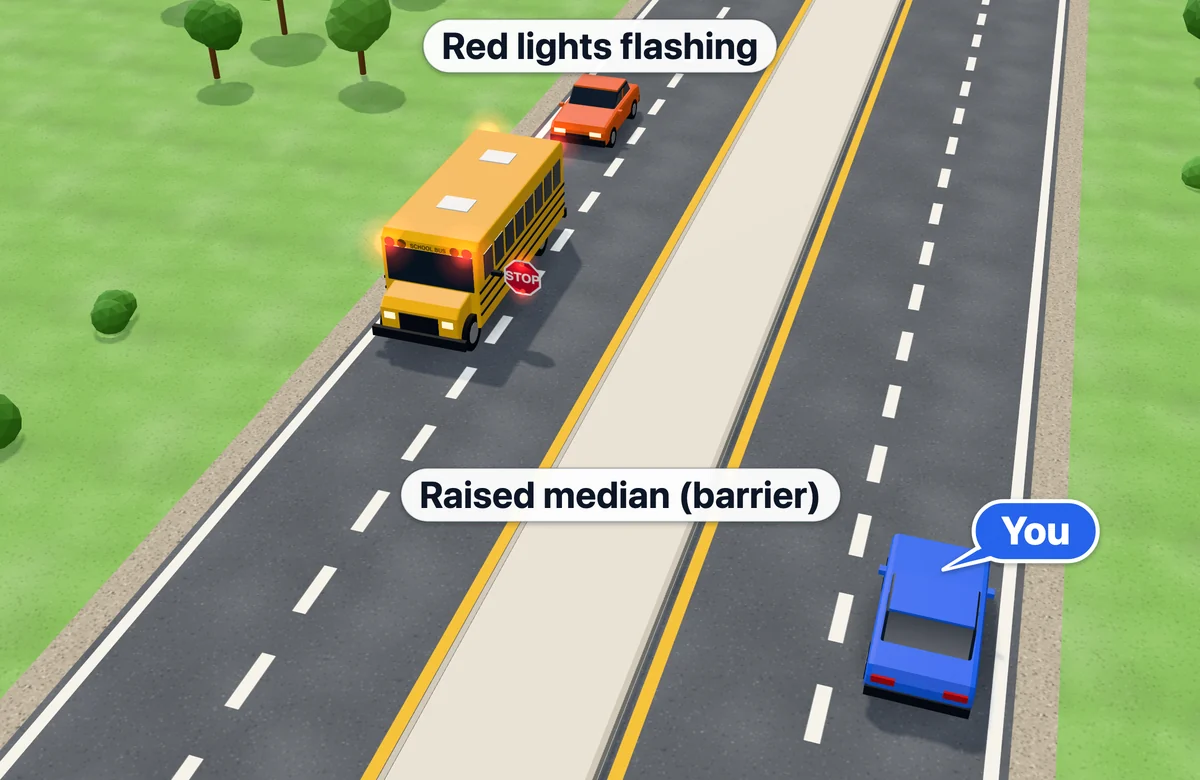
View diagram
You are on a highway with separated roadways and two or more lanes in each direction. A school bus on the other side is stopped with red lights flashing. What must you do?
- A Stop until the stop arm is retracted
- B Continue with caution; you need not stop
- C Stop only if children are visible
- D Pull onto the shoulder and wait
Show answer
B. Continue with caution; you need not stop
On a highway with separated roadways and two or more lanes each way, you do not need to stop for a school bus going the opposite direction. Drivers behind the bus, on the same side, must always stop.