Connecticut Permit Practice Test 3
26 questions written from the State of Connecticut Driver's Manual, with an explanation and page citation for every answer.
A 17-year-old is charged with driving under the influence. Can the case be handled under youthful offender status?
Keyboard: press 1–4 or A–D to answer, Enter for the next question, S to save, R to read aloud, P to pause reading, L to listen and answer.
About this test
These questions were written from the State of Connecticut Driver's Manual (Revised March 2023). 9 of the 21 Connecticut questions in this test cover rules that are specific to Connecticut or differ between states. Every answer comes with an explanation and a link to the exact page it comes from, so you can check it yourself.
Your answers are saved in this browser. Questions you miss go to My mistakes so you can practice them again.
Sample questions from this test
A 17-year-old is charged with driving under the influence. Can the case be handled under youthful offender status?
- A Yes, if it is a first offense
- B Yes, because every driver under 18 is eligible for that status
- C No; DUI is excluded from youthful offender status
- D Only if no one was injured
Show answer
C. No; DUI is excluded from youthful offender status
Someone under 18 cannot be treated as a youthful offender for negligent homicide with a vehicle, evading responsibility after a crash causing death or serious injury, or driving under the influence. These serious offenses are handled more strictly.
In Connecticut, a 17-year-old driver and her passenger are both stopped without seat belts. What can happen?
- A Only the driver can be fined $75
- B Only the passenger can be fined
- C Each can be cited and fined $75
- D Only a warning is given for a first offense
Show answer
C. Each can be cited and fined $75
It is illegal in Connecticut to drive or ride without a seat belt. When the driver is under 18, both the driver and the passenger can be cited and fined $75 each.

View diagram
A solid yellow line runs on your side of the center line, next to a dashed yellow line on the other side. What does this mean for you?
- A You may not pass
- B You may pass when safe
- C You may pass if no oncoming car is in sight
- D The lane is a turn-only lane
Show answer
A. You may not pass
With a dashed yellow line next to a solid yellow line, passing is allowed on the dashed side but not on the solid side. If the solid line is on your side, you may not pass.
What color are temporary signs in work zones?
- A Yellow with black letters
- B Green with white letters
- C Red with white letters
- D Orange with black letters or symbols
Show answer
D. Orange with black letters or symbols
All temporary work zone signs have an orange background with black letters or symbols. When you see orange, slow down and expect workers, equipment and changing lanes.
View diagram
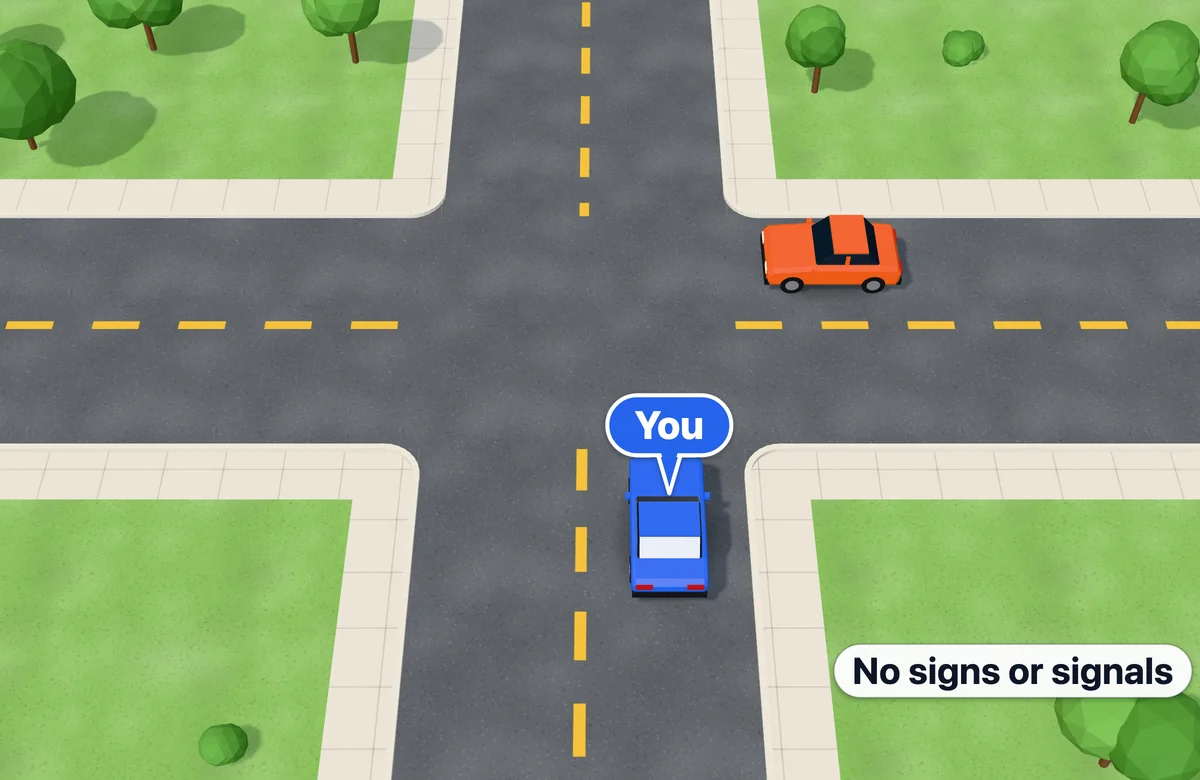
You reach an intersection with no signs or signals at the same time as a car on the cross street to your right. What should you do?
- A Go first because you are on the left
- B Yield to the car on your right
- C Go first if you are going straight
- D Flash your lights and go
Show answer
B. Yield to the car on your right
Where there is no stop sign, yield sign or signal, drivers must yield to vehicles coming from the right. Slow down at unmarked intersections so you can stop if needed.