Delaware Road Signs Test 3
22 road-sign questions based on the federal MUTCD, the standard every state's signs follow.
What does this sign require of drivers?
Keyboard: press 1–4 or A–D to answer, Enter for the next question, S to save, R to read aloud, P to pause reading, L to listen and answer.
About this test
Every state's road signs follow the federal Manual on Uniform Traffic Control Devices (MUTCD), so these sign questions apply in Delaware and everywhere else in the U.S. Learn the shapes and colors and you can read signs you have never seen before. Every answer comes with an explanation and a link to the exact page it comes from, so you can check it yourself.
Your answers are saved in this browser. Questions you miss go to My mistakes so you can practice them again.
Sample questions from this test
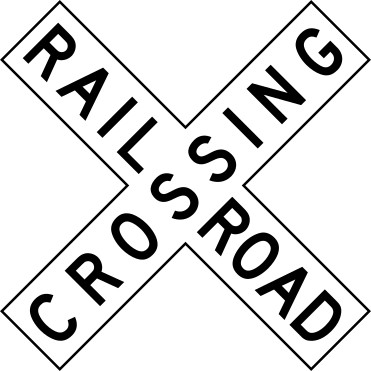
What does this sign require of drivers?
- A A railroad crossing is still some distance down the road
- B A road crosses yours at the next corner
- C Stop only when the gates are down
- D A railroad crosses here, and you must yield to trains
Show answer
D. A railroad crosses here, and you must yield to trains
The white X-shaped crossbuck marks the crossing itself. In most states it means you must yield to trains, slowing and stopping if one is coming. Trains cannot stop quickly, so never try to beat one.
Source: MUTCD 11th ed., page 1033
White lines on the pavement are used for what?
- A Separating traffic going in opposite directions
- B Separating lanes going the same way and marking the right edge
- C Marking the left edge of a divided highway
- D Marking lanes for left turns from both directions
Show answer
B. Separating lanes going the same way and marking the right edge
White lines separate lanes that flow in the same direction and mark the right edge of the road. Yellow lines deal with opposing traffic and left edges. Using color, you can tell which way traffic flows even without signs.
Source: MUTCD 11th ed., page 577
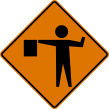
What should you do after passing this sign?
- A Watch for workers on the shoulder only
- B Be ready to obey a person directing traffic ahead
- C Follow the detour arrows onto another road
- D Speed up so you clear the work zone quickly
Show answer
B. Be ready to obey a person directing traffic ahead
This sign warns that a flagger is stationed ahead to control traffic, usually with a STOP/SLOW paddle. Slow down, be prepared to stop, and follow the flagger's directions.
Source: MUTCD 11th ed., page 846
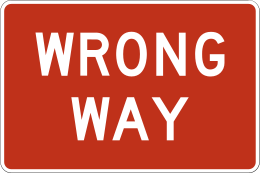
You pass this sign after turning onto a ramp. What has happened?
- A You have entered a lane meant only for buses
- B You missed your exit and should take the next one
- C You are heading toward a closed road and a detour
- D You are going against traffic and must safely turn around
Show answer
D. You are going against traffic and must safely turn around
This red rectangle is placed farther along a one-way road or ramp than the red DO NOT ENTER sign. Seeing it means you are traveling against traffic. Pull over safely, turn around when it is safe, and leave the way you came.
Source: MUTCD 11th ed., page 150
At a railroad crossing with no gates or lights, a crossbuck is mounted with another sign. Which sign is the usual default?
- A A STOP sign
- B A DO NOT ENTER sign
- C A speed limit sign
- D A YIELD sign
Show answer
D. A YIELD sign
Crossings without lights or gates are called passive crossings. The crossbuck is paired with a YIELD sign unless a study shows that a STOP sign is needed. Either way, you must slow down, look both ways and stop if a train is coming.
Source: MUTCD 11th ed., page 1035