Hawaii Permit Practice Test 2
26 questions written from the Official Hawaii Driver's Manual (2023 edition, r3 digital), with an explanation and page citation for every answer.
Under the Hawaii insurance law in force since January 1, 2026, what is the minimum bodily-injury liability coverage for one person?
Keyboard: press 1–4 or A–D to answer, Enter for the next question, S to save, R to read aloud, P to pause reading, L to listen and answer.
About this test
These questions were written from the Official Hawaii Driver's Manual (2023 edition, r3 digital) (2023). 7 of the 21 Hawaii questions in this test cover rules that are specific to Hawaii or differ between states. Every answer comes with an explanation and a link to the exact page it comes from, so you can check it yourself.
Your answers are saved in this browser. Questions you miss go to My mistakes so you can practice them again.
Sample questions from this test
Under the Hawaii insurance law in force since January 1, 2026, what is the minimum bodily-injury liability coverage for one person?
- A $40,000 per person
- B $25,000 per person
- C $20,000 per person
- D $80,000 per person
Show answer
A. $40,000 per person
Since January 1, 2026, Hawaii motor vehicle policies must carry at least $40,000 per person and $80,000 per accident for bodily injury, plus $20,000 for property damage. The 2023 manual still shows the older 20/40/10 limits.
Source: Hawaii Department of Transportation, Highways Division, Motor Vehicle Safety Office website
The Hawaii manual warns against driving with headsets or earphones that:
- A Are connected by a cord
- B Are used for phone calls only
- C Cover or go in both ears
- D Play music at low volume
Show answer
C. Cover or go in both ears
Do not drive with headsets or earphones that cover or go in both ears. They make it too hard to hear emergency horns or sirens.
Source: Official Hawaii Driver's Manual (2023 edition, r3 digital), page 59
What is Hawaii's basic speed law?
- A Any speed under the posted limit is legal
- B Speed is limited only on freeways
- C You may drive 5 mph over the limit in good weather
- D Never drive faster than is reasonable and prudent
Show answer
D. Never drive faster than is reasonable and prudent
The basic law says you must not drive faster than is reasonable and prudent. Your speed must suit the area, road, traffic, pedestrians, weather and light.
Source: Official Hawaii Driver's Manual (2023 edition, r3 digital), page 28
View diagram
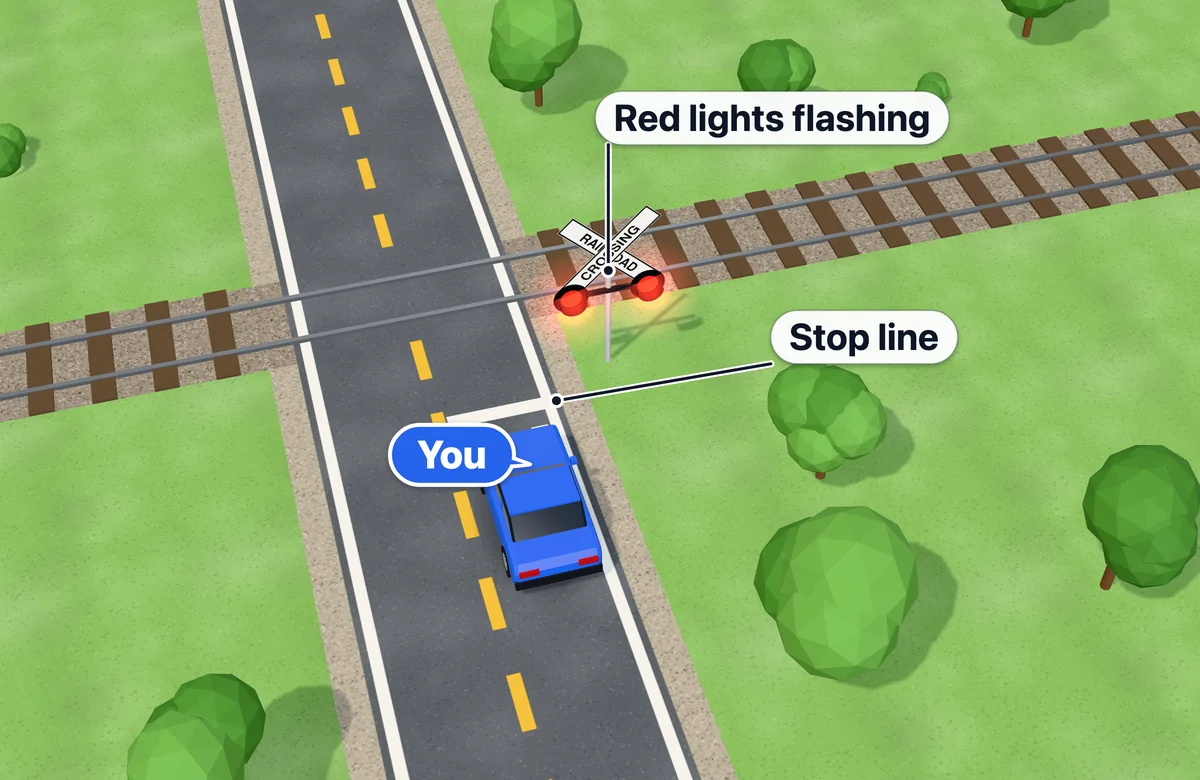
A railroad crossing signal is flashing. How far from the nearest rail must you stop?
- A At least 15 feet
- B At least 5 feet
- C At least 50 feet
- D Directly at the rail
Show answer
A. At least 15 feet
You must stop no less than 15 feet from the nearest rail when a signal is flashing, a gate is down, a flagman signals, or a train is close. Stopping well back keeps your car clear of the train.
Source: Official Hawaii Driver's Manual (2023 edition, r3 digital), page 27
Parking is prohibited where less than how much of the street width remains free for traffic?
- A 6 feet
- B 20 feet
- C 10 feet
- D 15 feet
Show answer
C. 10 feet
Hawaii prohibits parking at any place where less than 10 feet of the street's width remains for traffic. Vehicles must be able to get past safely.
Source: Official Hawaii Driver's Manual (2023 edition, r3 digital), page 28