Idaho Permit Practice Test 2
26 questions written from the Idaho Driver's Handbook, with an explanation and page citation for every answer.
In Idaho, a driver under 21 is considered to be driving under the influence at what blood-alcohol concentration?
Keyboard: press 1–4 or A–D to answer, Enter for the next question, S to save, R to read aloud, P to pause reading, L to listen and answer.
About this test
These questions were written from the Idaho Driver's Handbook (July 2026). 16 of the 21 Idaho questions in this test cover rules that are specific to Idaho or differ between states. Every answer comes with an explanation and a link to the exact page it comes from, so you can check it yourself.
Your answers are saved in this browser. Questions you miss go to My mistakes so you can practice them again.
Sample questions from this test
In Idaho, a driver under 21 is considered to be driving under the influence at what blood-alcohol concentration?
- A 0.04 or more
- B 0.05 or more
- C 0.08 or more
- D 0.02 or more
Show answer
D. 0.02 or more
Idaho sets a much lower limit for young drivers: 0.02 for anyone under 21, compared with 0.08 for drivers 21 and older. For an under-21 driver, even a single drink can be enough to reach it.
View diagram
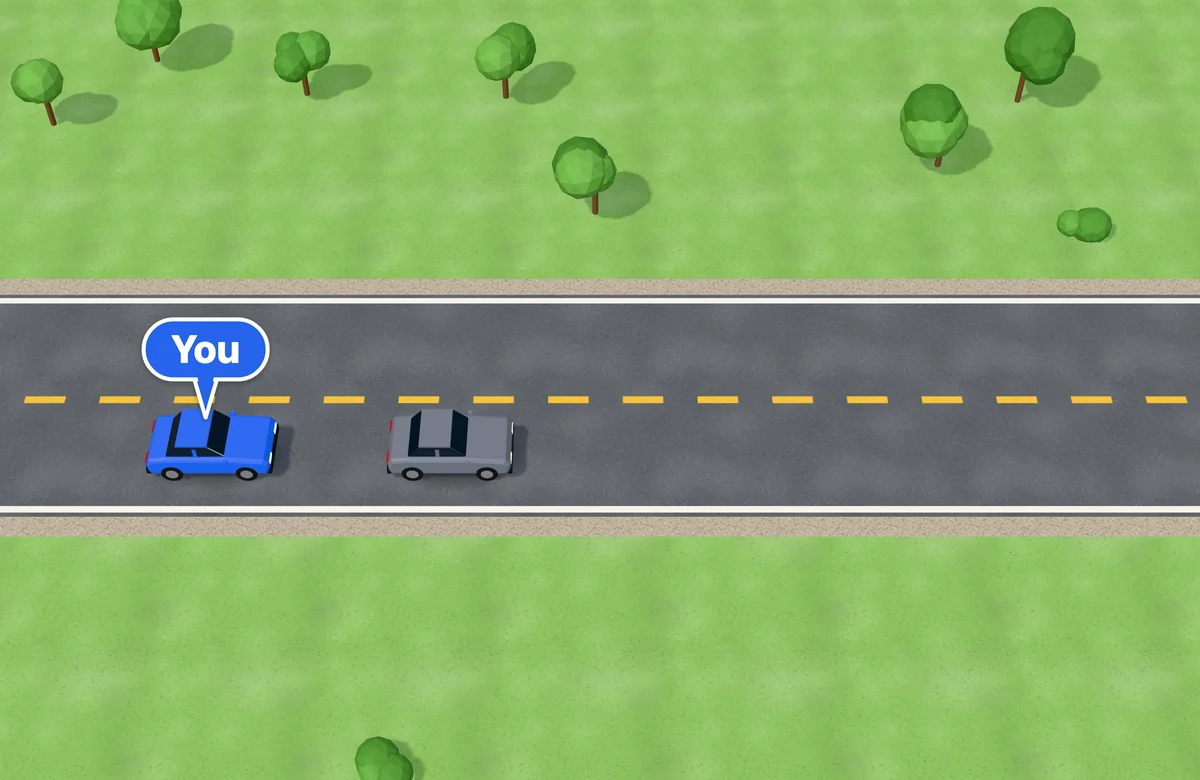
When passing on a two-lane road, how far from oncoming traffic must you complete the pass?
- A Before coming within 200 feet of it
- B Before coming within 100 feet of it
- C Before coming within 50 feet of it
- D Before coming within 500 feet of it
Show answer
A. Before coming within 200 feet of it
Idaho requires you to finish a pass before coming within 200 feet of oncoming traffic, and before reaching a marked no-passing zone. If you cannot, pull back and wait.
Source: Idaho Driver's Handbook, page 78
View diagram
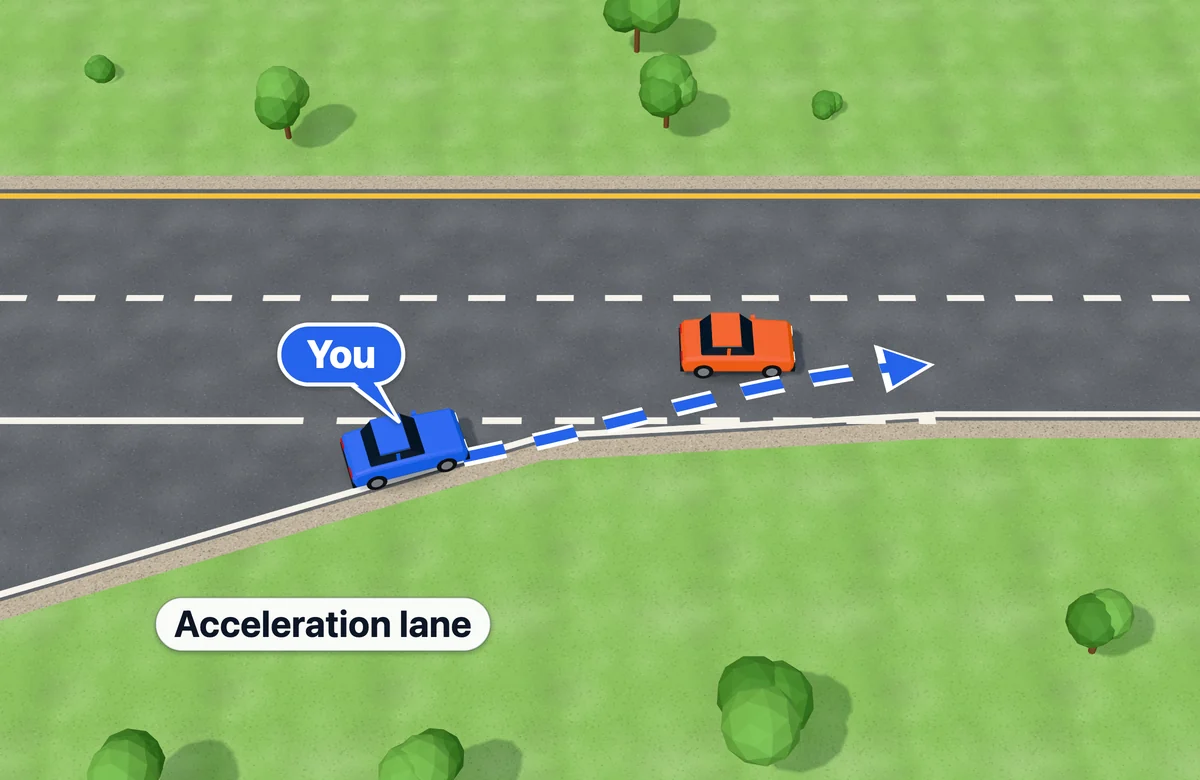
As you enter a freeway from the acceleration lane, what should you do?
- A Speed up to match freeway traffic and yield to vehicles already on it
- B Stop at the end of the ramp and wait for a large gap
- C Enter slowly and let freeway traffic adjust to you
- D Drive onto the shoulder until a gap opens
Show answer
A. Speed up to match freeway traffic and yield to vehicles already on it
Use the acceleration lane to reach the speed of freeway traffic so you can blend in smoothly. Remember that you must yield to traffic already on the freeway.
Source: Idaho Driver's Handbook, page 84
What colors are warning signs in a work zone?
- A Yellow and black
- B Red and white
- C Orange and black
- D Green and white
Show answer
C. Orange and black
Work zones are marked with orange signs, cones, drums, barricades or arrow panels. Warning signs in a work zone are orange and black, so orange should always tell you to slow down and stay alert.
Source: Idaho Driver's Handbook, page 46
A bicyclist approaches a stop sign in Idaho with no other traffic near the intersection. What does Idaho law require of the bicyclist?
- A The bicyclist must stop completely like a car
- B The bicyclist may proceed with caution without coming to a complete stop
- C The bicyclist must get off and walk the bike across
- D The bicyclist must wait for a car to arrive and wave them on
Show answer
B. The bicyclist may proceed with caution without coming to a complete stop
In Idaho, bicyclists do not need to come to a complete stop at stop signs. They must still yield to vehicles in or near the intersection and then proceed with caution, so drivers should expect this.
Source: Idaho Driver's Handbook, page 98