Study sheet for before your test. Notes aren’t allowed in the DMV test room. Source: Kansas Driving Handbook: Non-Commercial Driver's Manual, ksrevenue.gov · Checked September 22, 2026 · Printed Oct 11, 2026 · drivingtestpal.com/kansas/cheat-sheet/ |
Kansas · Study sheet Kansas permit test cheat sheetThe 43 Kansas rules, 12 numbers and 12 signs worth knowing cold. Page numbers point to the handbook. Test format25 questions Passing score20 of 25 correct (80%) Permit and test fees$10 total Minimum age for a permit14 years Supervised driving50 hours (10 at night) Hold your permit12 months minimum Numbers to know
Signs to know
Permits & licensing
Speed limits & control
School buses & emergency vehicles
Laws, points & insurance
Alcohol & drugs
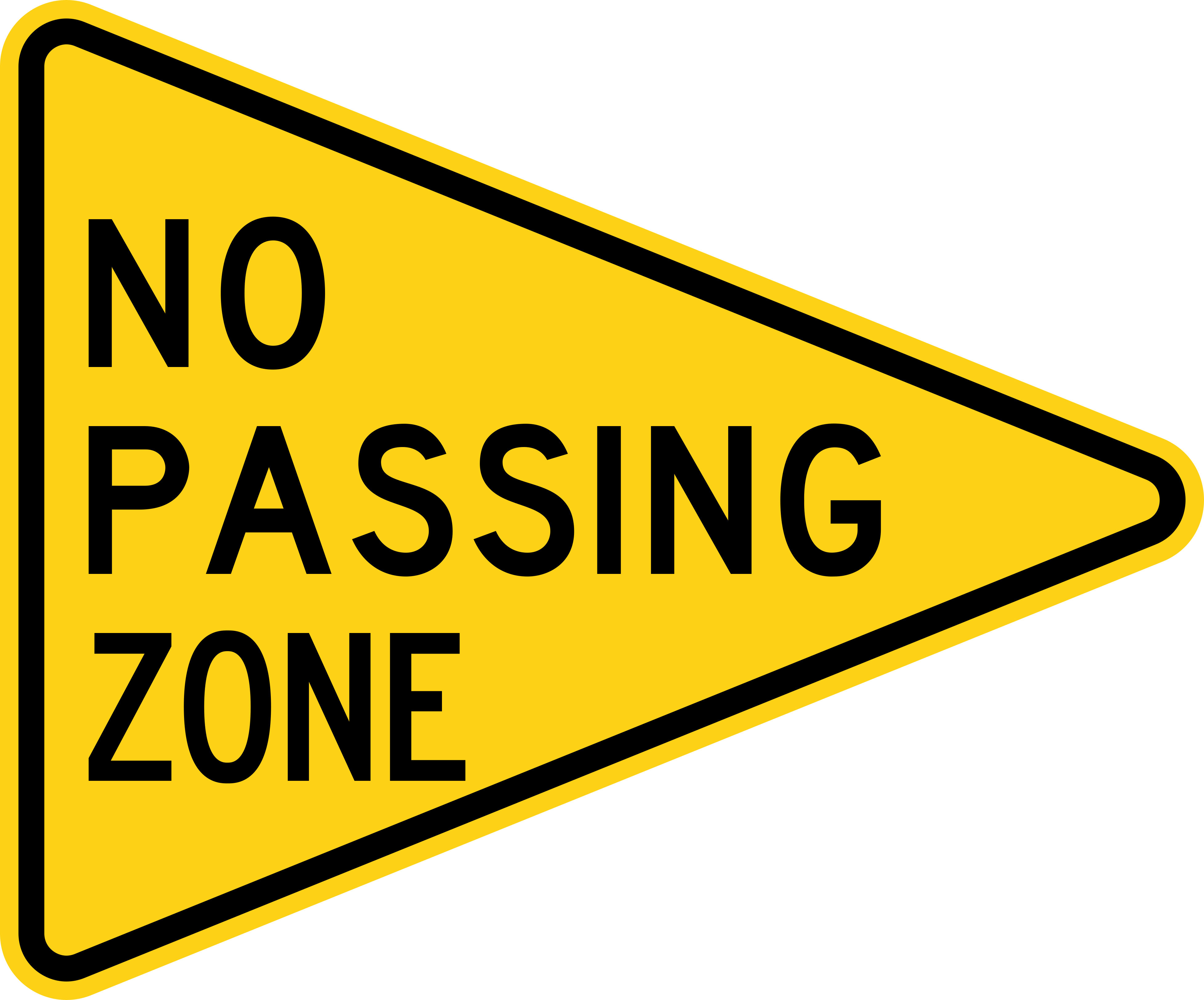
Lanes, passing & merging
Right of way & intersections
Parking & stopping
Distracted & drowsy driving
Seat belts & equipment
Traffic signals
Turning & signaling
Following distance & space
Sharing the road
Work zones
Night, weather & hazards
Highways & freeways
Emergencies & crashes
|
Kansas permit test cheat sheet
Kansas-specific rules from our question bank, condensed to one line each with the handbook page. Read it the night before; don’t use it instead of practicing.
Study sheet for before your test. Notes aren’t allowed in the DMV test room. See the study sheets to print.
- Test format
- 25 questions
- Passing score
- 20 of 25 correct (80%)
- Permit and test fees
- $10 total
- Minimum age for a permit
- 14 years
- Supervised driving
- 50 hours (10 at night)
- Hold your permit
- 12 months minimum
Permits & licensing
- Kansas lets you get a Class C instruction permit at 14. p. 9
- A permit holder may drive only with a licensed adult in the front seat. p. 12
- A 15-year-old can get a restricted license after logging 25 supervised hours and completing approved driver education. p. 12
- A parent or guardian signs an affidavit that the teen has driven at least 50 hours, 10 of them at night. p. 12
- At 16, a restricted license lets you drive for any reason from 5 a.m. to 9 p.m. p. 13
- At 16, only one minor passenger who is not a sibling may ride with you. p. 13
- At 15, you may drive alone only for specific purposes: work or farm work, directly to and from school for attendance on school days, and directly to and from religious activities. p. 13
- You must hold a state-issued learner's permit for at least one year before getting a restricted license. p. 12
- You must score 80% on the 25-question Kansas knowledge test, which means at least 20 correct answers. p. 94
- Kansas gives you four chances to pass the written test, with retests allowed the next working day for a $1.50 fee. p. 14
Speed limits & control
- Kansas sets a 30 mph maximum in any urban district unless a different limit is posted. p. 16
- Unless posted otherwise, the Kansas maximum is 65 mph on state and federal highways, 55 mph on county and township roads, and 75 mph on designated separated multilane highways. p. 16
- Kansas county and township roads have a 55 mph maximum unless posted otherwise. p. 16
- Kansas law doubles the scheduled speeding fine when the violation happens in a school zone. source
- Kansas's basic speed law says you may never drive faster than is reasonable and prudent for road, weather, traffic and vehicle conditions. p. 16
- Even without a posted minimum, Kansas law makes it unlawful to drive so slowly that you impede the normal flow of traffic. p. 16
School buses & emergency vehicles
- After the emergency vehicle passes, check traffic and return to the road carefully. p. 85
- Kansas's move-over law covers stationary emergency vehicles with flashing lights, including tow and recovery vehicles. p. 85
- In Kansas, traffic approaching a school bus in the opposing roadway of a divided highway is not required to stop. p. 52
- A center turning lane is not a median. p. 51
- Kansas law requires you to stop for a school bus, church bus or day care bus stopped to load or unload children. p. 18
- Kansas law requires you to stay stopped until the stop signal is retracted and the red lights are turned off. p. 18
Laws, points & insurance
- New Kansas residents must get a Kansas driver's license within 90 days of moving to the state. p. 11
- Three moving-violation convictions within a 12-month period can get your license suspended in Kansas. p. 14
- Kansas requires continuous liability insurance on your vehicle. p. 14
- Kansas revokes licenses for serious crimes such as vehicular homicide, reckless driving, felonies involving a vehicle and attempting to elude police. p. 15
- An expired Kansas license carries a $1.00 penalty. p. 14
- Kansas requires at least $25,000 for injury to or death of one person and $50,000 for two or more people in one accident, plus $25,000 for property damage. source
Parking & stopping
- Kansas prohibits parking within 15 feet of a fire hydrant. p. 19
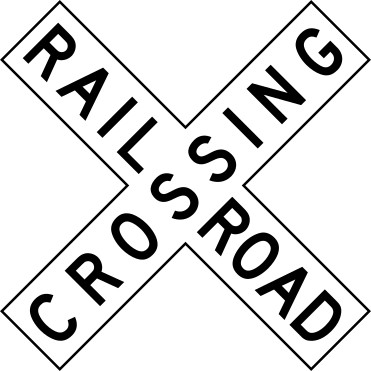
- You may not park within 50 feet of the nearest rail at a railroad crossing. p. 19
- Do not park within 30 feet approaching any traffic signal, stop sign or flashing beacon at the side of the road. p. 19
- Do not park within 20 feet of a fire station driveway on the same side of the street, or within 75 feet of the entrance on the opposite side. p. 19
- Kansas prohibits parking more than 12 inches from a curb. p. 19
Alcohol & drugs
- In Kansas, a BAC of .08 or higher is a violation of the law. p. 23
- Drivers under 21 can be arrested for alcohol impairment at .02 BAC in Kansas, far below the adult .08 limit. p. 23
- Under Kansas implied consent law, getting a license means you have agreed to a lawful alcohol or drug test. p. 24
- A first Kansas DUI conviction can bring a $750 to $1,000 fine plus court costs, a minimum of 48 hours in jail or 100 hours of community service, a license suspension and an ignition interlock. p. 24
- Kansas permanently revokes the license of a driver with a fifth test result of .08 or higher, or a fifth refusal. p. 15
Lanes, passing & merging
- Do not return to the right lane too soon. p. 17
- Kansas prohibits passing within 100 feet of an intersection or railroad grade crossing. p. 17
- You must return to your driving lane before coming within 200 feet of any vehicle approaching from the opposite direction. p. 17
- When you are being overtaken, stay in your lane and do not increase your speed. p. 17
Right of way & intersections
- When two vehicles reach an intersection from different roads at about the same time, the driver on the left yields to the vehicle on the right. p. 18
- In a business or residential district, a driver coming out of an alley, driveway or building must stop before driving onto the sidewalk. p. 18
- Kansas law says you may not enter an intersection, crosswalk or railroad crossing unless there is room on the other side for your vehicle, even on green. p. 18
Turning & signaling
Distracted & drowsy driving
- Kansas prohibits using any electronic device to write, send or read a written communication while driving, including texts and email. p. 19
- Kansas permit and restricted-license holders may not use wireless devices while driving. p. 12
- Kansas law now bars using a mobile phone without a hands-free device in a school zone while the reduced speed limit is enforced, and in a road construction zone while workers are present and signs are posted. source
Seat belts & equipment
Traffic signals
Following distance & space
Sharing the road
Work zones
Night, weather & hazards
Highways & freeways
- Kansas allows up to 75 mph on separated multilane highways that the Secretary of Transportation has designated and posted. p. 16
Emergencies & crashes
- When no officer is present, the driver (or an occupant 18 or older) must immediately report the crash to the nearest police authority if anyone is hurt or killed or the damage appears to be $1,000 or more. source