Kansas permit test: highways & freeways
Entering, exiting and driving on limited-access roads. 4 questions.
What is the highest speed limit Kansas allows on a separated multilane highway designated and posted by the Secretary of Transportation?
Keyboard: press 1–4 or A–D to answer, Enter for the next question, S to save, R to read aloud, P to pause reading, L to listen and answer.
Sample highways & freeways questions
What is the highest speed limit Kansas allows on a separated multilane highway designated and posted by the Secretary of Transportation?
- A 65 mph
- B 70 mph
- C 80 mph
- D 75 mph
Show answer
D. 75 mph
Kansas allows up to 75 mph on separated multilane highways that the Secretary of Transportation has designated and posted. Lower limits apply on other roads.
Source: Kansas Driving Handbook: Non-Commercial Driver's Manual, page 16
View diagram
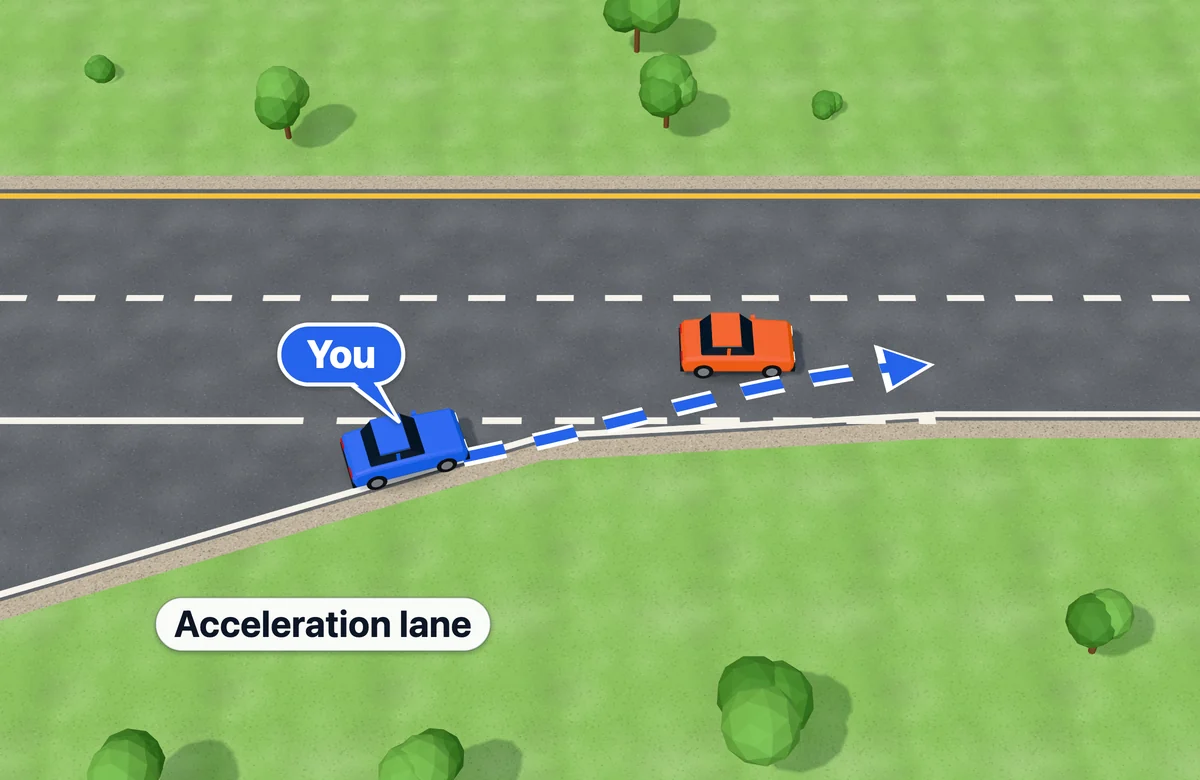
How should you use an acceleration lane when entering a freeway?
- A Drive slowly so traffic will let you in
- B Speed up to match traffic, then merge into a gap
- C Cross the solid white line early to merge
- D Stop at the end of the lane and wait for a gap
Show answer
B. Speed up to match traffic, then merge into a gap
Use the acceleration lane to reach the speed of traffic before you merge. Do not drive to the end and stop.
Source: Kansas Driving Handbook: Non-Commercial Driver's Manual, page 60
You are leaving a freeway. When should you begin to slow down?
- A A mile before the exit
- B After you have moved onto the deceleration lane
- C Only after you reach the end of the ramp
- D While still in the main travel lane
Show answer
B. After you have moved onto the deceleration lane
Keep your speed while on the main roadway. Do not slow down until you are in the deceleration lane, then use it to reduce speed.
Source: Kansas Driving Handbook: Non-Commercial Driver's Manual, page 61
When merging with other traffic, what size gap should you look for?
- A 2 to 3 seconds
- B 4 to 6 seconds
- C 1 to 2 seconds
- D 10 to 12 seconds
Show answer
B. 4 to 6 seconds
Select a gap of 4 to 6 seconds when merging, entering a road or changing lanes. Move into the middle of the gap so both vehicles can settle into a safe following interval.
Source: Kansas Driving Handbook: Non-Commercial Driver's Manual, page 64