Massachusetts Permit Practice Test 2
25 questions written from the Massachusetts Driver's Manual (Class D Passenger Vehicles), with an explanation and page citation for every answer.
At what blood alcohol content (BAC) is a driver 21 or older over the legal limit in Massachusetts?
Keyboard: press 1–4 or A–D to answer, Enter for the next question, S to save, R to read aloud, P to pause reading, L to listen and answer.
About this test
These questions were written from the Massachusetts Driver's Manual (Class D Passenger Vehicles) (Revised April 2026). 12 of the 20 Massachusetts questions in this test cover rules that are specific to Massachusetts or differ between states. Every answer comes with an explanation and a link to the exact page it comes from, so you can check it yourself.
Your answers are saved in this browser. Questions you miss go to My mistakes so you can practice them again.
Sample questions from this test
At what blood alcohol content (BAC) is a driver 21 or older over the legal limit in Massachusetts?
- A 0.10 or higher
- B 0.05 or higher
- C 0.08 or higher
- D 0.02 or higher
Show answer
C. 0.08 or higher
Drivers 21 and older are over the legal limit at a BAC of 0.08 or higher. Even below that, alcohol slows reaction time and judgment, so the only safe choice is not to drink and drive.
Source: Massachusetts Driver's Manual (Class D Passenger Vehicles), page 81
What does a double solid white line between two lanes going the same direction mean?
- A You may cross it after signaling first
- B Crossing the lines is not allowed
- C It marks a shared turn lane
- D Passing is allowed with care
Show answer
B. Crossing the lines is not allowed
A double solid white line separates two lanes going the same direction, and crossing it is not allowed. Broken white lines are the ones you may cross after signaling.
Source: Massachusetts Driver's Manual (Class D Passenger Vehicles), page 98
How far ahead should you signal before turning on a regular street in Massachusetts?
- A At least 200 feet
- B At least 500 feet
- C At least 100 feet
- D At least 50 feet
Show answer
C. At least 100 feet
Signal at least 100 feet before a turn, and at least 500 feet before a turn on a highway. Signal before you brake so drivers behind you know your plan.
Source: Massachusetts Driver's Manual (Class D Passenger Vehicles), page 105
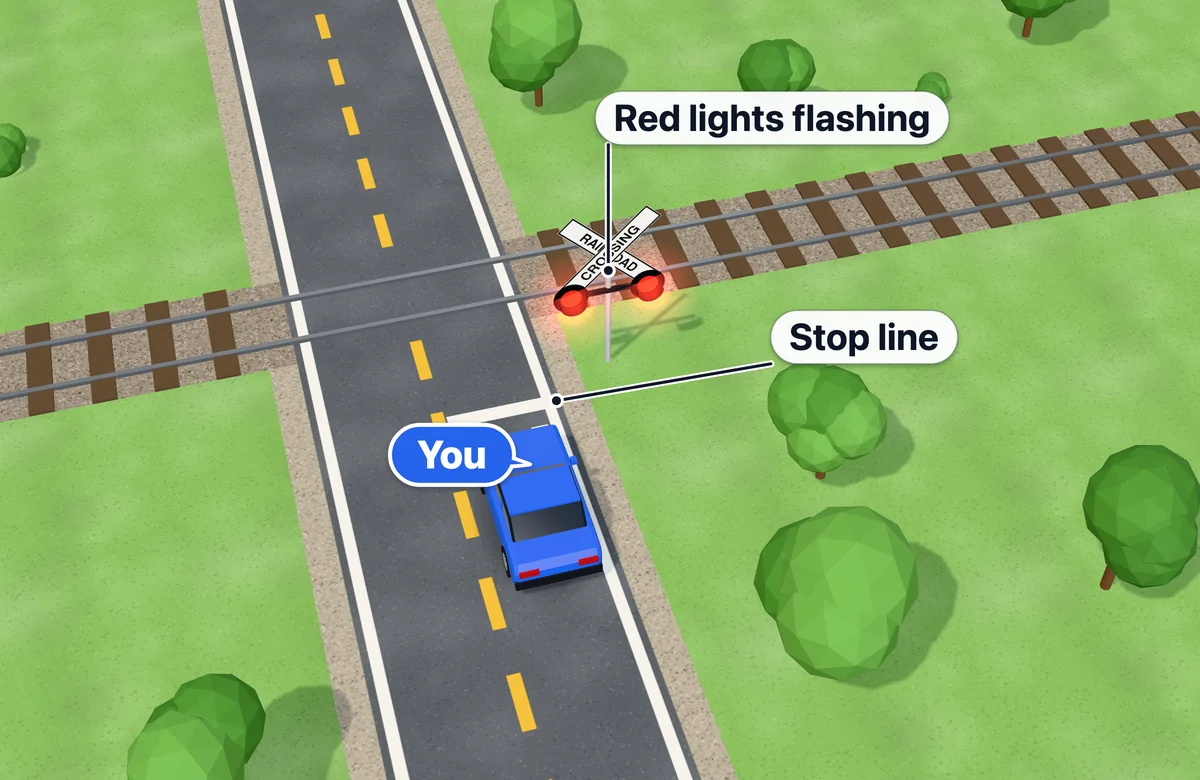
View diagram
The red lights begin flashing at a railroad crossing. Where must you stop?
- A Right at the gate arm
- B At least 5 feet before the nearest rail
- C At least 15 feet before the light post or gate
- D At least 50 feet before the crossing
Show answer
C. At least 15 feet before the light post or gate
When the lights flash at a railroad crossing, stop at least 15 feet before the light post or gate. Stay stopped until the gate rises and the lights stop, and never drive around a lowered gate.
Source: Massachusetts Driver's Manual (Class D Passenger Vehicles), page 95
What can a driver or passenger be fined for opening a car door into an oncoming bicyclist?
- A Up to $25
- B Up to $500
- C Up to $100
- D Up to $1,000
Show answer
C. Up to $100
Drivers and passengers can be fined up to $100 for opening a door into an oncoming bicycle. Check mirrors and open the door with your far hand (the Dutch Reach) so you turn and see bicyclists coming.
Source: Massachusetts Driver's Manual (Class D Passenger Vehicles), page 123