Study sheet for before your test. Notes aren’t allowed in the DMV test room. Source: Nevada Official Driver Handbook (DMV 700) (March 2024), dmv.nv.gov · Checked September 22, 2026 · Printed Oct 11, 2026 · drivingtestpal.com/nevada/cheat-sheet/ |
Nevada · Study sheet Nevada permit test cheat sheetThe 43 Nevada rules, 12 numbers and 12 signs worth knowing cold. Page numbers point to the handbook. Test format25 questions Passing score20 of 25 correct (80%) Permit and test fees$47.50 total Minimum age for a permit15 years, 6 months Supervised driving50 hours (10 at night) Hold your permit6 months minimum Numbers to know
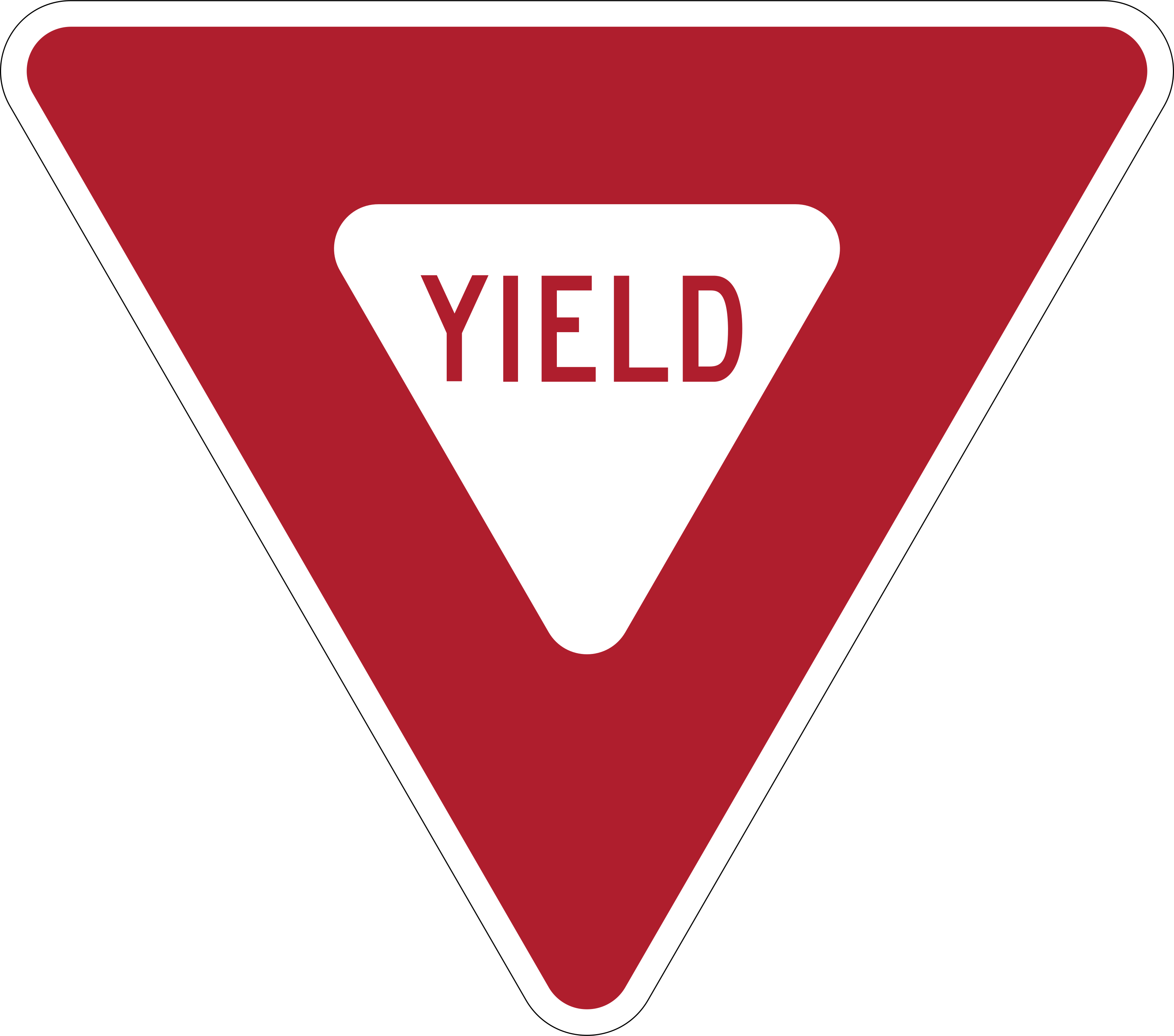
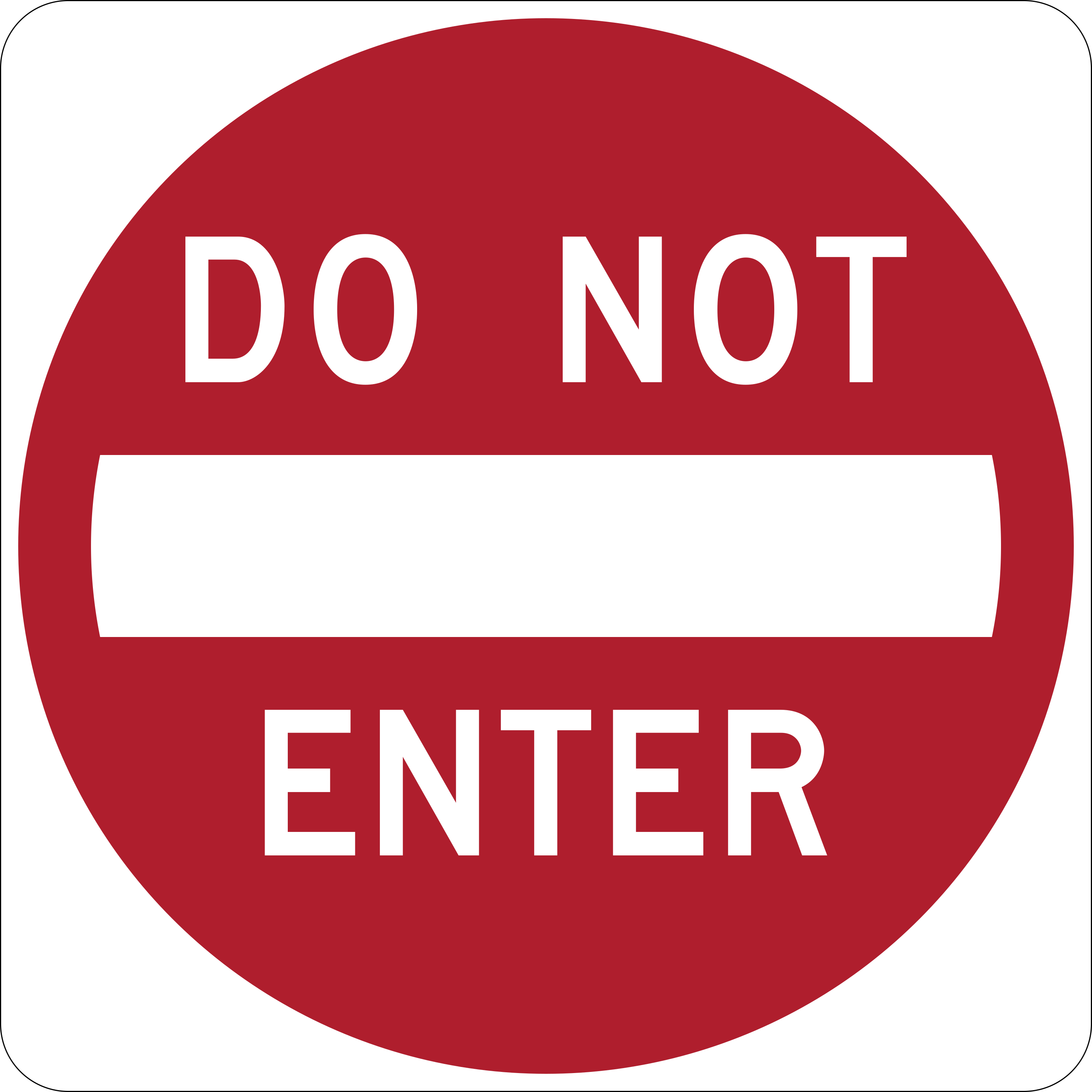
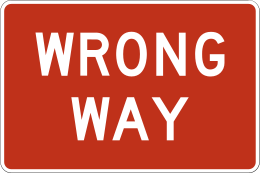
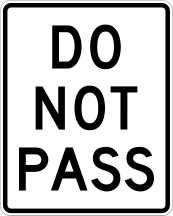
Signs to know
Permits & licensing
Laws, points & insurance
Alcohol & drugs
Parking & stopping
School buses & emergency vehicles
Seat belts & equipment
Turning & signaling
Sharing the road
Night, weather & hazards
Speed limits & control
Highways & freeways
Work zones
Lanes, passing & merging
Following distance & space
Distracted & drowsy driving
Traffic signals
Pavement markings
Right of way & intersections
Railroad crossings
|
Nevada permit test cheat sheet
Nevada-specific rules from our question bank, condensed to one line each with the handbook page. Read it the night before; don’t use it instead of practicing.
Study sheet for before your test. Notes aren’t allowed in the DMV test room. See the study sheets to print.
- Test format
- 25 questions
- Passing score
- 20 of 25 correct (80%)
- Permit and test fees
- $47.50 total
- Minimum age for a permit
- 15 years, 6 months
- Supervised driving
- 50 hours (10 at night)
- Hold your permit
- 6 months minimum
Permits & licensing
- Nevada lets you apply for an instruction permit at 15½. p. 15
- A Nevada instruction permit is good for one year, and you must carry it whenever you drive. p. 15
- Your supervising driver must be licensed, at least 21, have at least one year of licensed driving experience, and sit beside you. p. 15
- Drivers under 18 must hold the instruction permit for at least 6 months before applying for a license. p. 15
- Nevada teens within 30 miles of an approved driver education school must log 50 hours of supervised driving, with 10 of those hours at night. p. 14
- When driver education is not available in person or online, Nevada doubles the practice requirement to 100 hours behind the wheel, with 10 hours in the dark. p. 14
- For the first 6 months, a 16- or 17-year-old new driver may not carry passengers under 18 unless they are immediate family. p. 15
- Minors may not drive between 10 p.m. and 5 a.m. unless they are driving to or from a scheduled event. p. 15
- The curfew lasts until your 18th birthday no matter when your license was issued. p. 15
- Minors must have no at-fault crashes, no moving violation convictions and no alcohol or drug convictions for six months before receiving a license. p. 14
- New residents must apply for a Nevada license within 30 days of becoming a resident. p. 6
- The Nevada knowledge test has 25 multiple-choice questions and you need 80 percent, which is 20 correct answers. source
- You need at least 20/40 vision in one eye. source
Laws, points & insurance
- Nevada counts demerit points over a 12-month period, and reaching 12 or more points suspends your license. p. 77
- A traffic safety course removes at most three demerit points, and you may use it only once in a 12-month period. p. 77
- Drivers with between three and 11 points may remove three points by completing a DMV-approved traffic safety course. p. 77
- Reckless driving carries 8 demerit points, the highest value on the handbook's list of violations. p. 78
- Nevada assigns 2 demerit points for driving 11 to 20 mph over the posted limit. p. 78
- Following too closely is a 4-point violation, the same as failing to yield or running a signal. p. 78
- Nevada requires at least $25,000 for injury or death of one person, $50,000 for two or more people, and $20,000 for property damage in one crash. p. 75
- If police do not investigate the crash and it causes $750 or more in damage or any injury, you must send the DMV an SR-1 report within 10 days. p. 75
- Through its NV LIVE program the DMV detects insurance lapses. p. 75
- Participating in or organizing an unauthorized speed contest can suspend a young driver's license for not less than six months and up to two years. p. 13
- Most violations are reportable to your insurance company for three years, but DUI convictions stay on your record for seven years. p. 77
Alcohol & drugs
- Under the Illegal Per Se law, a chemical test showing 0.08% or more revokes your driving privilege. p. 79
- If you are under 21 and test at 0.02% or more but less than 0.08%, your driving privilege is suspended. p. 79
- Under Nevada's Implied Consent Law, refusing a blood, breath or urine test revokes your privilege to drive, and you are not eligible for a license for one year on a first refusal. p. 79
- If your privilege was revoked for refusing a test within the prior seven years, a new refusal makes you ineligible for three years. p. 79
- If you are convicted of DUI and had passengers under 15 in the vehicle, the court counts that as an aggravating factor when setting your sentence, which can make it harsher. p. 81
- Nevada's Illegal Per Se action revokes the license for 185 days when a test shows 0.08% or more. p. 80
- A second DUI within 7 years revokes the license for one year and brings 10 days to 6 months of jail or residential confinement, a $750 to $1,000 fine, and 100 to 200 hours of community service. p. 80
- Opened alcoholic beverages are illegal in the driver or passenger areas of a vehicle being driven. p. 81
- Anywhere in Nevada you can dial *NHP (*647) to report a suspected drunk driver or a highway emergency. p. 81
Parking & stopping
- Do not park within 15 feet of a hydrant where parallel parking is allowed, or within 20 feet where angle parking is allowed. p. 50
- You may not park on a crosswalk or within 20 feet of one. p. 50
- Do not park within 30 feet of a traffic control signal at the side of the highway. p. 50
- Never park within 50 feet of the nearest rail. p. 50
- On the same side, stay 20 feet from a fire station driveway; on the opposite side of the highway, stay 75 feet from the entrance. p. 50
- The legal parking position has both front and rear wheels within 18 inches of the curb, facing the direction traffic flows. p. 48
School buses & emergency vehicles
- Nevada law (NRS 484B.353) requires drivers to stop for a school bus showing flashing red lights and not pass until the driver turns them off. p. 64
- On divided highways, you must stop only if you are traveling in the same direction as the bus. p. 64
- Nevada's law (NRS 484B.607) covers stopped emergency, utility and service vehicles, including tow trucks. p. 61
- Nevada's duty to slow down covers law enforcement vehicles, tow trucks, NDOT vehicles, garbage trucks and others with lights, as well as anyone repairing a vehicle. p. 61
- When you approach a stopped emergency, tow, NDOT or service vehicle, Nevada requires you to slow to a reasonable speed below the posted limit, proceed with caution and be ready to stop. p. 61
Seat belts & equipment
- The driver and all passengers six and older must buckle up. p. 25
- Nevada requires children under six and less than 57 inches tall to ride in an approved child restraint system. p. 25
- Children under two must ride in a rear-facing child restraint in the back seat. p. 25
- Nevada forbids leaving a child aged 7 or younger unattended in a vehicle when conditions put the child at significant risk, unless a person at least 12 years old is supervising and can see the child. p. 25
- Nobody under 18 may ride in the bed of a pickup or flatbed truck on a paved highway in Nevada. p. 66
Turning & signaling
- Signal at least 100 feet (about 10 car lengths) before a turn on city streets and 300 feet (30 car lengths) on open highways. p. 45
- On open highways signal at least 300 feet (about 30 car lengths) before turning. p. 45
- Nevada forbids U-turns near a grade where there is less than 500 feet of visibility in both directions. p. 46
- Nevada forbids U-turns in business districts, and areas with churches, apartments, multifamily housing and public buildings count as business districts. p. 46
Speed limits & control
- The Basic Rule means you must drive at a reasonable or proper speed, considering traffic, weather, visibility, road surface and type of road. p. 35
- Nevada school zones have a speed limit of either 15 or 25 mph, shown on the posted sign. p. 33
- Nevada's handbook lists 25 mph as a typical posted limit for business and residential areas. p. 35
- Nevada law forbids driving faster than 80 mph in any event, and NDOT may post limits only up to 80 mph. source
Sharing the road
- If there is no adjacent lane, pass a cyclist on the left at a safe distance of at least three feet, and do not move back right until you are safely clear. p. 48
- Motorcycles and mopeds may ride no more than two abreast in one lane, with the consent of both drivers. p. 63
- Nevada defines a moped partly by a maximum speed of 30 mph on flat ground and no more than two brake horsepower. p. 64
- A blind or visually impaired pedestrian uses the sound of your engine as a guide, so stop no more than five feet from the crosswalk. p. 67
Night, weather & hazards
- Nevada requires headlights whenever people or vehicles cannot be clearly seen at 1,000 feet, such as in heavy rain, snow or fog, even in daytime. p. 56
- Dim your high beams at least 500 feet before an oncoming vehicle and 300 feet before a vehicle you are following. p. 56
- Studded snow tires may be used only from October 1 through April 30. p. 57
- Cars at high speed can be pushed off the road by only 6 inches of water, and most vehicles can float in 2 feet or less. p. 59
Pavement markings
Highways & freeways
Work zones
Lanes, passing & merging
Following distance & space
Distracted & drowsy driving
Traffic signals
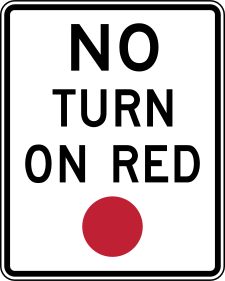
- Nevada allows a left turn on red only from a one-way street onto another one-way street with traffic moving left. p. 30
Right of way & intersections
- Nevada law (NRS 484B.290) gives a blind or visually impaired pedestrian with a white cane or guide animal the right-of-way at all times. p. 67
Railroad crossings
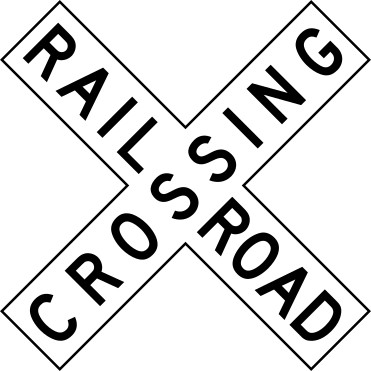
- If a train is coming, stop at least 15 feet from the tracks. p. 33
Emergencies & crashes
- You must complete and send the SR-1 within 10 days. p. 75