Tennessee permit test: pavement markings
Yellow and white lines, passing zones, crosswalks, stop lines and special lanes. 5 questions.
You notice a yellow line on your right and a white line on your left. What does this mean?
Keyboard: press 1–4 or A–D to answer, Enter for the next question, S to save, R to read aloud, P to pause reading, L to listen and answer.
Sample pavement markings questions
You notice a yellow line on your right and a white line on your left. What does this mean?
- A You are driving the wrong way
- B You are in a passing zone
- C You are in a bike lane
- D You are on a one-way street or ramp
Show answer
A. You are driving the wrong way
Remember "white on your right, yellow on your left." If the yellow line is on your right, you are on the wrong side of the road and must get into the proper lane immediately.
Source: Tennessee Comprehensive Driver License Manual, page 56

View diagram
The center line has a solid yellow line on your side and a broken yellow line on the other side. May you pass?
- A Yes, but only vehicles going under the limit
- B Yes, if no oncoming traffic is in sight
- C Yes, if you sound your horn first
- D No, not while the solid line is on your side
Show answer
D. No, not while the solid line is on your side
When a solid and a broken yellow line run side by side, the line closest to you controls. A solid line on your side means no passing; a broken line on your side means you may pass when it is safe.
Source: Tennessee Comprehensive Driver License Manual, page 57
View diagram
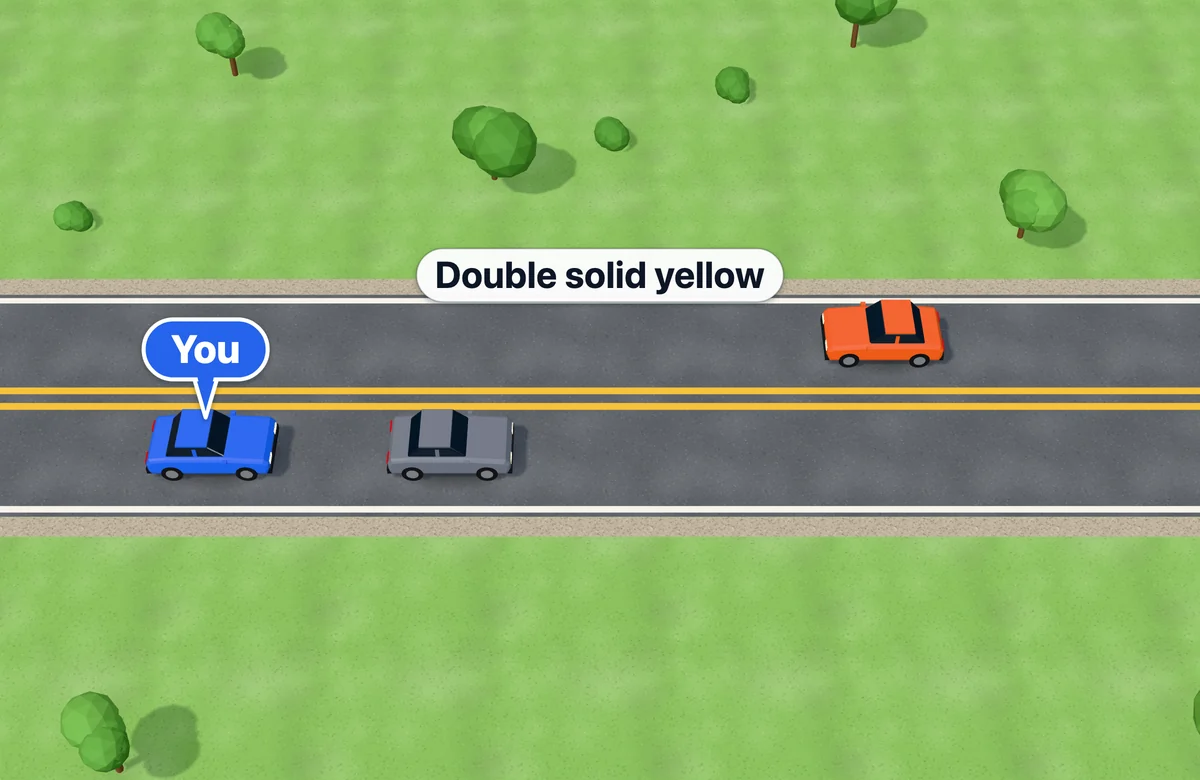
Two solid yellow lines separate the lanes. When may you cross them?
- A To pass a slow car when no traffic is coming
- B Never, for any reason
- C To turn into a driveway or side road when it is safe
- D Whenever you signal at least 50 feet ahead
Show answer
C. To turn into a driveway or side road when it is safe
Double solid yellow lines mean no passing from either direction, even if no traffic is in view. You may cross them to turn left into a driveway or side road when it is safe.
Source: Tennessee Comprehensive Driver License Manual, page 56
View diagram
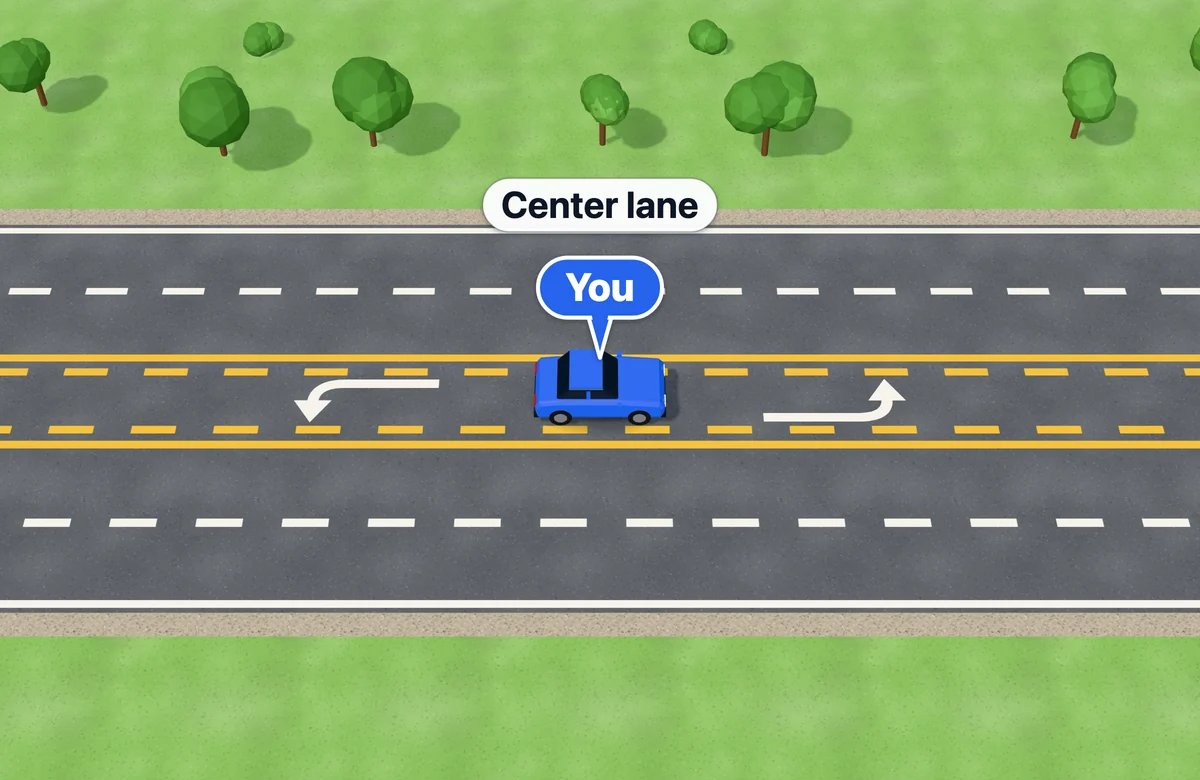
In Tennessee, what is the farthest you may travel in a shared center left-turn lane?
- A 300 feet
- B 100 feet
- C 500 feet
- D One full block
Show answer
A. 300 feet
A shared center turn lane is only for making left turns from either direction. You may not use it for passing or travel farther than 300 feet in it; enter it just before your turn.
Source: Tennessee Comprehensive Driver License Manual, page 74