Arkansas DFA Exam Simulator
A full-length mock exam: Arkansas does not publish the count or pass mark; we use 30 questions at 80%. New questions every attempt.
How this simulator works
- Knowledge test: 30 questions, 20 correct to pass.
- No time limit, like the real test. Take your time.
- You won’t see whether you were right until the end, just like at the Arkansas test. Then you can review every answer with its explanation.
- Questions are drawn fresh from the full Arkansas bank each time.
How the real Arkansas knowledge test works
Arkansas does not publish the count or pass mark; we use 30 questions at 80%. This simulator follows the same structure, gives no feedback until you finish, and draws a new set of questions from the full Arkansas bank every time.
Aim to pass the simulator two or three times in a row, on different days, before you book your test.
Sample questions from this test
What is the youngest age at which you can apply for an Arkansas instruction permit?
- A 15 years old
- B 14 years old
- C 16 years old
- D 13 years old
Show answer
B. 14 years old
You can apply for an Arkansas instruction permit at 14 by passing the knowledge exam and the vision test. Starting early gives you time to build supervised experience before the intermediate stage at 16.
Source: Arkansas Driver License Study Guide, Volume 1, page 15
A police officer pulls you over at night. What does the Arkansas guide tell you to do?
- A Get out and walk back to the patrol car
- B Dig through the glove box before the officer reaches you
- C Turn on your interior lights so the officer can see you
- D Turn off all lights so you do not blind the officer
Show answer
C. Turn on your interior lights so the officer can see you
At a night stop, switch on your interior lights, stay in the car and keep your hands visible, for example on top of the steering wheel. These steps let the officer see that the situation is safe.
Source: Arkansas Driver License Study Guide, Volume 1, page 3
View diagram
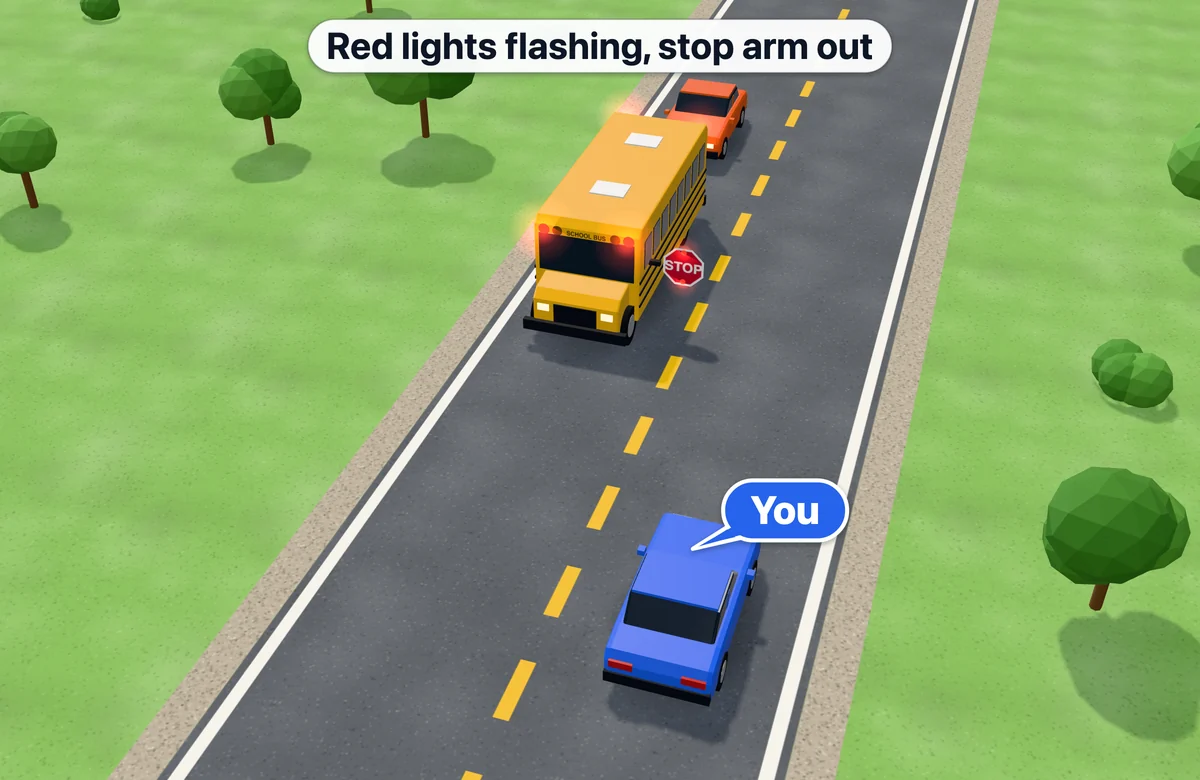
On a two-lane road, a school bus coming toward you in the opposite lane stops with its red lights flashing. What must you do?
- A Stop and stay stopped until the red lights go off
- B Slow to 10 mph and pass with care
- C Keep going, since the bus is in the other lane
- D Stop, then go once the children are on the sidewalk
Show answer
A. Stop and stay stopped until the red lights go off
When a school bus is stopped with red lights flashing, you must stop whether you are behind it, facing it or at an intersection. Stay stopped until the bus turns off its red lights and begins moving, because children often cross in front of the bus.
Source: Arkansas Driver License Study Guide, Volume 1, page 24
View diagram
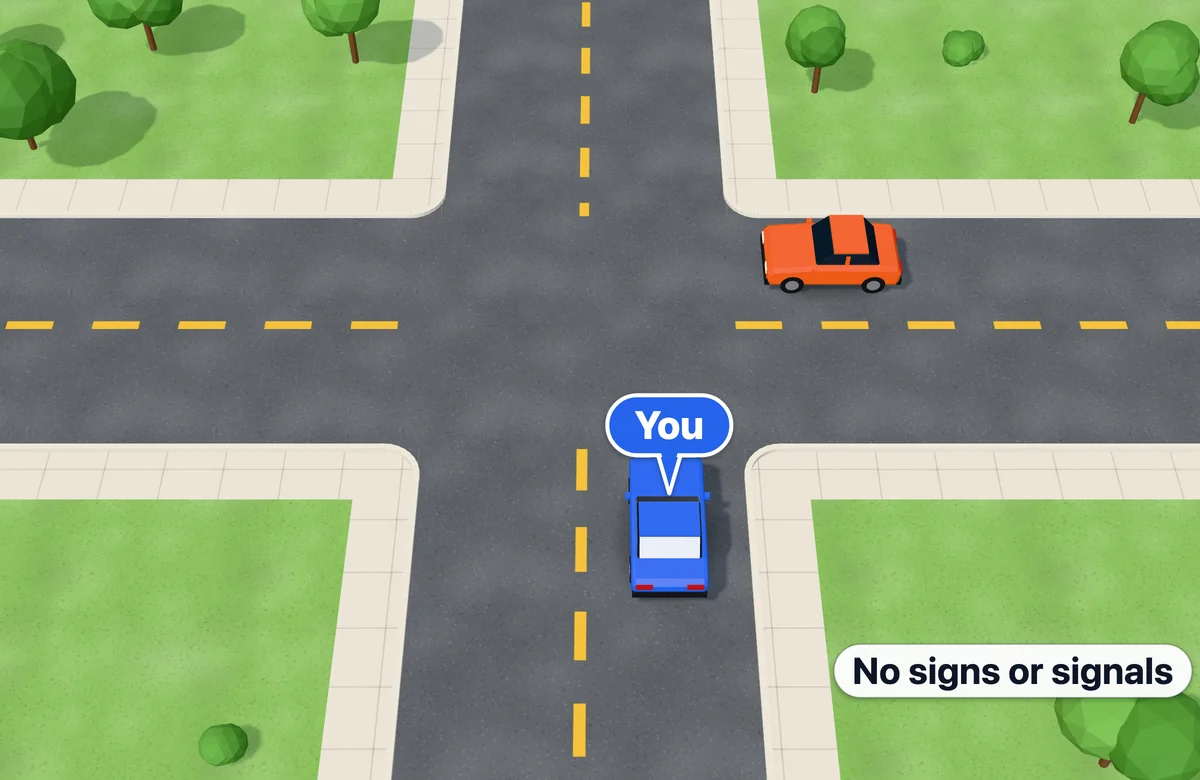
At an intersection with no signs or signals, two cars arrive at about the same time. Who must yield?
- A The driver on the right yields to the car on the left
- B The slower car yields to the faster car
- C The driver on the left yields to the car on the right
- D The car going straight yields to the turning car
Show answer
C. The driver on the left yields to the car on the right
At an uncontrolled intersection, you must yield to vehicles approaching from your right. Remember: the car on your right goes first. No driver has an absolute right-of-way, so be ready to yield to avoid a crash.
Source: Arkansas Driver License Study Guide, Volume 1, page 51
What following distance does the Arkansas guide recommend behind a motorcycle?
- A At least 4 to 6 seconds
- B At least 2 seconds, the same as for a car
- C At least 1 second, since motorcycles are small
- D At least 10 seconds
Show answer
A. At least 4 to 6 seconds
Leave at least four to six seconds behind a motorcycle so the rider has room to maneuver or stop in an emergency. In dry conditions a motorcycle can stop faster than a car, and even slight contact can cause a fall.
Source: Arkansas Driver License Study Guide, Volume 1, page 82