Connecticut permit test: lanes, passing & merging
Lane choice, changing lanes, blind spots, passing rules and merging. 5 questions.
On a two-lane road with a double solid yellow line, you come up behind a slow farm tractor. What does Connecticut law allow?
Keyboard: press 1–4 or A–D to answer, Enter for the next question, S to save, R to read aloud, P to pause reading, L to listen and answer.
Sample lanes, passing & merging questions
On a two-lane road with a double solid yellow line, you come up behind a slow farm tractor. What does Connecticut law allow?
- A Never passing, because double yellow lines can never be crossed
- B Passing only if the tractor driver waves you by
- C Passing across the line if you can see far enough ahead
- D Passing on the right shoulder
Show answer
C. Passing across the line if you can see far enough ahead
Connecticut permits passing slow-moving traffic, pedestrians, parked vehicles, animals, bicycles, mopeds and scooters in no-passing zones. You may cross a double yellow line to do so, but only if you can see far enough ahead to pass safely.
On a road with two lanes in your direction, which lane does Connecticut law require you to use?
- A The left lane, for faster travel
- B Either lane at any time
- C The right lane, except when passing
- D The left lane, except when exiting
Show answer
C. The right lane, except when passing
When your direction of travel has fewer than three lanes, Connecticut law requires you to drive in the right lane except when passing. You may move left to turn left or exit on the left.
At 55 mph on a two-lane road, about how much clear distance do you need to pass safely?
- A About 500 feet
- B About 800 feet
- C Over 1600 feet
- D About one mile
Show answer
C. Over 1600 feet
A pass at 55 mph takes about 10 seconds, and you and an oncoming car each cover over 800 feet. So you need over 1600 feet of clear road, about one-third of a mile.
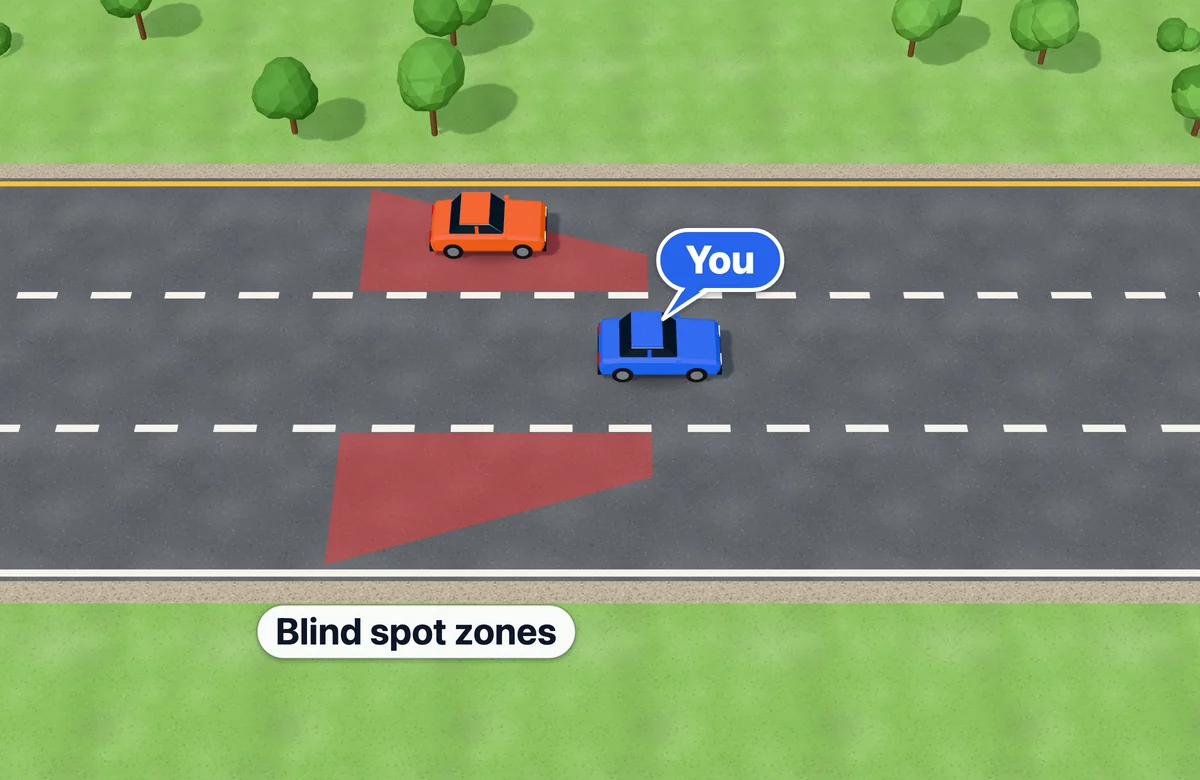
View diagram
Before changing lanes, how do you check your blind spot?
- A Turn your head and look over your shoulder
- B Check the rear-view mirror only
- C Check the side mirror only
- D Use your turn signal and wait two seconds
Show answer
A. Turn your head and look over your shoulder
Blind spots near your rear corners cannot be seen in your mirrors. You must turn your head and look over your shoulder in the direction you plan to move.