Connecticut permit test: parking & stopping
Where you may not park, distances from hydrants and crossings, curbs and hills. 4 questions.
How close to a fire hydrant may you park in Connecticut?
Keyboard: press 1–4 or A–D to answer, Enter for the next question, S to save, R to read aloud, P to pause reading, L to listen and answer.
Sample parking & stopping questions
How close to a fire hydrant may you park in Connecticut?
- A No closer than 5 feet
- B No closer than 10 feet
- C No closer than 15 feet
- D No closer than 25 feet
Show answer
B. No closer than 10 feet
In Connecticut you may not park within 10 feet of a fire hydrant. Firefighters need clear access to connect hoses quickly.
In Connecticut, how close to a stop sign may you park?
- A No closer than 10 feet
- B No closer than 20 feet
- C No closer than 50 feet
- D No closer than 25 feet
Show answer
D. No closer than 25 feet
Do not park within 25 feet of a stop sign. A parked car close to the sign can hide it from approaching drivers.
When parking parallel to a curb in Connecticut, what is the farthest your wheels may be from the curb?
- A 6 inches
- B 1 foot
- C 18 inches
- D 2 feet
Show answer
B. 1 foot
Connecticut prohibits parking more than one foot from the curb. Parking close to the curb keeps your car out of the travel lane.
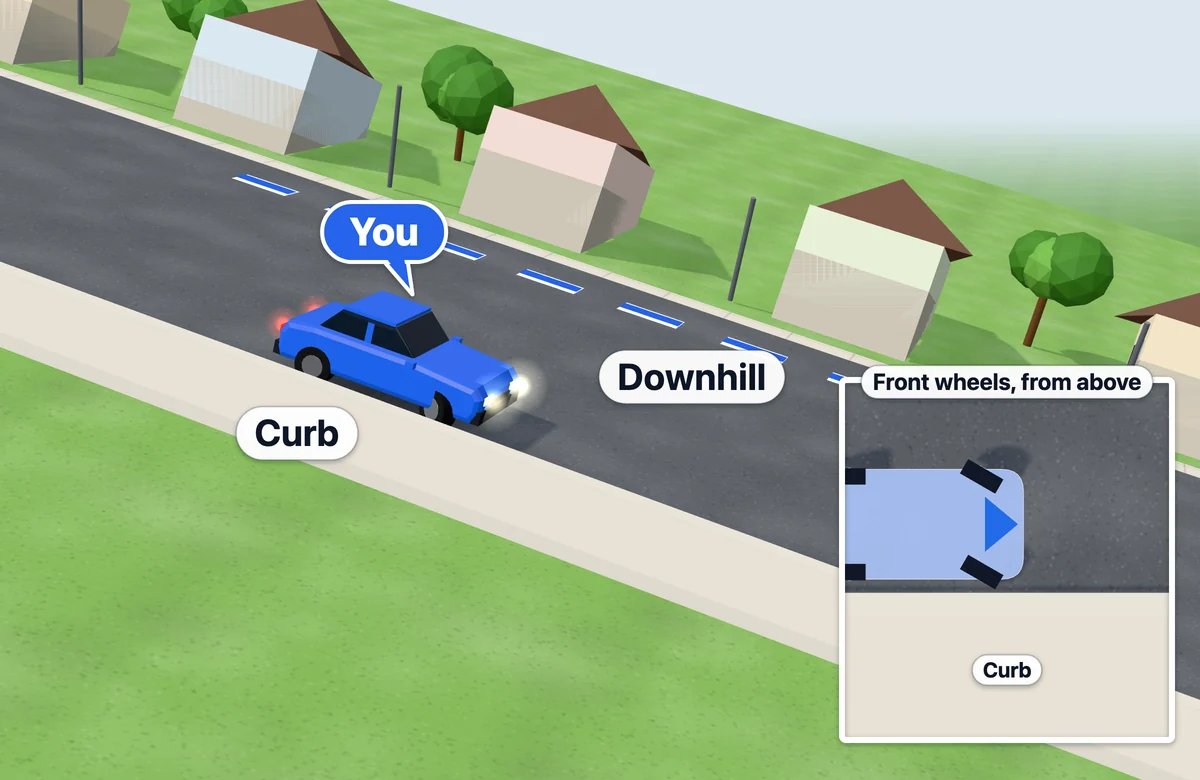
View diagram
You park facing downhill on a street with a curb. According to the Connecticut manual, how should you set your front wheels?
- A Turned sharply toward the curb
- B Straight ahead
- C Turned toward the center of the road, away from the curb
- D It does not matter if the parking brake is set
Show answer
A. Turned sharply toward the curb
When you park on a hill, set the parking brake and turn your wheels sharply toward the side of the road or curb. Facing downhill, the wheels then rest against the curb, so a rolling car moves away from traffic.