Connecticut permit test: pavement markings
Yellow and white lines, passing zones, crosswalks, stop lines and special lanes. 5 questions.
A solid yellow line runs on your side of the center line, next to a dashed yellow line on the other side. What does this mean for you?
Keyboard: press 1–4 or A–D to answer, Enter for the next question, S to save, R to read aloud, P to pause reading, L to listen and answer.
Sample pavement markings questions

View diagram
A solid yellow line runs on your side of the center line, next to a dashed yellow line on the other side. What does this mean for you?
- A You may not pass
- B You may pass when safe
- C You may pass if no oncoming car is in sight
- D The lane is a turn-only lane
Show answer
A. You may not pass
With a dashed yellow line next to a solid yellow line, passing is allowed on the dashed side but not on the solid side. If the solid line is on your side, you may not pass.
View diagram
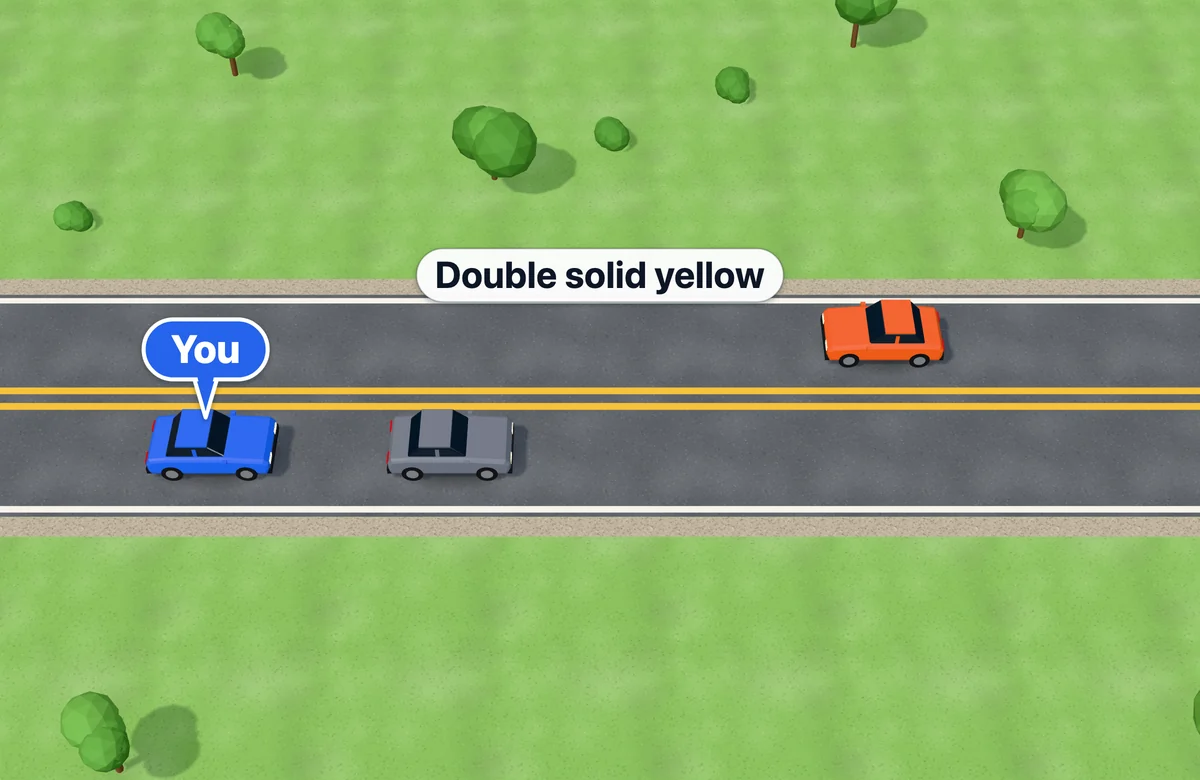
A road has double solid yellow center lines. When may you cross them?
- A To turn left into a driveway or street
- B To pass a car traveling at the speed limit
- C Whenever traffic is light
- D Never for any reason
Show answer
A. To turn left into a driveway or street
Double solid yellow lines mark the center of a two-way road where passing is not allowed. You may cross them to make a left turn to or from an alley, private road, driveway or street, and the manual also allows crossing to pass slow-moving vehicles, bicycles or parked vehicles when it is safe.
What does a double solid white line between lanes mean?
- A Lane changing is allowed with caution
- B The lanes carry traffic in opposite directions
- C Lane changing is prohibited
- D The lane on the left is for bicycles
Show answer
C. Lane changing is prohibited
A double solid white line prohibits changing lanes. White lines separate traffic moving in the same direction; dashed lines allow crossing and solid lines discourage it.
View diagram
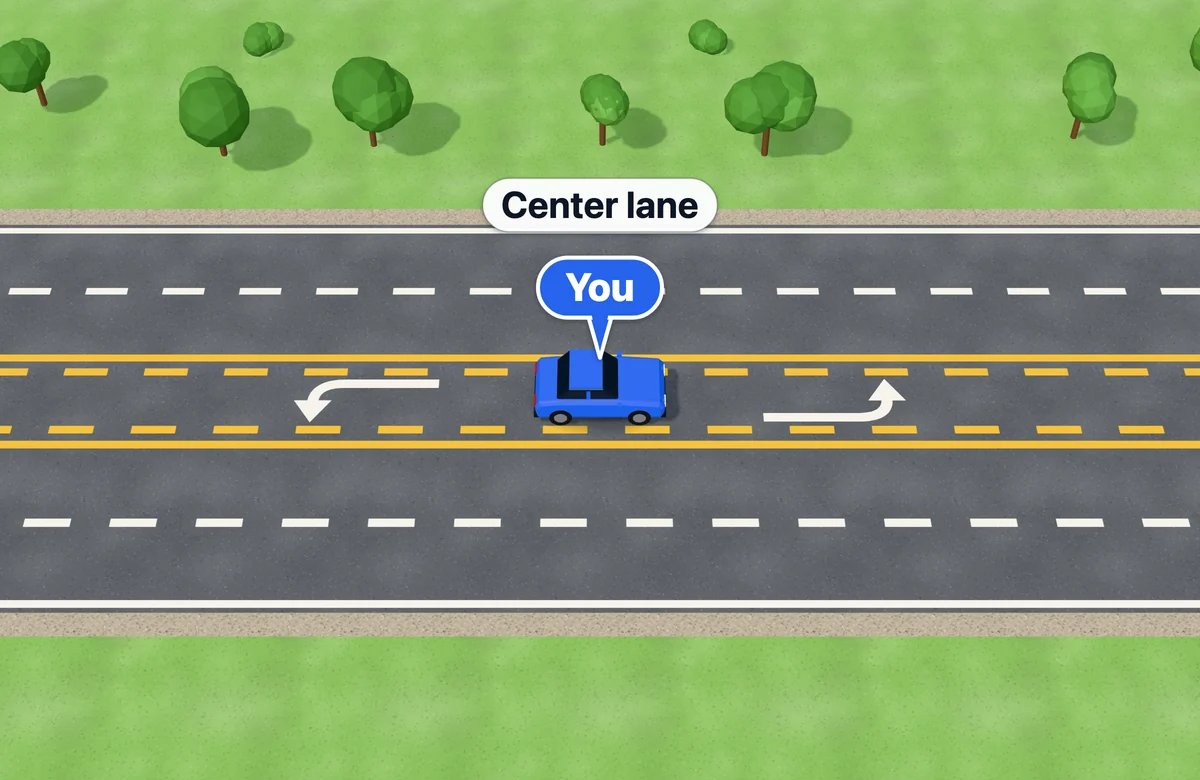
A center lane has solid and dashed yellow lines on each side and left-turn arrows pointing both ways. How may you use it?
- A As a passing lane when traffic is slow
- B For left turns only, or U-turns where allowed
- C As a regular travel lane
- D For parking or stopping briefly during the day
Show answer
B. For left turns only, or U-turns where allowed
A shared center lane is reserved for left turns, or U-turns where permitted, by traffic from both directions. Enter only when it is safe, since drivers coming the other way may use it too.