Delaware permit test: railroad crossings
Crossing signs and signals, when to stop and what to do if stuck. 4 questions.
What does a white X-shaped crossbuck sign at a railroad crossing mean?
Keyboard: press 1–4 or A–D to answer, Enter for the next question, S to save, R to read aloud, P to pause reading, L to listen and answer.
Sample railroad crossings questions
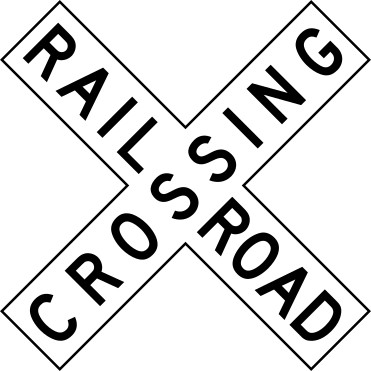
What does a white X-shaped crossbuck sign at a railroad crossing mean?
- A The same as a stop sign; every vehicle must stop
- B The same as a yield sign; yield to trains
- C The crossing is no longer in use
- D Only trucks and buses must slow down
Show answer
B. The same as a yield sign; yield to trains
The crossbuck has the same meaning as a yield sign: slow down, look both ways, and yield to any train. If lights flash or gates come down, you must stop.
Source: Delaware Driver Manual, page 84
At a railroad crossing, where can you usually find the Emergency Notification System (ENS) number to report a problem?
- A On the yellow advance warning sign
- B Painted on the pavement before the tracks
- C On a blue sign on or near the crossbuck
- D On the railroad crossing gate arm
Show answer
C. On a blue sign on or near the crossbuck
Every grade crossing has an emergency number, usually on a blue sign on the crossbuck or nearby. It includes a DOT number that tells the railroad exactly where the crossing is so trains can be stopped.
Source: Delaware Driver Manual, page 83
Your car stalls on the tracks and a train is coming. Which way should you run after getting out?
- A In the same direction the train is traveling
- B Straight back the way you drove in
- C Stay near the car to warn the engineer
- D Toward the direction the train is coming from, away from the tracks
Show answer
D. Toward the direction the train is coming from, away from the tracks
If a train is coming, get out and move away from the tracks at once. Run toward the train's direction of approach, at an angle away from the tracks, so flying debris will not hit you.
Source: Delaware Driver Manual, page 138
A train has just passed at a crossing with more than one track. When should you start across?
- A When the passing train is well down the track and no other train is coming
- B As soon as the last car clears the crossing
- C When the driver behind you honks
- D Only after waiting exactly two minutes
Show answer
A. When the passing train is well down the track and no other train is coming
At crossings with more than one track, wait until the passing train is well down the track before crossing. A second train may be hidden by the first one.
Source: Delaware Driver Manual, page 118