Study sheet for before your test. Notes aren’t allowed in the DMV test room. Source: The Official Florida Driver License Handbook (Florida Class E Driver License Handbook) (rev. 08/2023), flhsmv.gov · Checked September 22, 2026 · Printed Oct 11, 2026 · drivingtestpal.com/florida/cheat-sheet/ |
Florida · Study sheet Florida permit test cheat sheetThe 42 Florida rules, 12 numbers and 12 signs worth knowing cold. Page numbers point to the handbook. Test format50 questions Passing score40 of 50 correct (80%) Permit and test fees$48 total Minimum age for a permit15 years Supervised driving50 hours (10 at night) Hold your permit12 months minimum Numbers to know
Signs to know
Permits & licensing
Laws, points & insurance
Alcohol & drugs
Speed limits & control
Sharing the road
School buses & emergency vehicles
Seat belts & equipment
Lanes, passing & merging
Night, weather & hazards
Right of way & intersections
Following distance & space
Parking & stopping
Emergencies & crashes
Traffic signals
Turning & signaling
Highways & freeways
Railroad crossings
Road signs
Pavement markings
Work zones
Distracted & drowsy driving
|
Florida permit test cheat sheet
Florida-specific rules from our question bank, condensed to one line each with the handbook page. Read it the night before; don’t use it instead of practicing.
Study sheet for before your test. Notes aren’t allowed in the DMV test room. See the study sheets to print.
- Test format
- 50 questions
- Passing score
- 40 of 50 correct (80%)
- Permit and test fees
- $48 total
- Minimum age for a permit
- 15 years
- Supervised driving
- 50 hours (10 at night)
- Hold your permit
- 12 months minimum
Permits & licensing
- You must be at least 15 to get a Florida learner's license, and you also need an FLHSMV-approved driver education course (required since July 1, 2025) and passing vision and knowledge exams. p. 16
- A learner must always be accompanied by a licensed driver who is at least 21 and rides in the seat closest to the driver's right. p. 9
- For the first three months, learners may drive only in daylight. p. 9
- Teens must hold the learner's license for 12 months or until their 18th birthday, whichever comes first. p. 16
- A parent, guardian or responsible adult 21 or older must certify at least 50 hours of driving, 10 of them at night. p. 16
- Teens must have no moving-violation convictions for 12 months from the learner's license issue date. p. 16
- A 16-year-old licensed driver may not drive from 11 p.m. to 6 a.m. unless driving to or from work or with a licensed driver 21 or older. p. 33
- Licensed 17-year-olds may not drive between 1 a.m. and 5 a.m. unless driving to or from work or with a licensed driver 21 or older. p. 33
- Since July 1, 2025, a learner's license applicant must complete a driver education course approved by FLHSMV that meets the Department of Education's Driver Education/Traffic Safety-Classroom standard. source
- The Class E Knowledge Exam has 50 multiple-choice questions on traffic laws, safe driving and traffic controls. source
Laws, points & insurance
- Florida's No-Fault Law requires at least $10,000 in Personal Injury Protection (PIP) and $10,000 in Property Damage Liability (PDL). p. 31
- If you own a vehicle that has been in Florida for 90 days, consecutive or not, within the last 365 days, you must meet the No-Fault insurance requirements. p. 31
- If you will not keep insurance for the whole registration period, turn your plate in to a driver license service center before canceling the policy. p. 31
- Florida suspends your license for 30 days if you collect 12 points in 12 months, 3 months for 18 points in 18 months, and 1 year for 24 points in 36 months. p. 37
- Any driver under 18 who earns 6 or more points in 12 months is automatically restricted to Business Purposes Only for one year, and each extra point adds 90 days. p. 37
- Speeding 15 MPH or less over the limit is 3 points, 16 MPH or more over is 4 points, and speeding that causes a crash is 6 points. p. 38
- You may elect a basic driver improvement course instead of points for most noncriminal moving violations, but not if you were charged with exceeding the speed limit by more than 30 MPH. p. 25
- If your license or plate is suspended for lack of insurance, you cannot get a temporary license for any reason, not even for work. p. 32
- After a DUI conviction you must carry at least $100,000 BIL per person, $300,000 for two or more people, and $50,000 PDL. p. 32
Alcohol & drugs
- Your license is administratively suspended at arrest if your breath or blood alcohol level is .08 or above, or if you refuse testing. p. 33
- By signing your license you agreed to take breath, blood or urine tests when lawfully asked. p. 34
- Refusing a second time leads to an 18-month suspension and a first-degree misdemeanor charge. p. 34
- Under zero tolerance, any driver under 21 with a BAL of .02 or higher automatically loses their license for six months. p. 34
- A first DUI conviction carries a $500 to $1,000 fine, rising to $1,000 to $2,000 with a BAL of .15 or higher or a minor in the vehicle. p. 34
- To challenge an administrative suspension for a .08 BAL or a test refusal, you must apply for a review hearing at a Bureau of Administrative Reviews office within 10 days of the arrest. p. 39
Speed limits & control
- Florida's standard limit in municipal, business and residential areas is 30 MPH unless another limit is posted. p. 76
- Florida's standard speed limit for streets and highways is 55 MPH, except where otherwise posted. p. 76
- When the posted limit is 70 MPH, the minimum speed is 50 MPH. p. 76
- Florida's handbook calls the speeding buffer a myth. p. 76
- Florida's standard school zone speed limit is 20 MPH during the posted times or when the light is flashing. p. 76
Parking & stopping
- You may not park within 15 feet of a fire hydrant. p. 74
- Do not park within 20 feet of an intersection. p. 74
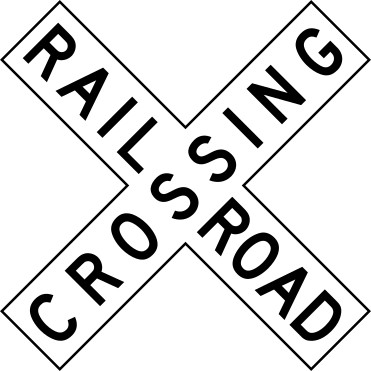
- Do not park within 50 feet of a railroad crossing. p. 74
- Park parallel to the curb in the direction of traffic, with your right-hand wheels within 12 inches of the curb. p. 73
- After parking, set the brake, shift to Park, turn off the engine and lock the car. p. 73
Sharing the road
- Florida law requires at least three feet of clearance when you drive next to or pass a bicyclist, and you should slow down. p. 89
- All bicyclists and passengers under 16 must wear helmets that meet federal safety standards. p. 90
- Florida motorcycle operators must wear a helmet unless they are 21 or older and carry a medical insurance policy with at least $10,000 in benefits for injuries. p. 95
- A white cane with a red tip or a guide dog means the pedestrian is visually impaired. p. 96
- Anyone under 18 driving a golf cart on a public road or street must have a valid learner's license or driver license. p. 93
School buses & emergency vehicles
- On a multi-lane road you must leave the lane closest to the stopped emergency, tow, sanitation or utility vehicle. p. 73
- On a two-lane road, slow to 20 MPH below the posted limit. p. 73
- On a two-way street or highway, drivers in both directions must stop for a school bus that is loading or unloading. p. 97
- If a highway is divided by a raised barrier or an unpaved median at least five feet wide, drivers going the opposite way do not have to stop. p. 97
- Passing a stopped school bus carries a minimum $265 fine and 4 points, and passing on the side where children get on and off raises the minimum to $465. p. 35
Seat belts & equipment
- Florida requires safety belts for all drivers, all front-seat passengers and all passengers under 18. p. 36
- The driver is charged if any passenger under 18 is not properly restrained. p. 36
- Children under 4 must ride in a child safety seat, and children ages 4 and 5 must use either a safety seat or a booster seat. p. 36
- Low beams must show objects 150 feet ahead and high beams 450 feet, and both must be visible from 1,000 feet. p. 46
- Blue lights, and red lights visible from the front, are reserved for emergency and law enforcement vehicles. p. 46
Lanes, passing & merging
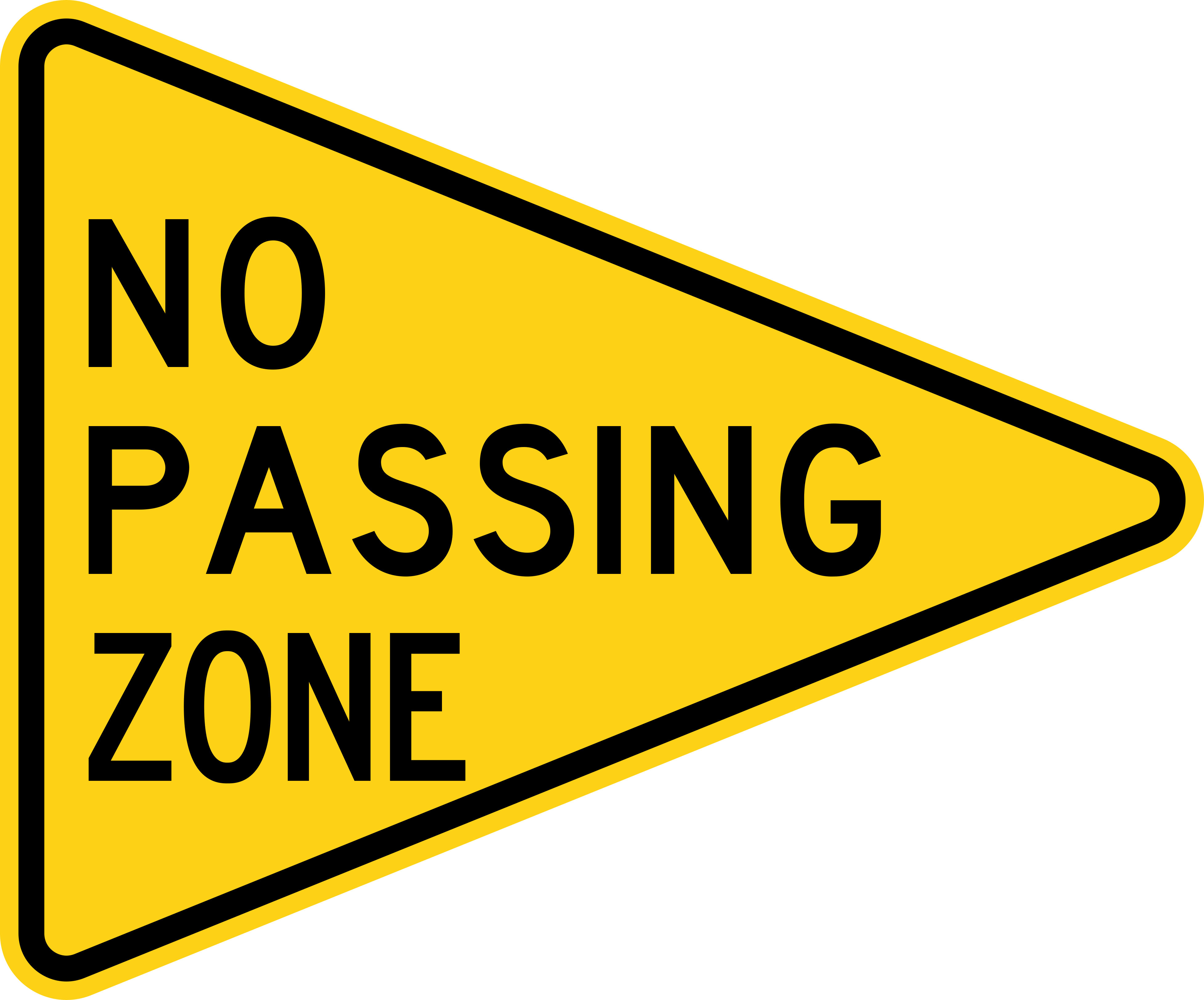
- Florida requires you to return to the right side before coming within 200 feet of any approaching vehicle. p. 75
- Passing is not allowed on hills or curves where you cannot see at least 500 feet ahead. p. 75
- Florida law says a driver must move out of the left lane when being overtaken from behind by a faster vehicle. p. 75
- You must stay within the speed limit while passing. p. 75
Night, weather & hazards
- Florida law requires headlights between sunset and sunrise. p. 81
- Florida law forbids high beams within 500 feet of an oncoming vehicle and within 300 feet of a vehicle you are following. p. 81
- Do not use high beams within 300 feet of a vehicle ahead of you. p. 81
- In Florida, when you turn on your wipers, turn on your headlights. p. 80
Right of way & intersections
- At an open intersection you must yield if a vehicle is already in it, if you are entering or crossing a state highway from a secondary road, if you are entering a paved road from an unpaved one, or if you are turning left in front of oncoming traffic. p. 70
- Drivers must yield to funeral processions. p. 92
- All drivers must yield to public transit buses traveling in the same direction that have signaled and are reentering traffic from a designated pullout bay. p. 96
Following distance & space
- Keep at least four seconds between you and the vehicle ahead in favorable conditions, and more in bad weather or heavy traffic. p. 69
- It is against the law to follow a fire truck responding to an emergency closer than 500 feet. p. 70
- A truck or any vehicle towing another vehicle must not follow within 300 feet of another truck or towed vehicle. p. 70
Emergencies & crashes
- If the crash is minor and your vehicle is blocking traffic, you must move it or have it moved. p. 85
- If a crash causes vehicle or property damage and no law enforcement report is required, you must file a written report with FLHSMV within 10 days. p. 85
- Leaving a crash that causes death is a first-degree felony with a minimum 4-year prison term, plus losing your license for at least 3 years. p. 85
Traffic signals
Turning & signaling
Highways & freeways
Railroad crossings
Road signs
- Bicyclists going straight may travel through a right-turn lane, and Florida's sign tells you to yield to them. p. 55
Pavement markings
- Vehicles in either direction must not pass across double solid yellow lines. p. 52
Work zones
- Florida doubles speeding fines in school zones and construction zones, with civil penalties up to $1,000, and you may have to take a driving course. p. 37
Distracted & drowsy driving
- Texting while driving is illegal everywhere in Florida. p. 42