Kansas Permit Practice Test 6
25 questions written from the Kansas Driving Handbook: Non-Commercial Driver's Manual, with an explanation and page citation for every answer.
Under Kansas law, how must a child under age 4 ride in a passenger car?
Keyboard: press 1–4 or A–D to answer, Enter for the next question, S to save, R to read aloud, P to pause reading, L to listen and answer.
About this test
These questions were written from the Kansas Driving Handbook: Non-Commercial Driver's Manual (AAMVA 09 Model Test Version). 11 of the 20 Kansas questions in this test cover rules that are specific to Kansas or differ between states. Every answer comes with an explanation and a link to the exact page it comes from, so you can check it yourself.
Your answers are saved in this browser. Questions you miss go to My mistakes so you can practice them again.
Sample questions from this test
Under Kansas law, how must a child under age 4 ride in a passenger car?
- A On an adult's lap in the back seat
- B In a federally approved child safety seat
- C In an adult lap-and-shoulder belt in the back seat
- D In a booster seat with a lap belt
Show answer
B. In a federally approved child safety seat
Kansas requires every child under 4 to be in a federally approved child safety seat. The driver is responsible for making sure children are properly restrained.
Source: Kansas Driving Handbook: Non-Commercial Driver's Manual, page 16
Unless otherwise posted, what is the maximum speed in a Kansas urban district?
- A 35 mph
- B 25 mph
- C 30 mph
- D 20 mph
Show answer
C. 30 mph
Kansas sets a 30 mph maximum in any urban district unless a different limit is posted. Where a lower limit is posted, such as in a school zone, obey the posted sign.
Source: Kansas Driving Handbook: Non-Commercial Driver's Manual, page 16

View diagram
On a two-lane road, a solid yellow line is on your side of the center and a dashed line is on the other side. May you pass?
- A Yes, but only slower trucks
- B Yes, if you return within 200 feet
- C No, not while the solid line is on your side
- D Yes, if no oncoming traffic is visible
Show answer
C. No, not while the solid line is on your side
When a solid and a dashed yellow line are side by side, only the driver with the dashed line may pass. A solid yellow line on your side means you may not pass.
Source: Kansas Driving Handbook: Non-Commercial Driver's Manual, page 43
After an emergency vehicle passes you, how far behind it must you stay?
- A At least 100 feet
- B At least 200 feet
- C At least 500 feet
- D At least one car length
Show answer
C. At least 500 feet
After the emergency vehicle passes, check traffic and return to the road carefully. Stay at least 500 feet away from the emergency vehicle.
Source: Kansas Driving Handbook: Non-Commercial Driver's Manual, page 85
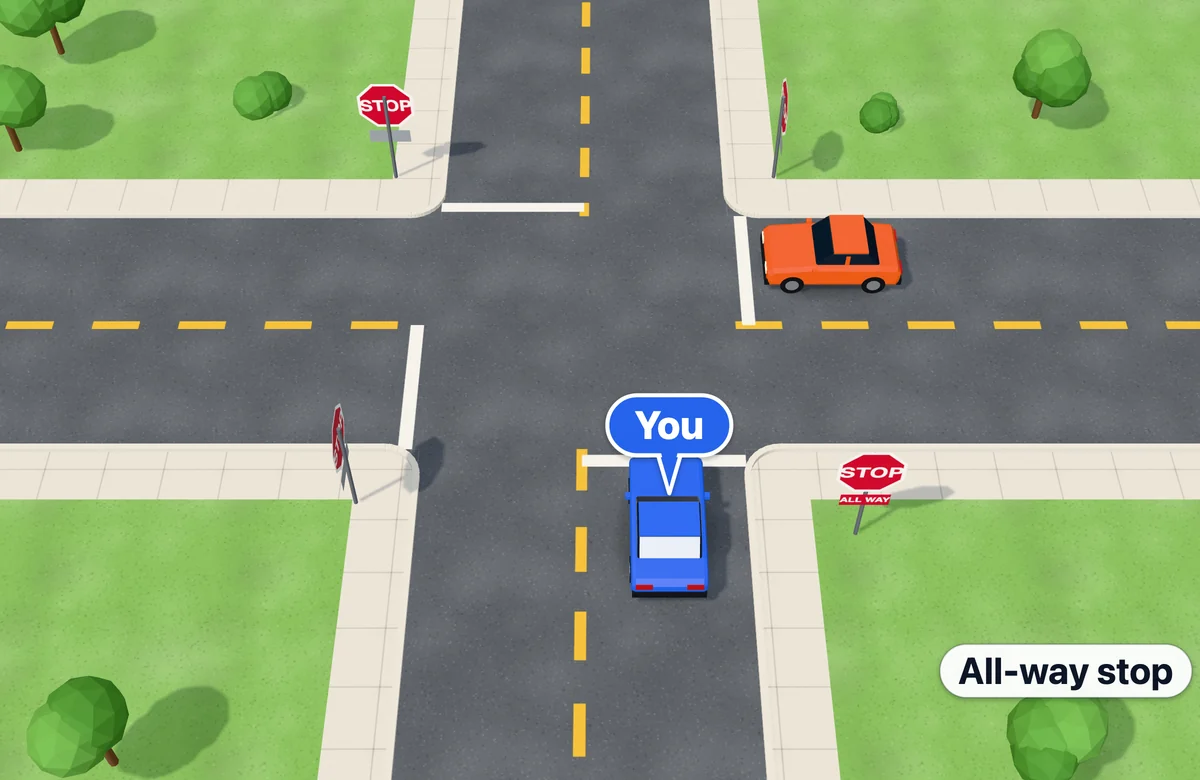
View diagram
At a 4-way stop, you and another car arrive at the same time. The other car is on your right. Who goes first?
- A The car on your right
- B Whoever is turning left
- C Whichever car is going straight
- D You do, because you are on the left
Show answer
A. The car on your right
At a 4-way stop, the first driver to arrive goes first. If more than one arrives at the same time, the vehicle on the right goes first.
Source: Kansas Driving Handbook: Non-Commercial Driver's Manual, page 33