Kentucky Permit Practice Test 6
25 questions written from the Kentucky Driver Manual, with an explanation and page citation for every answer.
Which statement about Kentucky's seat belt law is correct?
Keyboard: press 1–4 or A–D to answer, Enter for the next question, S to save, R to read aloud, P to pause reading, L to listen and answer.
About this test
These questions were written from the Kentucky Driver Manual (Updated 7-23-26). 12 of the 20 Kentucky questions in this test cover rules that are specific to Kentucky or differ between states. Every answer comes with an explanation and a link to the exact page it comes from, so you can check it yourself.
Your answers are saved in this browser. Questions you miss go to My mistakes so you can practice them again.
Sample questions from this test
Which statement about Kentucky's seat belt law is correct?
- A It applies only on interstates and parkways
- B It applies only to the driver and front-seat passenger
- C It is primary, so police can stop you just for not wearing a belt
- D It is secondary, so you can only be cited after another violation
Show answer
C. It is primary, so police can stop you just for not wearing a belt
Kentucky's seat belt law is primary, so an officer can stop you for not wearing a belt. The driver and all passengers in vehicles made after 1981 must be properly belted or in a proper child restraint.
Source: Kentucky Driver Manual, page 38
View diagram
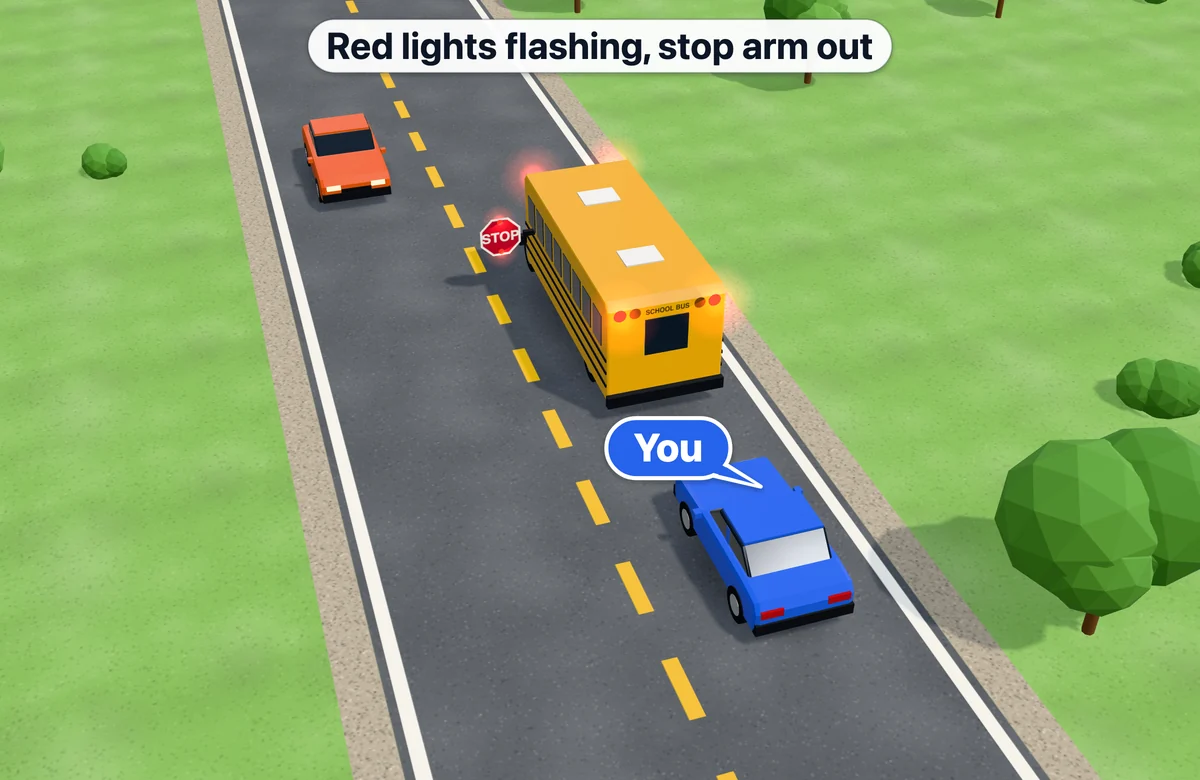
In Kentucky, which stopped buses require you to stop when they are loading or unloading passengers?
- A School buses and church buses
- B Only buses with children under 12 aboard
- C School buses only
- D City transit buses and school buses
Show answer
A. School buses and church buses
In Kentucky you must stop for a school bus or a church bus that is stopped on any road to load or unload passengers. Remain stopped until everyone is clear of the road and the bus is moving.
Source: Kentucky Driver Manual, page 52
View diagram
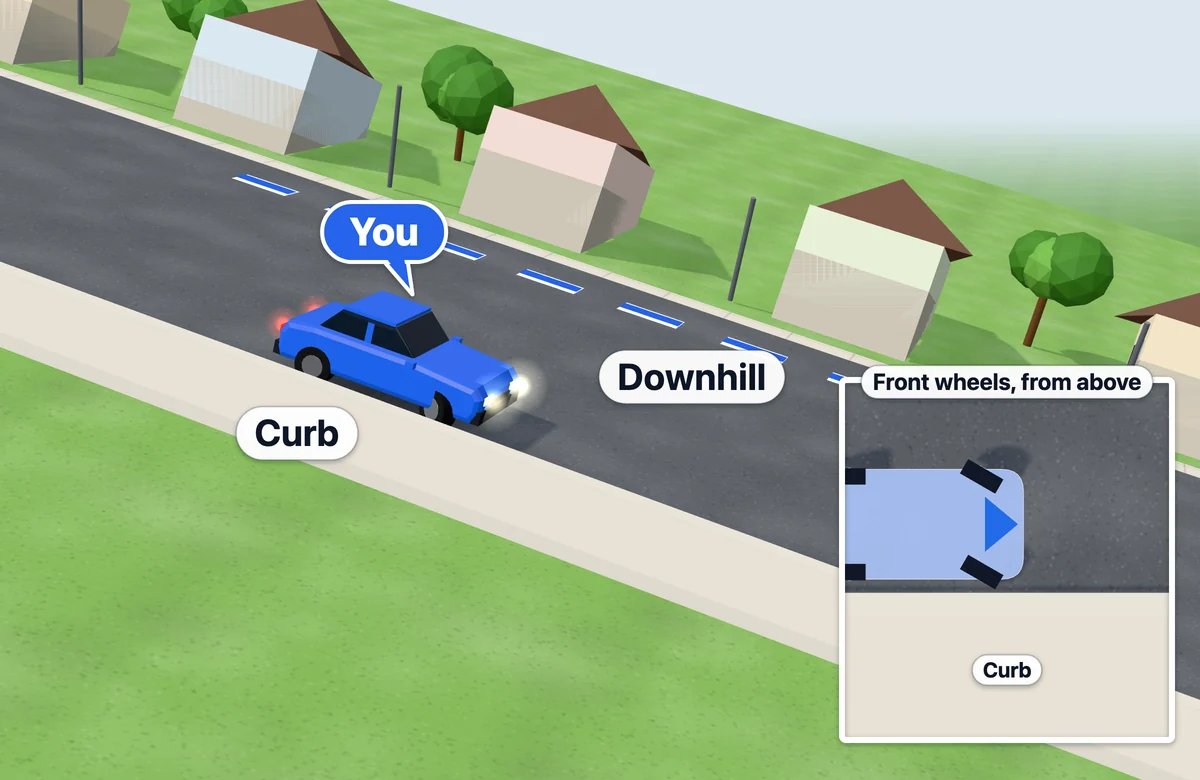
You park downhill next to a curb. Which way should you turn your front wheels?
- A Away from the curb, toward the street
- B Toward the curb, so the car rolls into it
- C It does not matter if the parking brake is set
- D Straight ahead
Show answer
B. Toward the curb, so the car rolls into it
When parked on a hill, turn your wheels so the car will touch the curb if it starts to roll. Facing downhill, that means turning the wheels toward the curb.
Source: Kentucky Driver Manual, page 54
A Kentucky owner lets the insurance lapse on a registered car. What penalty can the owner and driver face?
- A A written warning for a first offense
- B Loss of the driver's license for exactly one year, with no fine
- C A fine of $500 to $1,000, up to 90 days in jail, or both
- D A $100 fine with no other penalty
Show answer
C. A fine of $500 to $1,000, up to 90 days in jail, or both
Driving without insurance is a criminal offense in Kentucky. The owner and driver face a fine of $500 to $1,000, up to 90 days in jail, or both, and the vehicle's registration is revoked.
Source: Kentucky Driver Manual, page 27
You are waiting to turn left and an oncoming car is turning right into the same street. Who must yield?
- A The right-turning driver, because right turns are completed faster
- B Whoever signaled first
- C You; left-turners yield to opposing traffic, even right-turners
- D Neither; both may turn at the same time
Show answer
C. You; left-turners yield to opposing traffic, even right-turners
When turning left, you yield to drivers in the opposing lane, and that includes vehicles turning right. A left turn crosses the other driver's path, so the burden is on you.
Source: Kentucky Driver Manual, page 42