Maine permit test: pavement markings
Yellow and white lines, passing zones, crosswalks, stop lines and special lanes. 4 questions.
What do broken white lines between lanes mean?
Keyboard: press 1–4 or A–D to answer, Enter for the next question, S to save, R to read aloud, P to pause reading, L to listen and answer.
Sample pavement markings questions
What do broken white lines between lanes mean?
- A Lanes go opposite directions; passing is allowed
- B Lanes go the same direction and you may change lanes when safe
- C Changing lanes is not allowed
- D The lane is reserved for buses
Show answer
B. Lanes go the same direction and you may change lanes when safe
Broken white lines separate lanes going in the same direction and allow safe lane changes. Solid white lines discourage changing lanes.

View diagram
On a two-lane road, the center line is solid on your side and broken on the other side. May you pass?
- A Yes, if no cars are coming
- B No, not while the solid line is on your side
- C Yes, if the car ahead is going under the limit
- D Yes, but only motorcycles and bicycles
Show answer
B. No, not while the solid line is on your side
You should not pass when the solid part of the center line is on your side. The broken line on the other side lets oncoming drivers pass, not you.
At a red light there is a stop line painted before the crosswalk. Where must you stop?
- A At the far edge of the crosswalk
- B At the stop line
- C With your front wheels in the crosswalk
- D At the edge of the cross street
Show answer
B. At the stop line
If there is a stop line before the crosswalk, stop at the stop line. Stop lines give pedestrians room to walk and give large vehicles room to turn.
View diagram
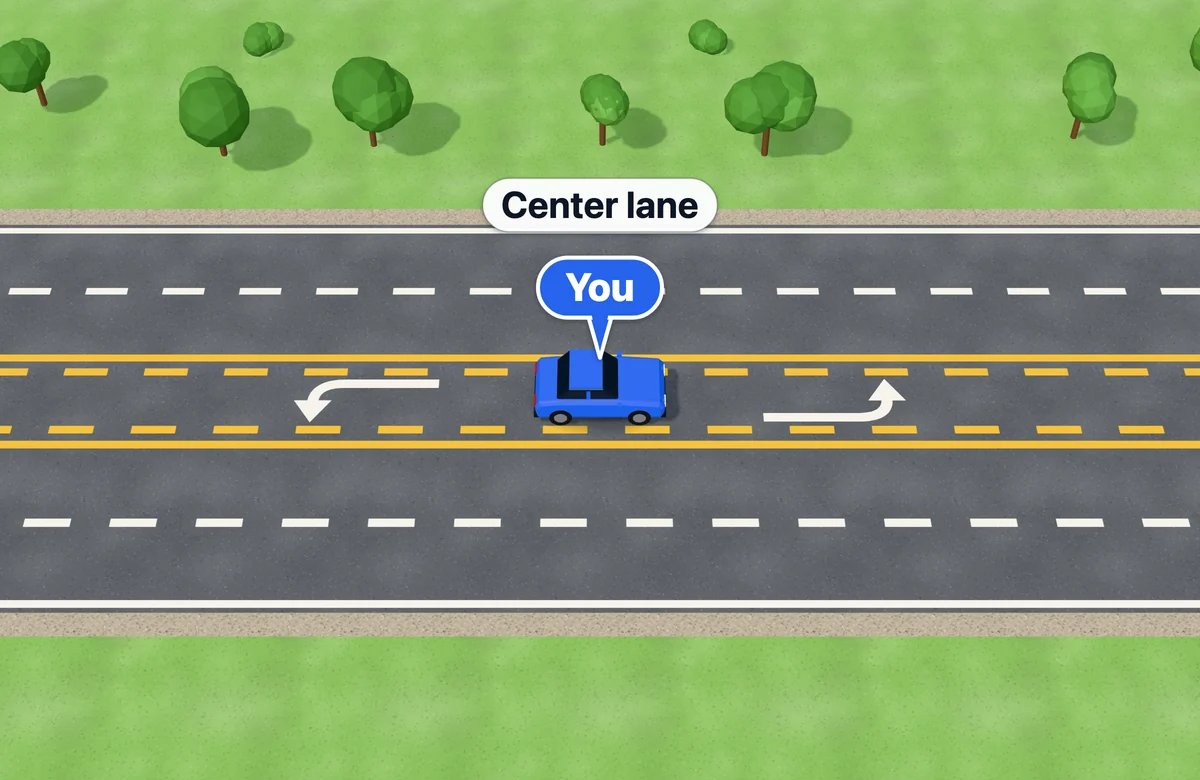
What may you use a shared center left-turn lane for?
- A For passing slow vehicles
- B For through traffic during rush hour
- C For parking briefly while unloading
- D Only for left turns, by traffic from either direction
Show answer
D. Only for left turns, by traffic from either direction
A shared center left-turn lane is only for vehicles turning left, and traffic from either direction may use it. It is not for through driving or for passing.