Maryland Permit Practice Test 1
26 questions written from the Maryland Driver's Manual (DL-002), with an explanation and page citation for every answer.
If you are under 25 and have never had a driver's license, what is the youngest age at which you can get a Maryland Learner's Instructional Permit?
Keyboard: press 1–4 or A–D to answer, Enter for the next question, S to save, R to read aloud, P to pause reading, L to listen and answer.
About this test
These questions were written from the Maryland Driver's Manual (DL-002) (October 2025 Edition; DL-002). 12 of the 21 Maryland questions in this test cover rules that are specific to Maryland or differ between states. Every answer comes with an explanation and a link to the exact page it comes from, so you can check it yourself.
Your answers are saved in this browser. Questions you miss go to My mistakes so you can practice them again.
Sample questions from this test
If you are under 25 and have never had a driver's license, what is the youngest age at which you can get a Maryland Learner's Instructional Permit?
- A 15 years and 6 months
- B 16 years exactly
- C 16 years and 6 months
- D 15 years and 9 months
Show answer
D. 15 years and 9 months
Maryland applicants younger than 25 must be at least 15 years and 9 months old for a Type 1 Learner's Instructional Permit. Starting just before 16 gives new drivers time to finish driver education and practice hours before they can apply for a Provisional License.
In Maryland, after a complete stop at a red light and when no sign prohibits it, which turn is allowed besides a right turn?
- A A left turn from a two-way street onto a one-way street
- B A left turn from any street, as long as no traffic is coming either way
- C A U-turn when the intersection is completely clear
- D A left turn from a one-way street onto another one-way street
Show answer
D. A left turn from a one-way street onto another one-way street
Unless a sign prohibits it, after a full stop at a steady red light you may turn right, or turn left from a one-way street onto another one-way street. You must still yield to pedestrians and all other traffic.
View diagram
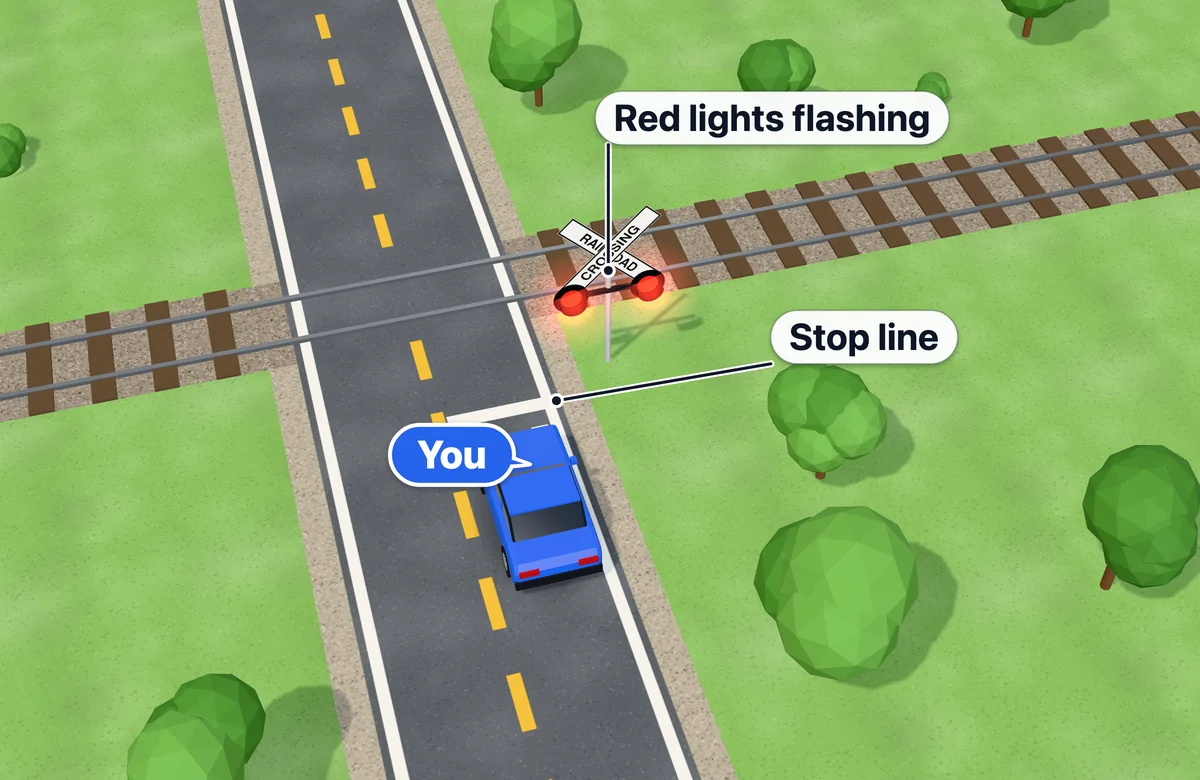
A flashing red signal is on at a railroad crossing, but you do not see a train. What must you do?
- A Stop completely and wait until the signal stops flashing
- B Slow down and cross if the tracks look clear
- C Stop, then cross right away if no train is visible either way
- D Speed up to cross before a train appears
Show answer
A. Stop completely and wait until the signal stops flashing
At a railroad crossing with a flashing red signal, you must come to a complete stop even if you do not see a train. Go only when the signal stops flashing and the way is clear. Trains are often closer and faster than they look.
What does a fluorescent pink sign tell you?
- A There is a school zone ahead
- B There is an emergency traffic incident ahead
- C There is a construction or maintenance work area ahead
- D There is a recreation area nearby
Show answer
B. There is an emergency traffic incident ahead
Fluorescent pink signs are used for emergency traffic incidents, such as a crash scene or a temporary closure. Slow down and expect detours, stopped vehicles and responders ahead.
You are driving alongside a large truck. How can you tell that the truck driver probably cannot see you?
- A The truck's turn signal is not flashing
- B You can see the truck's brake lights
- C You cannot see the driver's face in the truck's side mirror
- D The truck driver has not honked at you
Show answer
C. You cannot see the driver's face in the truck's side mirror
Trucks and buses have large blind spots, called no-zones, on both sides, in front and behind. If you cannot see the driver's face in the truck's side-view mirror, the driver cannot see you, so do not linger beside the truck.