Study sheet for before your test. Notes aren’t allowed in the DMV test room. Source: Nebraska Driver's Manual (Class O), dmv.nebraska.gov · Checked September 22, 2026 · Printed Oct 11, 2026 · drivingtestpal.com/nebraska/cheat-sheet/ |
Nebraska · Study sheet Nebraska permit test cheat sheetThe 44 Nebraska rules, 12 numbers and 12 signs worth knowing cold. Page numbers point to the handbook. Test format25 questions Passing score20 of 25 correct (80%) Permit and test fees$13 total Minimum age for a permit14 years Supervised driving50 hours (10 at night) Hold your permit6 months minimum Numbers to know
Signs to know
Permits & licensing
Laws, points & insurance
Alcohol & drugs
Speed limits & control
School buses & emergency vehicles
Seat belts & equipment
Parking & stopping
Night, weather & hazards
Traffic signals
Following distance & space
Emergencies & crashes
Distracted & drowsy driving
Road signs
Sharing the road
Pavement markings
Turning & signaling
Lanes, passing & merging
Highways & freeways
Railroad crossings
Work zones
|
Nebraska permit test cheat sheet
Nebraska-specific rules from our question bank, condensed to one line each with the handbook page. Read it the night before; don’t use it instead of practicing.
Study sheet for before your test. Notes aren’t allowed in the DMV test room. See the study sheets to print.
- Test format
- 25 questions
- Passing score
- 20 of 25 correct (80%)
- Permit and test fees
- $13 total
- Minimum age for a permit
- 14 years
- Supervised driving
- 50 hours (10 at night)
- Hold your permit
- 6 months minimum
Permits & licensing
- The LPD can be issued on or after your 15th birthday, and you may apply up to 60 days early so it is ready on time. p. 11
- An LPD holder may drive only with a licensed driver who is at least 21 sitting in the seat beside them. p. 12
- The LPE lets a 14-year-old practise driving for a School Permit, and you cannot apply before your 14th birthday. p. 10
- An LPE expires six months after it is issued, which is enough time to practise and move up to a School Permit. p. 10
- The School Permit is meant for students in rural areas and small towns. p. 10
- You can apply for a School Permit at 14 years and two months, and only after you have held an LPE or LPD for at least two months. p. 10
- A POP applicant must have held an LPE, SCP or LPD for at least six months, without getting three or more points in the six months before applying. p. 12
- The 50-hour certification form, signed by a parent, guardian or licensed driver at least 21, must show at least 10 hours of driving between sunset and sunrise. p. 12
- A POP holder may drive unsupervised from 6 a.m. to 12 midnight. p. 12
- For the first six months, a POP holder may carry no more than one passenger younger than 19 who is not an immediate family member. p. 9
- A POP holder may drive unsupervised between midnight and 6 a.m. only when driving between home and work or a school activity. p. 12
- Drivers under 18 who have held a POP for at least 12 months and have not collected three or more points in the previous 12 months have the written and drive tests waived. p. 13
- Any new Nebraska resident who holds a valid license from another state must get a Nebraska license within 30 days. p. 9
Laws, points & insurance
- Reaching 12 points in a two-year period triggers an automatic six-month revocation. p. 26
- A DUI conviction adds 6 points, half of the 12 that trigger automatic revocation. p. 27
- Reading, typing or sending written messages on a handheld device while driving costs 3 points. p. 27
- Convictions remain on your record for five years, but the points stop counting two years after the date of the violation. p. 27
- A 2-point credit may be granted for finishing an approved driver improvement course before 12 points are reached. p. 27
- Nebraska requires at least $25,000 of liability coverage for damage to the property of others in one crash. p. 26
- Nebraska's minimum liability amounts are $25,000 for injury to one person, $50,000 for injury to two or more people, and $25,000 for property damage. p. 26
- Drivers under 21 who accumulate six or more points within one year must take a driver improvement course within three months. p. 9
- Violating the terms of an LPE, SCP or LPD can lead to suspension or revocation. p. 26
Alcohol & drugs
- Nebraska has a "zero tolerance" law for drivers under 21, and driving with a BAC of .02% or more is illegal for them. p. 32
- It is illegal for anyone to drive with a BAC of .08% or more, whatever their age or vehicle. p. 32
- By driving in Nebraska you have already agreed to take a chemical test when an officer asks. p. 32
- A first-time offender who fails an alcohol test serves a 180-day ALR. p. 28
- Drivers who fail or refuse an alcohol test receive a temporary license that expires 15 days after it is issued. p. 28
- It is illegal to drink or possess an open alcohol container inside any vehicle on a public road or in a public parking area. p. 32
- For an underage .02% conviction, the court impounds the license for 30 days, and the conviction stays on the record for 90 days. p. 28
Speed limits & control
- Nebraska's default limit is 25 MPH in residential districts and 20 MPH in business districts. p. 60
- The default limit on any gravel or non-dustless road is 50 MPH. p. 60
- Rural interstate highways in Nebraska have a 75 MPH maximum. p. 60
- Expressways, super-two highways and freeways on the state highway system have a 70 MPH limit unless signs say otherwise. p. 60
- On any paved (dustless) road that is not part of the state highway system, the default limit is 55 MPH. p. 60
Parking & stopping
- Do not park or stop within 15 feet of a fire hydrant. p. 65
- You may not park within 20 feet of a crosswalk at an intersection. p. 65
- Do not park within 30 feet of a flashing signal, stop sign, yield sign or other traffic control device at the roadside. p. 65
- You may not park within 50 feet of railroad tracks, on a bridge, or inside a highway tunnel. p. 65
- Park within 12 inches of and parallel to the curb or road edge, on the right side unless it is a one-way street. p. 64
School buses & emergency vehicles
- On a controlled-access highway such as the interstate, Nebraska's Move Over Law applies when you approach any stopped vehicle on your side of the road, unless it is empty with no one near it. source
- If you cannot move over because of traffic or other conditions, the law requires you to reduce speed and keep a safe speed past the stopped vehicles. p. 59
- A first Move Over Law violation can bring a fine of up to $100. p. 92
- You may not follow a fire truck on an emergency run closer than 500 feet, or drive or park within the block where it has stopped. p. 60
- Amber lights mean the bus is about to stop to load or unload children. p. 78
Seat belts & equipment
- Children ride rear-facing up to age two, or until they reach the highest height or weight the seat maker allows. p. 34
- Children up to age eight must ride correctly secured in a federally approved child safety seat, and in a back seat when one is available. p. 34
- Under a secondary law, a driver is cited for the violation only when stopped and ticketed for something else. p. 33
- Nebraska requires pneumatic tires with at least 2/32 inch of tread. p. 37
- Children up to age eighteen may not ride in cargo areas, and this is a primary law, so an officer can stop you for it alone. p. 34
Night, weather & hazards
- Use high beams on open highways, but dim them when following within 200 feet of another vehicle and when meeting oncoming traffic. p. 69
- Use headlights whenever your windshield wipers are on, and any time you have trouble seeing other vehicles. p. 74
- In fog, use low beams, slow down and use extreme caution. p. 70
- Studded tires are lawful in Nebraska only from November 1 to April 1. p. 71
Traffic signals
- When a signal is dark and no officer or flagger is directing traffic, the intersection is treated as an all-way stop. p. 39
- Turning left on a circular red light after a full stop is allowed only from a one-way street onto another one-way street. p. 40
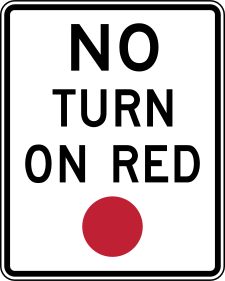
- Right turns on red are allowed after a complete stop unless signs prohibit them. p. 40
Following distance & space
Emergencies & crashes
- If a crash injures or kills anyone, or apparently causes $2,000 or more in damage to one person's property, send a crash report to the Nebraska Department of Transportation within 10 days unless a peace officer investigated. source
- In a minor interstate crash with no injuries and drivable vehicles, drive the cars to the nearest shoulder out of the travel lanes. p. 59
- Nebraska's 'Don't Veer for Deer' advice is to brake firmly, steer to keep control and stop as safely as possible. p. 34
Distracted & drowsy driving
- Nebraska's GDL rules bar permit and POP holders from using any type of interactive wireless communication device while driving, not just texting. p. 9
- In Nebraska it is illegal to use a handheld wireless device to read, type or send written messages while driving. p. 73
- The manual lists the fine for texting and driving as $200 to $500, and the offence also adds 3 points. p. 72
Road signs
Sharing the road
Pavement markings
- It is illegal to drive in a bike lane, but you may cross it to move into another travel lane, to enter or leave on-street parking, or to enter or leave private property. p. 54
Right of way & intersections
- Motorists should leave at least three feet of clearance to avoid hitting a pedestrian on any roadway. p. 60
Turning & signaling
- Signal at least 100 feet before you turn or move left or right. p. 62
Lanes, passing & merging
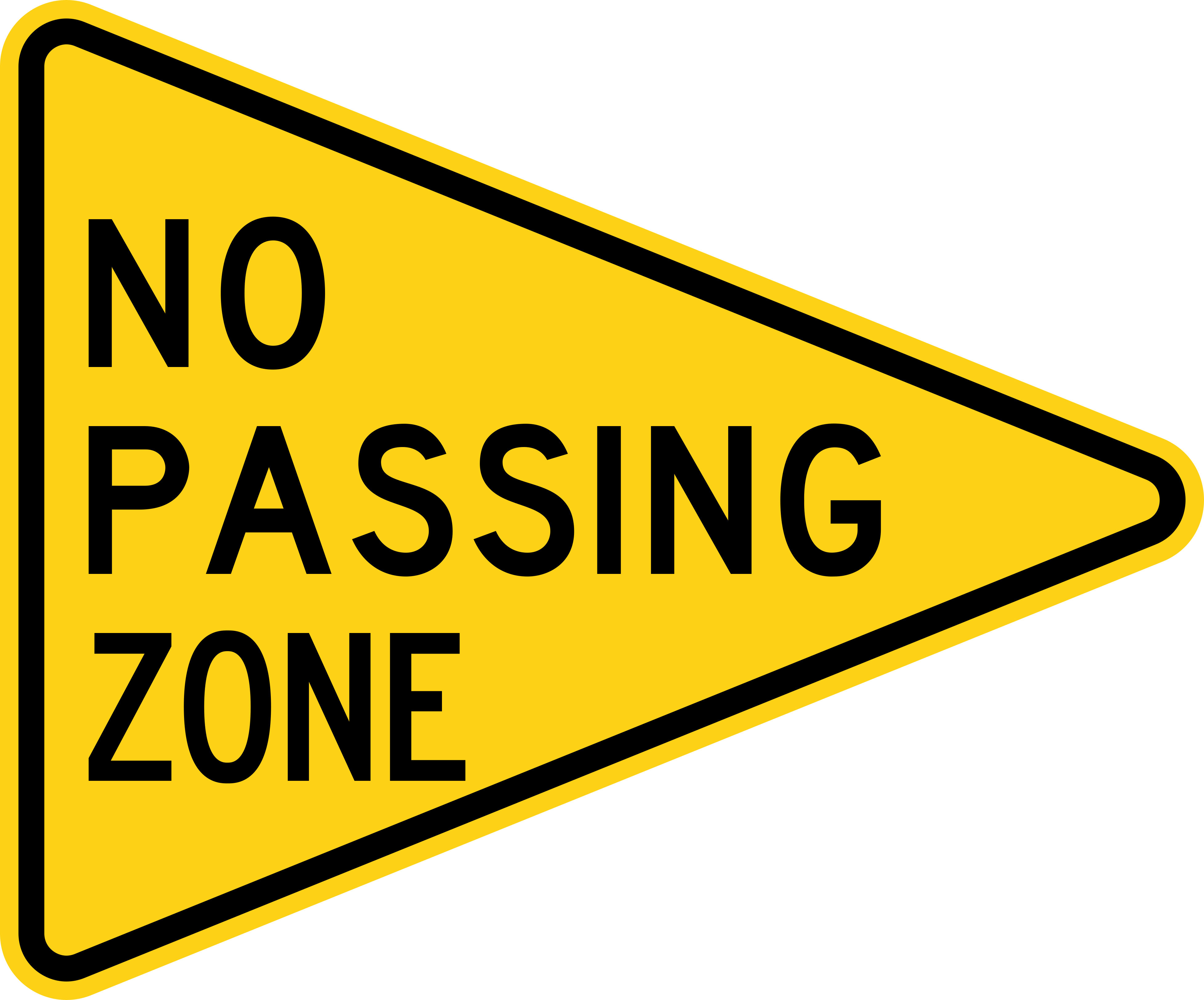
- It is unlawful to pass within 100 feet of any intersection or railroad crossing. p. 61
Highways & freeways
- The minimum speed on the interstate is 40 MPH. p. 68
Railroad crossings
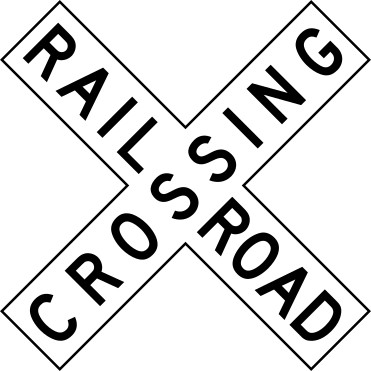
- When required to stop, stop at the stop line. p. 66
Work zones
- Fines are doubled in school zones and in work zones when workers are present. p. 61