Nevada permit test: lanes, passing & merging
Lane choice, changing lanes, blind spots, passing rules and merging. 4 questions.
On a two-lane road in Nevada, you may not pass at or within how many feet of a street or railroad crossing?
Keyboard: press 1–4 or A–D to answer, Enter for the next question, S to save, R to read aloud, P to pause reading, L to listen and answer.
Sample lanes, passing & merging questions
On a two-lane road in Nevada, you may not pass at or within how many feet of a street or railroad crossing?
- A 50 feet
- B 300 feet
- C 100 feet
- D 200 feet
Show answer
C. 100 feet
Do not pass on a two-lane road at or within 100 feet of a street crossing or a railroad crossing. Vehicles may turn or stop there, and you would be in the oncoming lane.
On a Nevada highway outside any city or town, there are two lanes in your direction. You are in the far left lane below the speed limit, you are not passing anyone or turning left, and a faster car comes up behind you in your lane. What does the law require?
- A Brake to warn the other driver
- B Move out of the left lane
- C Speed up above the limit to keep pace
- D Stay in the left lane and keep your speed
Show answer
B. Move out of the left lane
On a highway with two lanes in the same direction, it is illegal to drive in the far left lane below the posted limit while a faster vehicle is overtaking you from behind. Exceptions include driving in a city or town and preparing for a left turn.
Which of these is never allowed when passing another vehicle?
- A Passing on the left on a multi-lane highway
- B Using the shoulder of the road to pass
- C Signaling before you move out
- D Passing where the yellow line on your side is broken
Show answer
B. Using the shoulder of the road to pass
You may never use the shoulder to pass, and you should never exceed the speed limit to pass. Passing on the right is allowed only on roads marked for two or more lanes in your direction and never off the pavement.
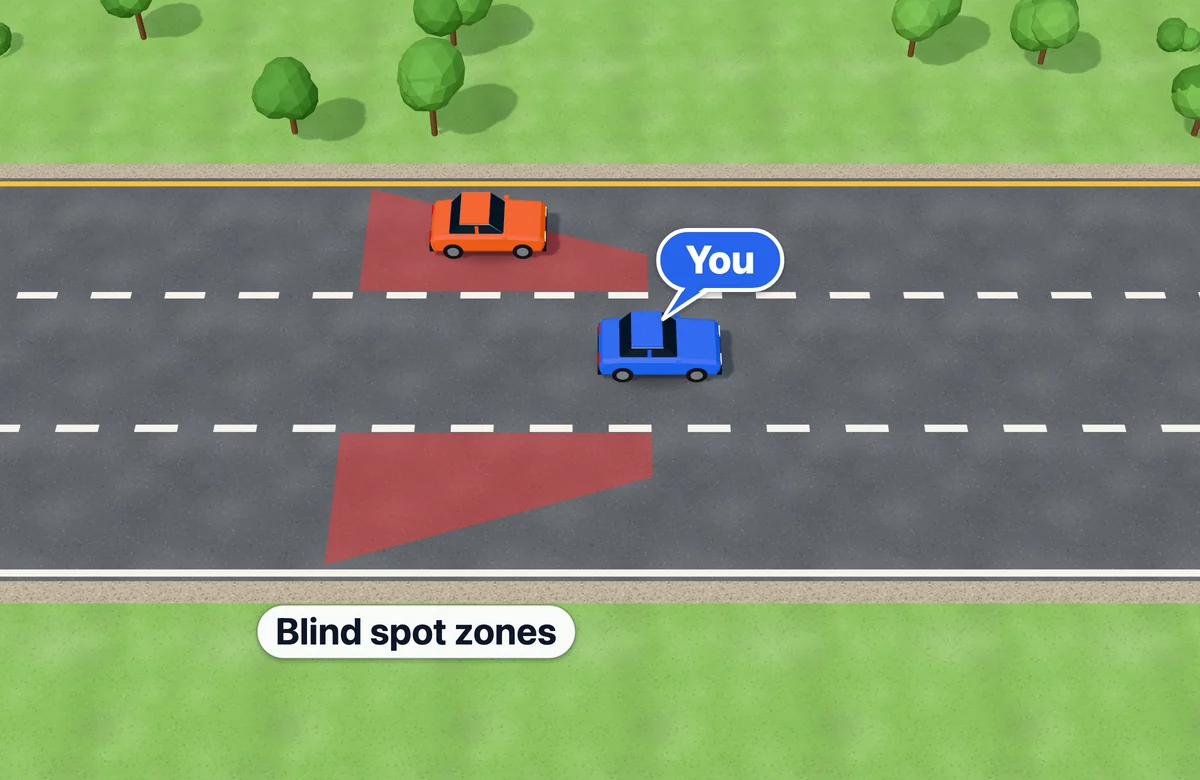
View diagram
What should you do before changing lanes?
- A Change lanes in the intersection to save time
- B Signal and move over at once
- C Check only your rear-view mirror
- D Check mirrors, signal, and look over your shoulder
Show answer
D. Check mirrors, signal, and look over your shoulder
Check your mirrors, signal 100 feet ahead on city streets or 300 feet on highways, then look over your shoulder for blind spots before moving. Do not change lanes in an intersection.