Nevada permit test: pavement markings
Yellow and white lines, passing zones, crosswalks, stop lines and special lanes. 5 questions.
In Nevada, what is the farthest you may drive in a center left-turn lane before making your left turn?
Keyboard: press 1–4 or A–D to answer, Enter for the next question, S to save, R to read aloud, P to pause reading, L to listen and answer.
Sample pavement markings questions
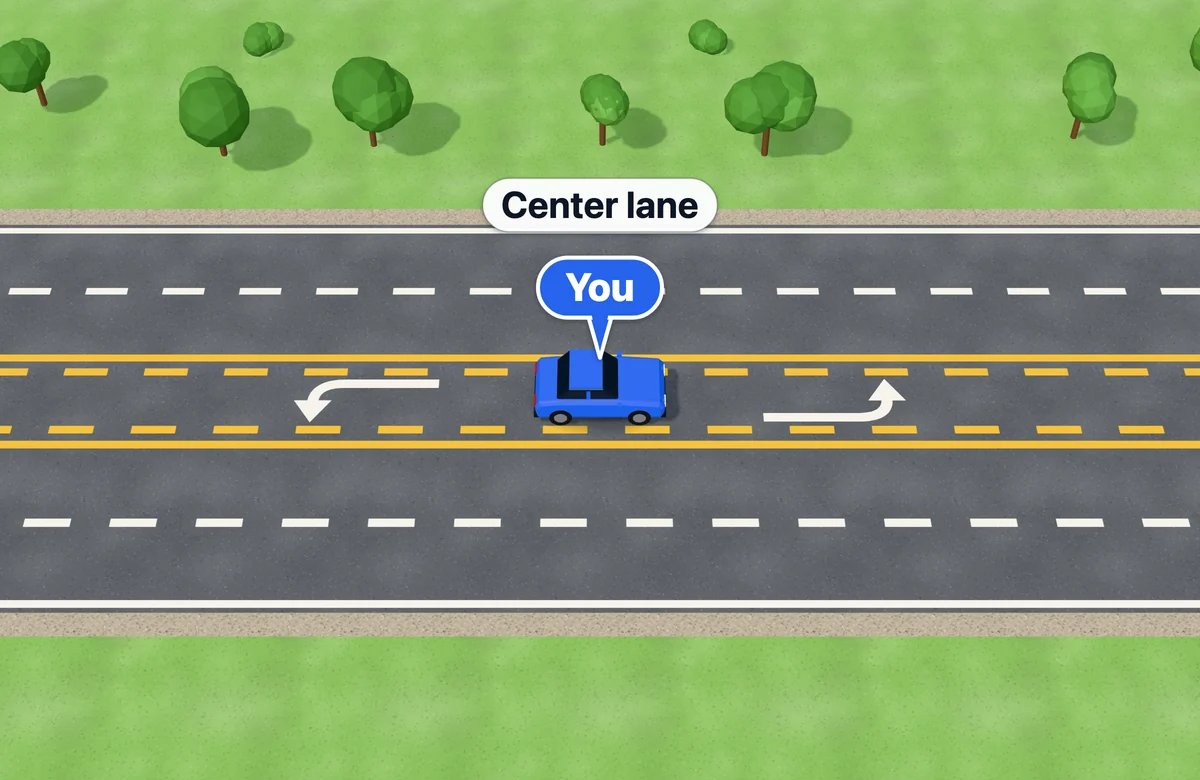
View diagram
In Nevada, what is the farthest you may drive in a center left-turn lane before making your left turn?
- A 200 feet
- B 300 feet
- C 100 feet
- D 500 feet
Show answer
A. 200 feet
Nevada limits travel in a center turn lane to 200 feet before a left turn. The lane is for turning, not for traveling or passing.
You turn left from a driveway into a center turn lane to merge with traffic. How far may you travel in that lane before merging?
- A As far as you need
- B No more than 100 feet
- C No more than 200 feet
- D No more than 50 feet
Show answer
D. No more than 50 feet
After a left turn onto the highway you may use the center lane for no more than 50 feet before merging. Remember: 200 feet before a turn, 50 feet after one.
A solid white line separates two lanes going the same direction. What does it mean?
- A Traffic on each side moves in opposite directions
- B It marks a bike lane only
- C Do not change lanes or pass across it
- D You may pass if it is safe
Show answer
C. Do not change lanes or pass across it
A solid white line between lanes going the same way means stay in your lane: do not change lanes or pass. Solid white also marks the road edge and the shoulder.

View diagram
On a two-lane road, the center line is solid yellow on your side and broken yellow on the other side. May you pass?
- A No, because the line on your side is solid
- B Yes, because one line is broken
- C Yes, but only during daylight
- D Only if the car ahead is under the limit
Show answer
A. No, because the line on your side is solid
When double yellow lines have a solid line on your side, you may not pass. A broken line on your side means you may pass when it is safe.