New Hampshire Permit Practice Test 2
25 questions written from the New Hampshire Driver's Manual, with an explanation and page citation for every answer.
You are passing a bicyclist while traveling 30 mph. What is the minimum clearance presumed reasonable under New Hampshire law?
Keyboard: press 1–4 or A–D to answer, Enter for the next question, S to save, R to read aloud, P to pause reading, L to listen and answer.
About this test
These questions were written from the New Hampshire Driver's Manual (Rev. 11/25). 13 of the 20 New Hampshire questions in this test cover rules that are specific to New Hampshire or differ between states. Every answer comes with an explanation and a link to the exact page it comes from, so you can check it yourself.
Your answers are saved in this browser. Questions you miss go to My mistakes so you can practice them again.
Sample questions from this test
You are passing a bicyclist while traveling 30 mph. What is the minimum clearance presumed reasonable under New Hampshire law?
- A 3 feet
- B 2 feet
- C 5 feet
- D 1 foot
Show answer
A. 3 feet
At 30 mph or less, at least 3 feet between your vehicle and a bicyclist is presumed reasonable. Give one more foot for every 10 mph above 30, and slow down when passing.
Unless signs say otherwise, what is the maximum speed limit in a New Hampshire business or urban residence district?
- A 25 mph
- B 35 mph
- C 40 mph
- D 30 mph
Show answer
D. 30 mph
New Hampshire's maximum is 30 mph in business or urban residence districts and 35 mph in rural residence districts. Remember that speed limits are the most you may drive under ideal conditions.
View diagram
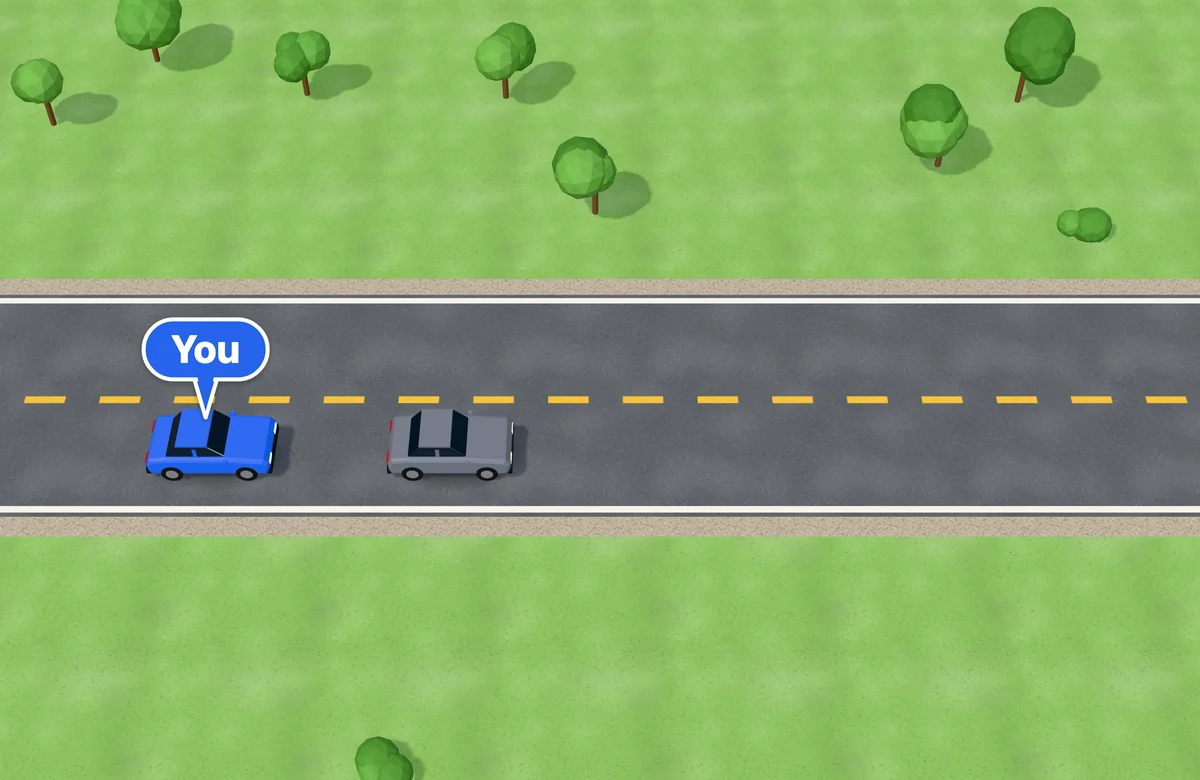
A single broken yellow line separates two lanes. What does it tell you?
- A Traffic moves in the same direction, and you may pass whenever it is safe
- B Traffic moves in opposite directions, and passing is banned
- C The lane is reserved for left turns only
- D Traffic moves in opposite directions, and you may pass when safe
Show answer
D. Traffic moves in opposite directions, and you may pass when safe
Yellow lines separate traffic moving in opposite directions, and white lines separate traffic moving the same way. A broken line means you may pass when it is safe.
A train is approaching a crossing and there is no stop line. Where must you stop?
- A Between 5 and 10 feet from the nearest rail
- B At least 100 feet from the nearest rail
- C Right at the crossbuck sign, wherever it is
- D Between 15 and 50 feet from the nearest rail
Show answer
D. Between 15 and 50 feet from the nearest rail
When a train is approaching, stop behind the stop line, or no closer than 15 feet and no farther than 50 feet from the nearest rail. Do not go until the lights stop flashing and trains have passed.
How close may you park to a crosswalk at an intersection in New Hampshire?
- A No closer than 15 feet
- B No closer than 30 feet
- C No closer than 20 feet
- D No closer than 50 feet
Show answer
C. No closer than 20 feet
Do not park within 20 feet of a crosswalk at an intersection. Parked cars near crosswalks hide pedestrians from approaching drivers.