New Hampshire Permit Practice Test 6
25 questions written from the New Hampshire Driver's Manual, with an explanation and page citation for every answer.
A driver under 20 has their original license suspended after a hearing for a first qualifying offense. What suspension range applies?
Keyboard: press 1–4 or A–D to answer, Enter for the next question, S to save, R to read aloud, P to pause reading, L to listen and answer.
About this test
These questions were written from the New Hampshire Driver's Manual (Rev. 11/25). 9 of the 20 New Hampshire questions in this test cover rules that are specific to New Hampshire or differ between states. Every answer comes with an explanation and a link to the exact page it comes from, so you can check it yourself.
Your answers are saved in this browser. Questions you miss go to My mistakes so you can practice them again.
Sample questions from this test
A driver under 20 has their original license suspended after a hearing for a first qualifying offense. What suspension range applies?
- A At least 45 days, but no more than 90 days
- B At least 90 days, but no more than 180 days
- C At least 9 months, but no more than 2 years
- D At least 20 days, but no more than 40 days
Show answer
D. At least 20 days, but no more than 40 days
Under New Hampshire's "Under 20" law, the Director can suspend an original license after a hearing. Suspensions grow with each offense: 20-40 days, then 45-90 days, then 90-180 days plus a driver attitude program.

View diagram
What minimum following distance does the New Hampshire Driver's Manual recommend in normal conditions?
- A At least two seconds
- B At least three seconds
- C At least four seconds
- D One car length per 10 mph
Show answer
C. At least four seconds
Keep at least four seconds between you and the vehicle ahead. Count from when its rear passes a fixed point until you reach that point; if you get there before "one-thousand-four," slow down and recount.
The car ahead is slowing to turn left. May you pass it on the paved shoulder?
- A Yes, if the shoulder is paved
- B Yes, if you signal first
- C Yes, if you keep under 25 mph
- D No, never pass on the shoulder, paved or not
Show answer
D. No, never pass on the shoulder, paved or not
Never pass on the shoulder, whether it is paved or not. Shoulders are for emergencies, and pedestrians, cyclists or stopped vehicles may be there.
It is illegal for a New Hampshire driver under 21 to have physical control of a vehicle with an alcohol concentration of at least what level?
- A 0.00
- B 0.05
- C 0.02
- D 0.08
Show answer
C. 0.02
Drivers under 21 may not have physical control of a vehicle with an alcohol concentration of 0.02 or more, or while impaired by any drug. This near-zero rule reflects that young drivers are both inexperienced and underage to drink.
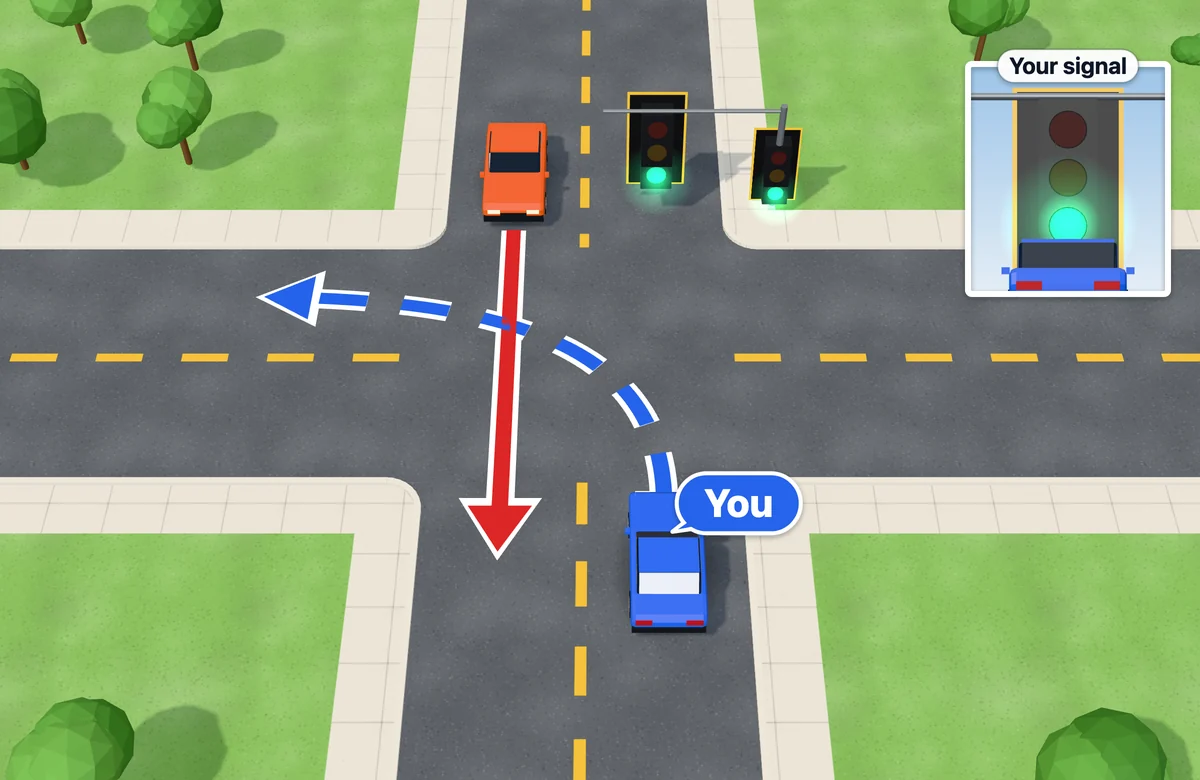
View diagram
You want to turn left at an intersection, and an oncoming car is close enough to be a hazard. What must you do?
- A Turn quickly before the oncoming car arrives
- B Yield until the oncoming car has passed
- C Go first, since you were in the intersection first
- D Flash your headlights and then turn
Show answer
B. Yield until the oncoming car has passed
Under RSA 265:29, a driver turning left must yield to vehicles from the opposite direction that are in the intersection or close enough to be an immediate hazard. Turn only when there is a safe gap.