New Mexico permit test: following distance & space
Following-distance rules, stopping distance and keeping a space cushion. 4 questions.
What following-distance rule does the New Mexico driver manual teach for normal conditions?
Keyboard: press 1–4 or A–D to answer, Enter for the next question, S to save, R to read aloud, P to pause reading, L to listen and answer.
Sample following distance & space questions

View diagram
What following-distance rule does the New Mexico driver manual teach for normal conditions?
- A The two-second rule
- B One car length per 10 mph
- C The five-second rule
- D The three-second rule
Show answer
D. The three-second rule
Watch the vehicle ahead pass a fixed point and count. If you reach the point before "one-thousand-three," you are too close; the three-second rule works at any speed.
In which of these situations does the manual say you may need a four-second following distance?
- A When driving on a dry, empty highway
- B When following a car in light traffic
- C When following a motorcycle
- D When driving in a school zone at 15 mph
Show answer
C. When following a motorcycle
Use a four-second following distance on slippery roads, when following motorcycles or emergency vehicles, when pulling a trailer or heavy load, near railroad crossings, or when stopped on a hill.
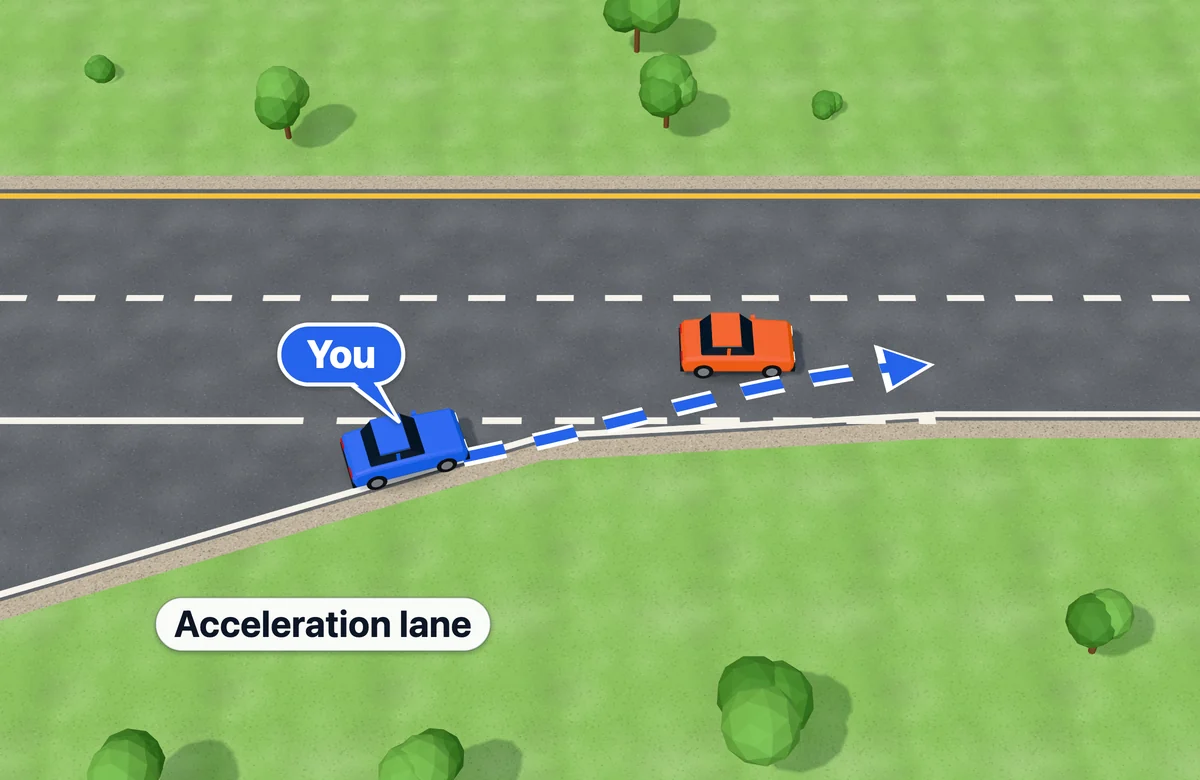
View diagram
When merging, the manual says you need a gap of about four seconds. Why?
- A So you can stop in the middle of the merge
- B So you can merge more slowly than traffic
- C You and the car behind each get about two seconds
- D So you can stay beside the other car
Show answer
C. You and the car behind each get about two seconds
If you move into the middle of a four-second gap, you and the vehicle now behind you each have about a two-second following distance. You need that gap whenever you change lanes, enter a road or your lane merges.
With good tires and brakes on dry pavement, about how far does it take to react and stop from 50 mph?
- A About 400 feet
- B About 100 feet
- C About 200 feet
- D About 800 feet
Show answer
A. About 400 feet
At 50 mph it can take about 400 feet, about a city block, to react and stop. At 30 mph it takes about 200 feet. If you cannot see that far ahead, slow down.