New Mexico permit test: pavement markings
Yellow and white lines, passing zones, crosswalks, stop lines and special lanes. 4 questions.
What does a dashed white line between two lanes going the same way mean?
Keyboard: press 1–4 or A–D to answer, Enter for the next question, S to save, R to read aloud, P to pause reading, L to listen and answer.
Sample pavement markings questions
What does a dashed white line between two lanes going the same way mean?
- A You may cross it to change lanes when safe
- B You may not change lanes
- C It separates opposite directions
- D It marks the edge of the road
Show answer
A. You may cross it to change lanes when safe
A dashed white line between same-direction lanes means you may cross it to change lanes if it is safe. White lines separate traffic going the same way; yellow lines separate opposite directions.

View diagram
On a two-lane road, a solid yellow line is on your side of the center and a dashed yellow line is on the other side. May you pass?
- A Yes, if the road ahead looks clear to you
- B Yes, but only to pass a slow truck or tractor
- C No, not while the solid line is on your side
- D Only during daylight hours
Show answer
C. No, not while the solid line is on your side
When both a solid and a dashed yellow line separate opposing traffic, you may not pass if the solid line is on your side. If the dashed line is on your side, you may pass when it is safe.
View diagram
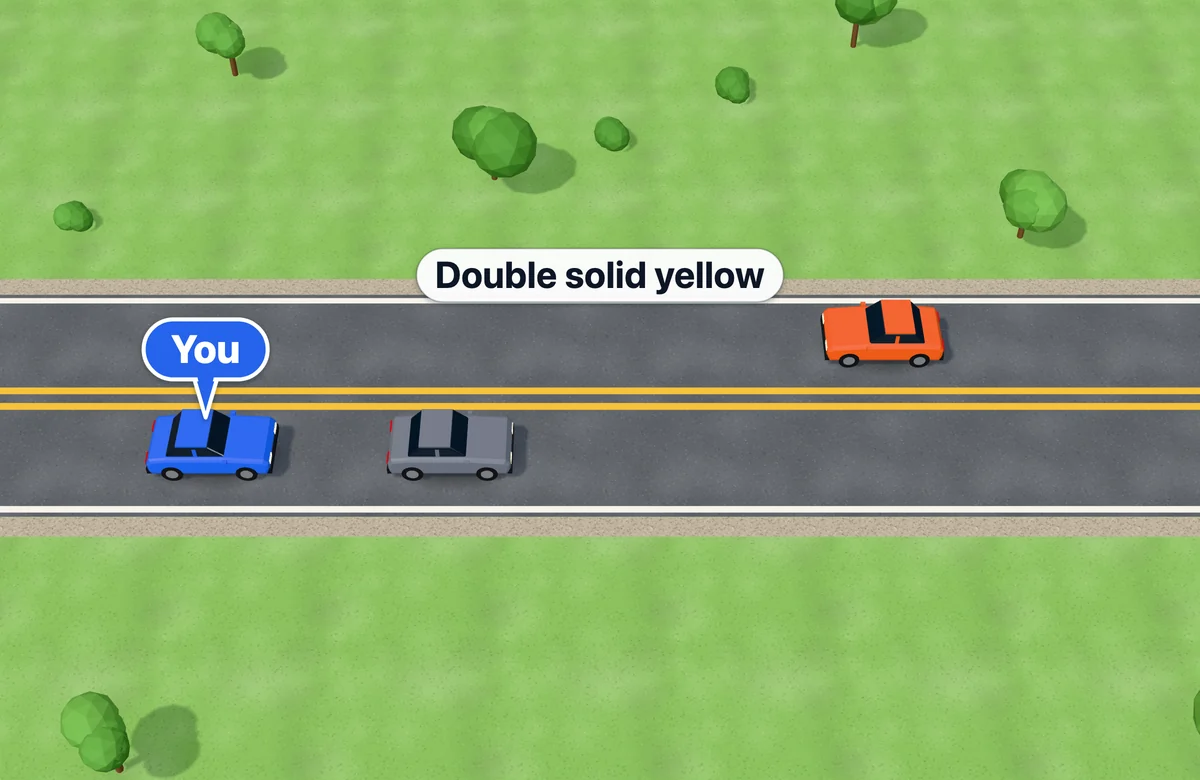
The road has two solid yellow center lines. According to the New Mexico manual, when may you cross them?
- A To pass a slow vehicle
- B Never, for any reason
- C To change lanes on a hill
- D To turn into a driveway when safe
Show answer
D. To turn into a driveway when safe
Two solid yellow lines mean neither side may pass. You may, however, cross a solid yellow line to turn into a driveway if it is safe.
View diagram
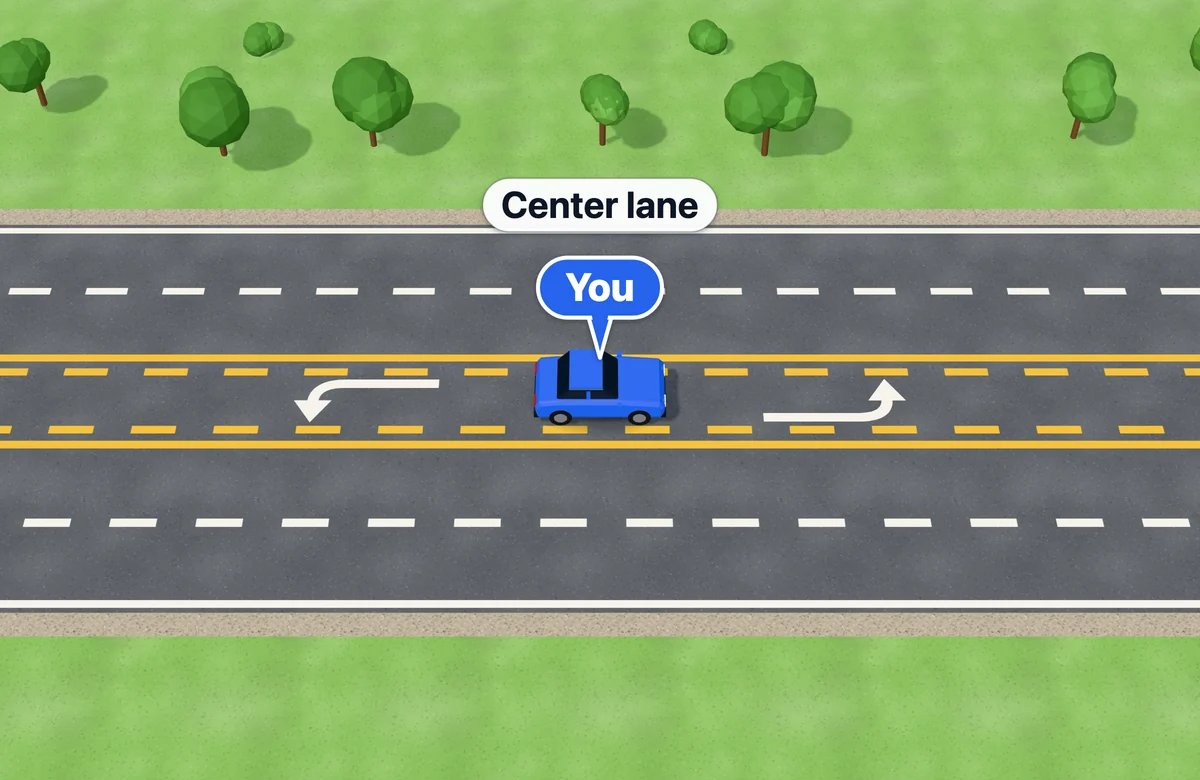
A center lane is marked on each side by a solid yellow line and a dashed yellow line, with left-turn arrows pointing both ways. What is it for?
- A Passing slower vehicles
- B Left turns by traffic from both directions
- C Driving long distances in either direction
- D Parking for emergency vehicles
Show answer
B. Left turns by traffic from both directions
A shared center lane is reserved for left turns, or U-turns where permitted, by traffic going in both directions. Enter it only when you can do so safely, and watch for oncoming turners.