New York permit test: pavement markings
Yellow and white lines, passing zones, crosswalks, stop lines and special lanes. 5 questions.
A solid yellow line and a broken yellow line divide the road, and the solid line is on your side. When may you cross it?
Keyboard: press 1–4 or A–D to answer, Enter for the next question, S to save, R to read aloud, P to pause reading, L to listen and answer.
Sample pavement markings questions

View diagram
A solid yellow line and a broken yellow line divide the road, and the solid line is on your side. When may you cross it?
- A Any time you want to pass slower traffic
- B Whenever there is no oncoming traffic
- C Only to pass a vehicle going under the speed limit
- D Only to make a left turn into a driveway
Show answer
D. Only to make a left turn into a driveway
When the solid line is on your side, you may not pass or cross except to turn left into a driveway. Drivers on the broken-line side may pass when it is safe.
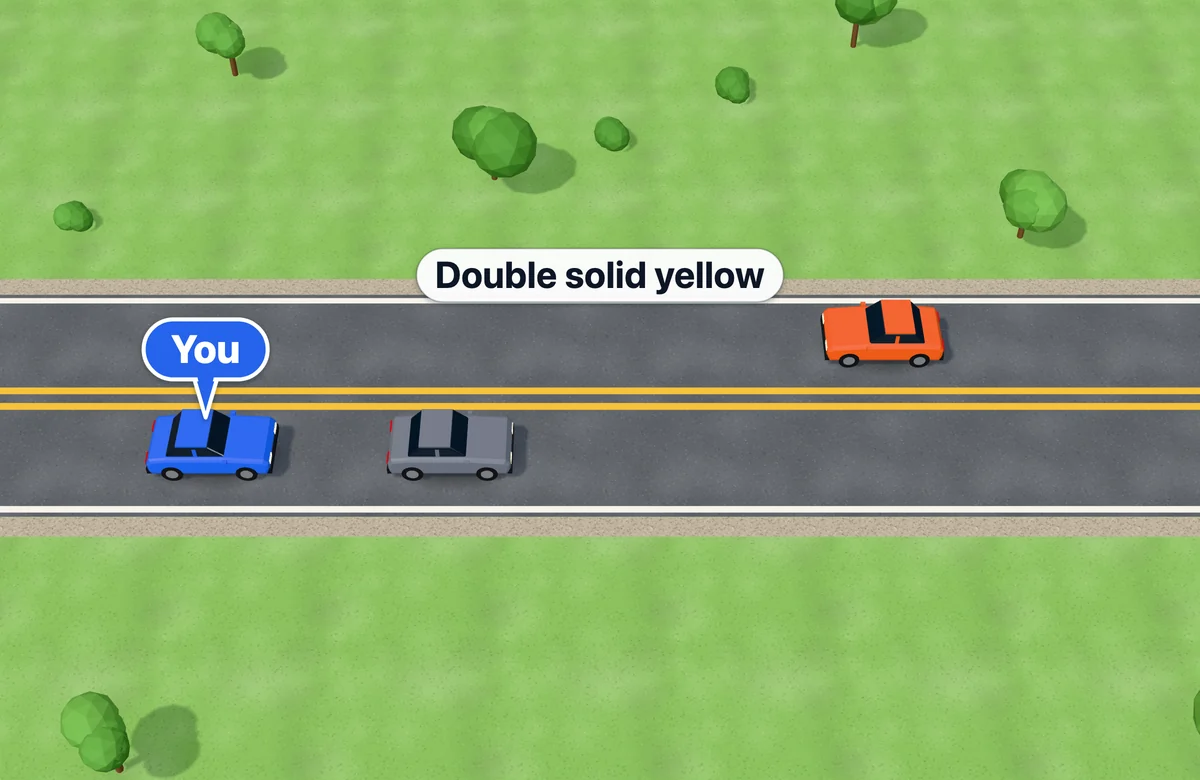
View diagram
When may you cross double solid yellow lines?
- A To pass a slow vehicle on a straight road
- B To change lanes when traffic is light
- C Only to turn left to enter or leave the road, such as into a driveway
- D Never, for any reason
Show answer
C. Only to turn left to enter or leave the road, such as into a driveway
Double solid lines mean no passing and no lane changes. You may cross them only to turn left to enter or leave the highway, such as into a driveway or for a legal U-turn.
A single solid white line separates two lanes going your way. When may you change lanes across it?
- A Only when obstructions or traffic conditions make it necessary
- B Any time, as long as you signal
- C Never, under any circumstances
- D Only to pass vehicles going below the speed limit
Show answer
A. Only when obstructions or traffic conditions make it necessary
A single solid lane line discourages lane changes. You may pass or change lanes across it only when an obstruction or traffic conditions make it necessary. A broken line allows lane changes whenever it is safe.
On a city street, a diamond-marked HOV lane is separated from your lane by a broken white line. You are alone in a car. When may you enter the HOV lane?
- A Any time traffic in your own lane is heavy and slow
- B To pass a slow vehicle, then move back
- C Never while the restriction is in effect
- D To make a right turn at the next intersection
Show answer
D. To make a right turn at the next intersection
Diamond lanes are reserved for buses, HOVs, bicycles or other special vehicles while the rules are in effect. On city streets, where the separating line is broken, other vehicles may enter only to make a right turn at the next intersection.