North Carolina Permit Practice Test 4
25 questions written from the North Carolina Driver Handbook, with an explanation and page citation for every answer.
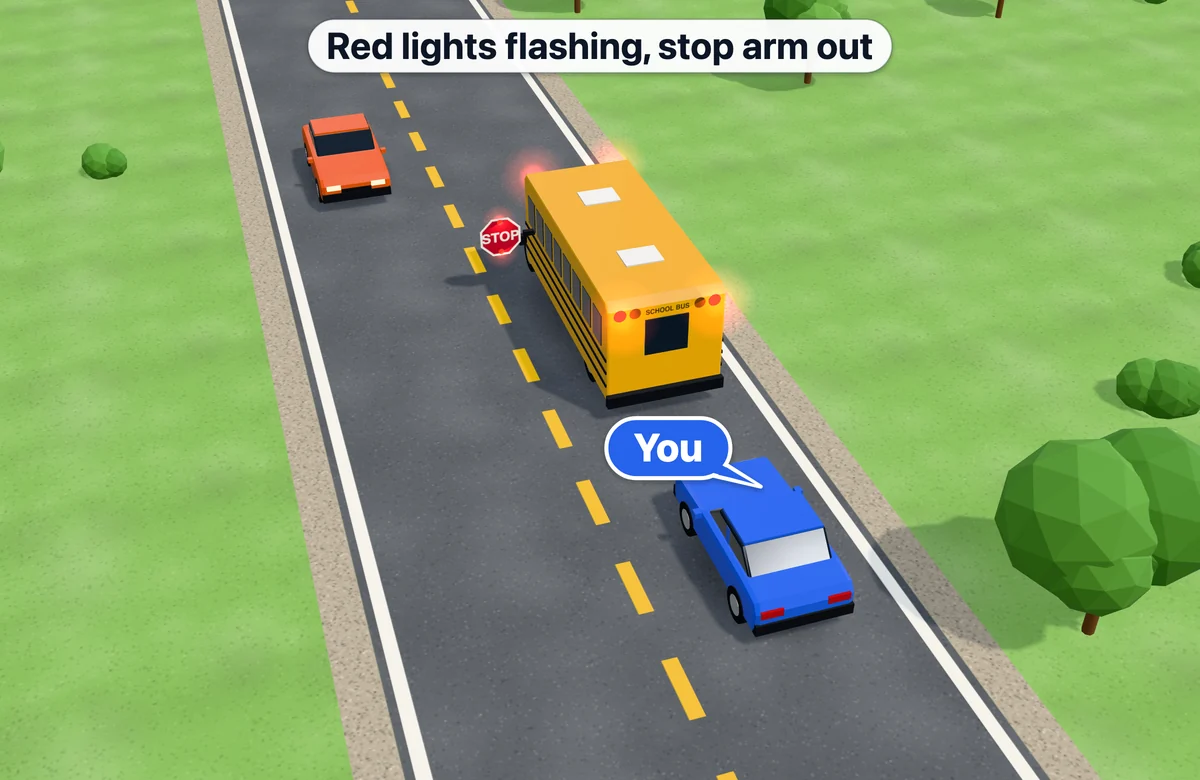
On a two-lane road, a school bus ahead stops with its red lights flashing to let children off. Who must stop?
Keyboard: press 1–4 or A–D to answer, Enter for the next question, S to save, R to read aloud, P to pause reading, L to listen and answer.
About this test
These questions were written from the North Carolina Driver Handbook (Revised May 2025). 14 of the 20 North Carolina questions in this test cover rules that are specific to North Carolina or differ between states. Every answer comes with an explanation and a link to the exact page it comes from, so you can check it yourself.
Your answers are saved in this browser. Questions you miss go to My mistakes so you can practice them again.
Sample questions from this test
View diagram
On a two-lane road, a school bus ahead stops with its red lights flashing to let children off. Who must stop?
- A All traffic in both directions
- B Only drivers who see children crossing
- C Only traffic behind the bus
- D Only traffic meeting the bus
Show answer
A. All traffic in both directions
On a two-lane road, traffic from both directions must stop for a school bus loading or unloading passengers. Children often cross in front of the bus, so oncoming drivers are in their path too.
Under North Carolina law, which child must ride in a weight-appropriate child passenger restraint system?
- A A child under 6 who weighs less than 60 pounds
- B A child under 4 who weighs less than 40 pounds
- C Any child under 12, whatever their weight
- D A child under 8 who weighs less than 80 pounds
Show answer
D. A child under 8 who weighs less than 80 pounds
A child under 8 and under 80 pounds must be secured in a weight-appropriate child restraint. Older children under 16 must use a restraint or seat belt. Boosters help seat belts fit across the hips and shoulder, not the stomach and neck.

A stop sign has no stop line or crosswalk painted in front of it. Where must you stop?
- A Right next to the stop sign, wherever it is posted
- B Before entering the intersection, where you can see the cross street
- C In the middle of the intersection, where you can see best
- D At least 50 feet before the edge of the intersection
Show answer
B. Before entering the intersection, where you can see the cross street
Stop at the marked stop line if there is one. If there is no stop line or crosswalk, stop before entering the intersection at a point where you can see the intersecting street. Then go only when the way is clear.
Before a 15-year-old in North Carolina can test for a learner permit, what driver education must be completed?
- A 30 hours of classroom and 60 hours behind the wheel
- B An online course with no behind-the-wheel training
- C 30 hours of classroom and 6 hours behind the wheel
- D 20 hours of classroom and 10 hours behind the wheel
Show answer
C. 30 hours of classroom and 6 hours behind the wheel
Applicants under 18 must show a certificate from an approved driver education course of at least 30 classroom hours and six behind-the-wheel hours. The course comes first; the 60-hour practice log is kept afterward while holding the permit.
Passing on a curve or hill is unsafe and usually illegal if you cannot see at least how far ahead?
- A 300 feet
- B 1,000 feet
- C 200 feet
- D 500 feet
Show answer
D. 500 feet
Do not pass on any curve or hill where you cannot see at least 500 feet ahead. An oncoming car can appear quickly, and you need room to complete the pass and return to your lane.