Oregon permit test: sharing the road
Pedestrians, bicyclists, motorcyclists, trucks, buses and slow vehicles. 8 questions.
A pedestrian is in a crosswalk. Under Oregon law, in which case must you stop and remain stopped?
Keyboard: press 1–4 or A–D to answer, Enter for the next question, S to save, R to read aloud, P to pause reading, L to listen and answer.
Sample sharing the road questions
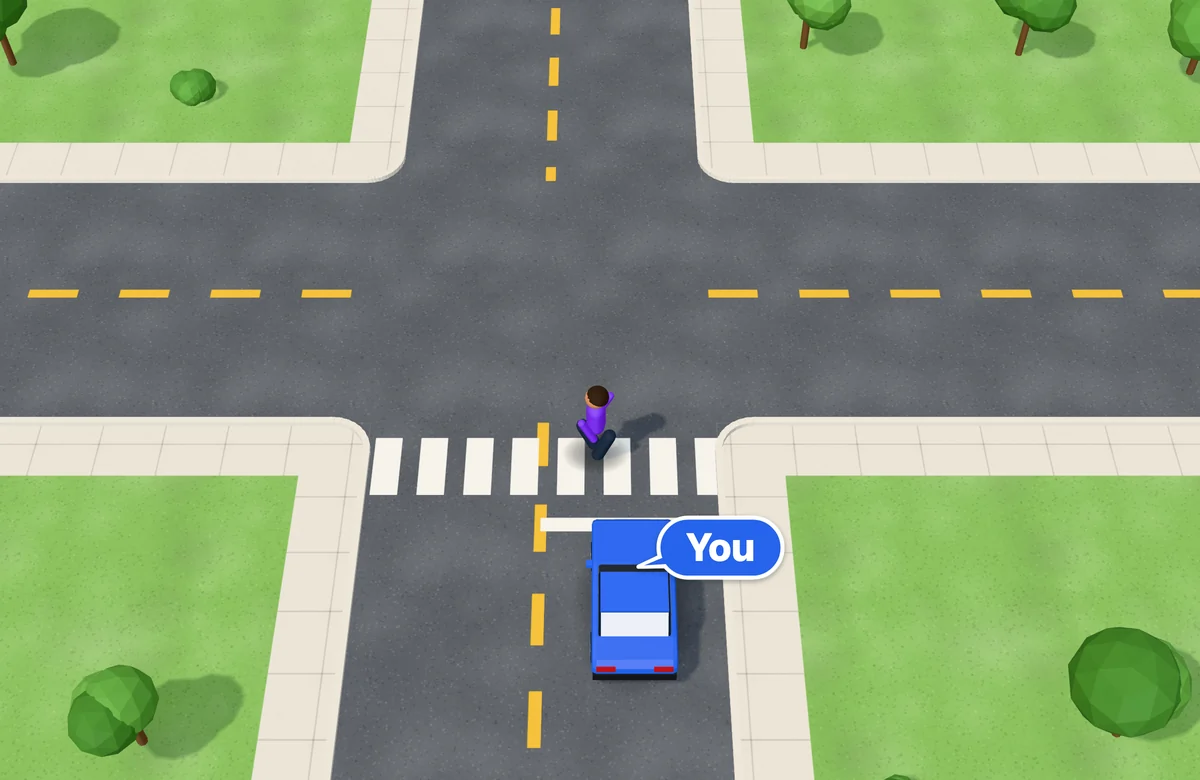
View diagram
A pedestrian is in a crosswalk. Under Oregon law, in which case must you stop and remain stopped?
- A Only when the pedestrian is directly in front of your car's bumper
- B When the pedestrian is in your lane or the lane next to yours
- C Only at crosswalks marked with painted lines
- D Only when a pedestrian signal shows WALK
Show answer
B. When the pedestrian is in your lane or the lane next to yours
Oregon requires you to stop and stay stopped for a pedestrian in a crosswalk who is in your lane, in a lane next to yours (including a bike lane) or in the lane you are turning into.
You are turning at an intersection with a traffic signal, and a pedestrian is crossing the street you are turning onto. Under Oregon law, how far must they be from the lane you are turning into before you turn?
- A Six feet or more
- B Past the lane you are turning into, plus the next lane
- C All the way across the street
- D Three feet or more
Show answer
A. Six feet or more
At a signalized intersection the pedestrian must be at least six feet from the lane you are turning into before you start the turn. Without a signal, they must be past your lane plus the next lane.
There are no painted lines at an Oregon intersection. Is there a crosswalk?
- A Only if there is a sidewalk on both corners
- B No, a crosswalk exists only where white lines are painted on the road
- C Only within a school zone
- D Yes, every intersection has a crosswalk, at least six feet wide
Show answer
D. Yes, every intersection has a crosswalk, at least six feet wide
Oregon treats every intersection as having a crosswalk, even if none is painted. Picture the sidewalk or shoulder extending across the road; that area is at least six feet wide.
You are driving 45 mph and want to pass a person on a bicycle riding in your lane. What does Oregon require?
- A Never pass a bicycle when going over 35 mph
- B Leave exactly three feet of space
- C Leave enough distance to avoid hitting the rider if they fell
- D Honk so the rider moves onto the shoulder
Show answer
C. Leave enough distance to avoid hitting the rider if they fell
At speeds over 35 mph, Oregon allows you to pass a bicyclist in your lane only if you leave enough room that you would not hit them if they fell into your lane. If you cannot pass safely, slow down and stay behind.