Pennsylvania Permit Practice Test 1
26 questions written from the Pennsylvania Driver's Manual (PUB 95), with an explanation and page citation for every answer.
What is the earliest age at which you can apply for a Pennsylvania learner's permit?
Keyboard: press 1–4 or A–D to answer, Enter for the next question, S to save, R to read aloud, P to pause reading, L to listen and answer.
About this test
These questions were written from the Pennsylvania Driver's Manual (PUB 95) (PUB 95). 14 of the 21 Pennsylvania questions in this test cover rules that are specific to Pennsylvania or differ between states. Every answer comes with an explanation and a link to the exact page it comes from, so you can check it yourself.
Your answers are saved in this browser. Questions you miss go to My mistakes so you can practice them again.
Sample questions from this test
What is the earliest age at which you can apply for a Pennsylvania learner's permit?
- A On or after your 15th birthday
- B On or after your 17th birthday
- C Six months before your 16th birthday
- D On or after your 16th birthday
Show answer
D. On or after your 16th birthday
Pennsylvania does not accept a learner's permit application before your 16th birthday. You can get the medical part of the DL-180 done a little early, but the permit itself starts at 16.
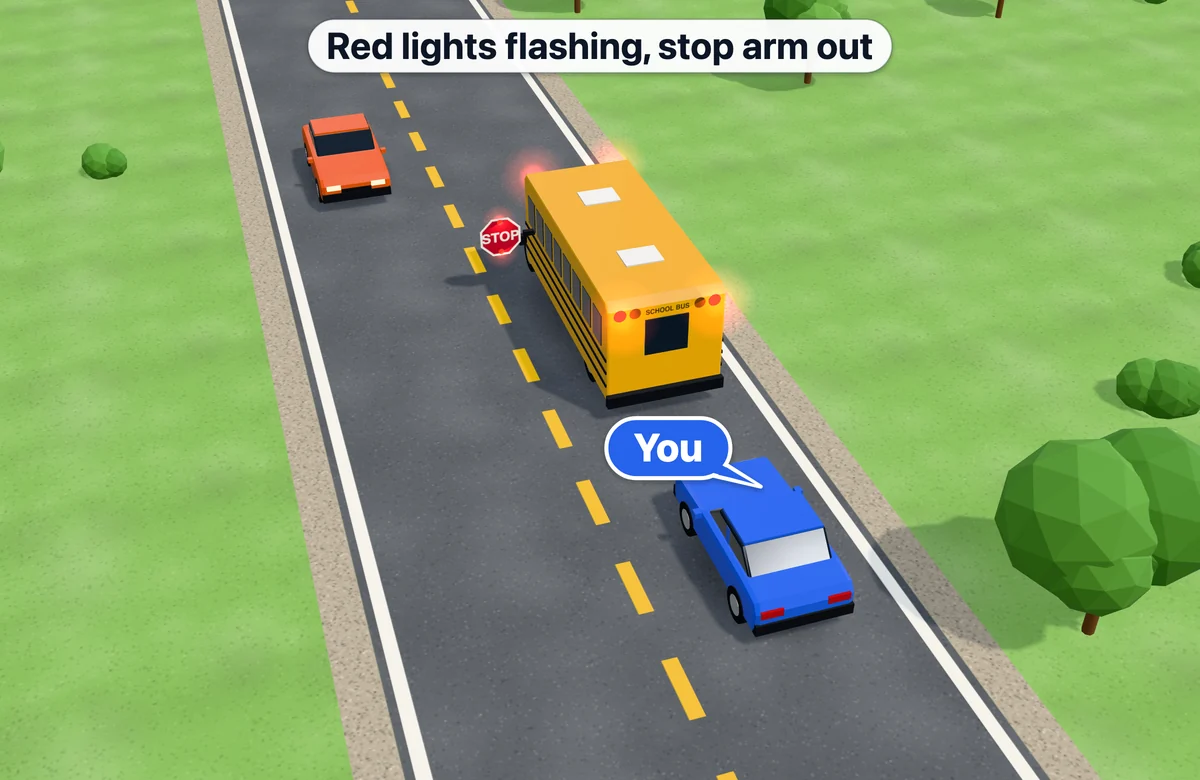
View diagram
A school bus stops ahead with red lights flashing and its stop arm out. How close may you get to it?
- A You must stop at least 10 feet away
- B You must stop at least 20 feet away
- C You may pass slowly if no children are visible
- D You must stop at least 5 feet away
Show answer
A. You must stop at least 10 feet away
Pennsylvania requires you to stop at least 10 feet from a school bus with red lights flashing and stop arm extended, whether you are behind it, meeting it or at an intersection where it is stopped. Stay stopped until the lights stop, the arm is withdrawn and children are safe.
Unless a traffic control device says otherwise, you may not pass when you are within how many feet of an intersection or railroad crossing?
- A 500 feet
- B 100 feet
- C 50 feet
- D 300 feet
Show answer
B. 100 feet
You may not pass within 100 feet of, or while crossing, an intersection or railroad grade crossing, or within 100 feet of a bridge, elevated structure or tunnel. Vehicles may turn or stop there, and space is tight.
You are stopped for speeding in a Pennsylvania work zone and your headlights are off. What extra fine applies?
- A There is no extra fine during daylight
- B An additional $100
- C An additional $25
- D An additional $500
Show answer
C. An additional $25
Pennsylvania law requires headlights in all posted work zones at any time of day, not just active ones. If you are stopped for a violation in a work zone with your headlights off, you are fined an additional $25.
It is raining lightly during the day and your wipers are on intermittent. What does Pennsylvania law require?
- A Use your high beams
- B Daytime running lights are enough
- C Nothing, because it is daytime
- D Turn on your headlights, with your taillights lit
Show answer
D. Turn on your headlights, with your taillights lit
Pennsylvania requires headlights whenever your wipers are in continuous or intermittent use because of the weather. Daytime running lights are not enough because your taillights must also be lit.