Washington Permit Practice Test 3
25 questions written from the Washington Driver Guide, with an explanation and page citation for every answer.
What is Washington's minimum liability insurance for injury or death of one person in a collision?
Keyboard: press 1–4 or A–D to answer, Enter for the next question, S to save, R to read aloud, P to pause reading, L to listen and answer.
About this test
These questions were written from the Washington Driver Guide (2025). 12 of the 20 Washington questions in this test cover rules that are specific to Washington or differ between states. Every answer comes with an explanation and a link to the exact page it comes from, so you can check it yourself.
Your answers are saved in this browser. Questions you miss go to My mistakes so you can practice them again.
Sample questions from this test
What is Washington's minimum liability insurance for injury or death of one person in a collision?
- A $50,000
- B $25,000
- C $10,000
- D $15,000
Show answer
B. $25,000
Washington requires liability coverage of at least $25,000 for one person's injury or death, $50,000 for two or more people, and $10,000 for property damage. You must carry proof of insurance.
Source: Washington Driver Guide, page 43
What do double solid white lines between lanes mean?
- A You may cross them to pass
- B They mark a lane that is ending
- C They separate traffic moving in opposite directions
- D They are a barrier, and crossing them is illegal
Show answer
D. They are a barrier, and crossing them is illegal
Double solid white lines are a barrier between lanes, and it is illegal to cross them. White lines separate lanes going the same way; yellow lines separate opposite directions.
View diagram
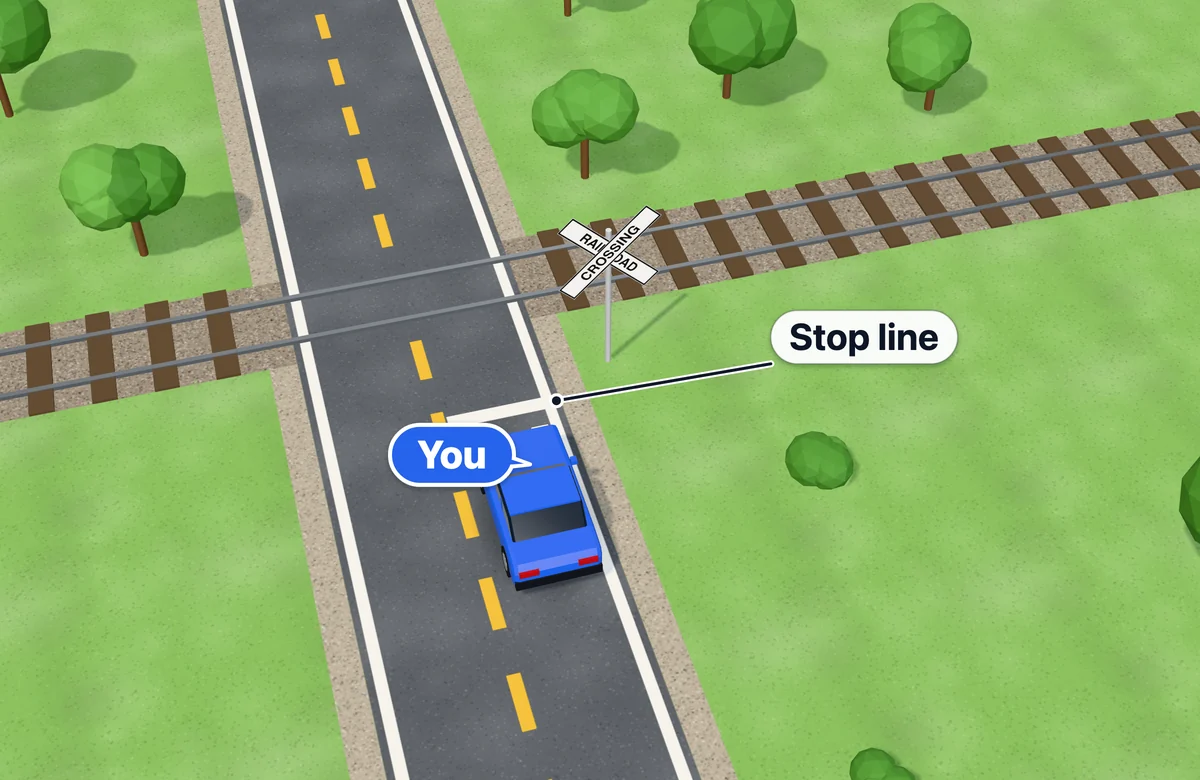
When you must stop at a railroad crossing, how far from the nearest rail should you stop?
- A Between 5 and 10 feet
- B Between 60 and 100 feet
- C Between 15 and 50 feet
- D Right at the edge of the tracks
Show answer
C. Between 15 and 50 feet
Stop between 15 and 50 feet from the nearest rail when signals flash, gates are lowering or down, a flagger signals, a train is near, you hear its horn, or a stop sign is posted.
When driving near other vehicles, what is the minimum space the Washington Driver Guide says to leave between you and the vehicle ahead?
- A At least twice the length of your vehicle
- B At least one car length
- C At least 10 feet
- D Enough to read their license plate
Show answer
A. At least twice the length of your vehicle
The guide says to leave a distance at least twice the length of your vehicle between you and the vehicle ahead. Keeping space around you gives you time to find another path if there's a problem.
A tire suddenly blows out while you are driving. What should you do?
- A Brake hard right away
- B Grip the wheel firmly, keep straight, and slow gradually
- C Steer quickly onto the shoulder
- D Speed up to keep control
Show answer
B. Grip the wheel firmly, keep straight, and slow gradually
If a tire blows out, grip the wheel firmly and keep the vehicle going straight. Take your foot off the accelerator, don't brake (or brake gently if needed), and pull off when it is safe.