Washington Permit Practice Test 6
25 questions written from the Washington Driver Guide, with an explanation and page citation for every answer.
Your car breaks down on the road. Where should you place emergency flares?
Keyboard: press 1–4 or A–D to answer, Enter for the next question, S to save, R to read aloud, P to pause reading, L to listen and answer.
About this test
These questions were written from the Washington Driver Guide (2025). 10 of the 20 Washington questions in this test cover rules that are specific to Washington or differ between states. Every answer comes with an explanation and a link to the exact page it comes from, so you can check it yourself.
Your answers are saved in this browser. Questions you miss go to My mistakes so you can practice them again.
Sample questions from this test
Your car breaks down on the road. Where should you place emergency flares?
- A 200 to 300 feet behind the vehicle
- B 10 to 20 feet behind the vehicle
- C Directly in front of the vehicle
- D 500 feet ahead of the vehicle
Show answer
A. 200 to 300 feet behind the vehicle
Warn other road users by placing flares 200 to 300 feet behind your vehicle. Also turn on your flashers and headlights and stop where drivers can see you, not just over a hill or around a curve.
View diagram
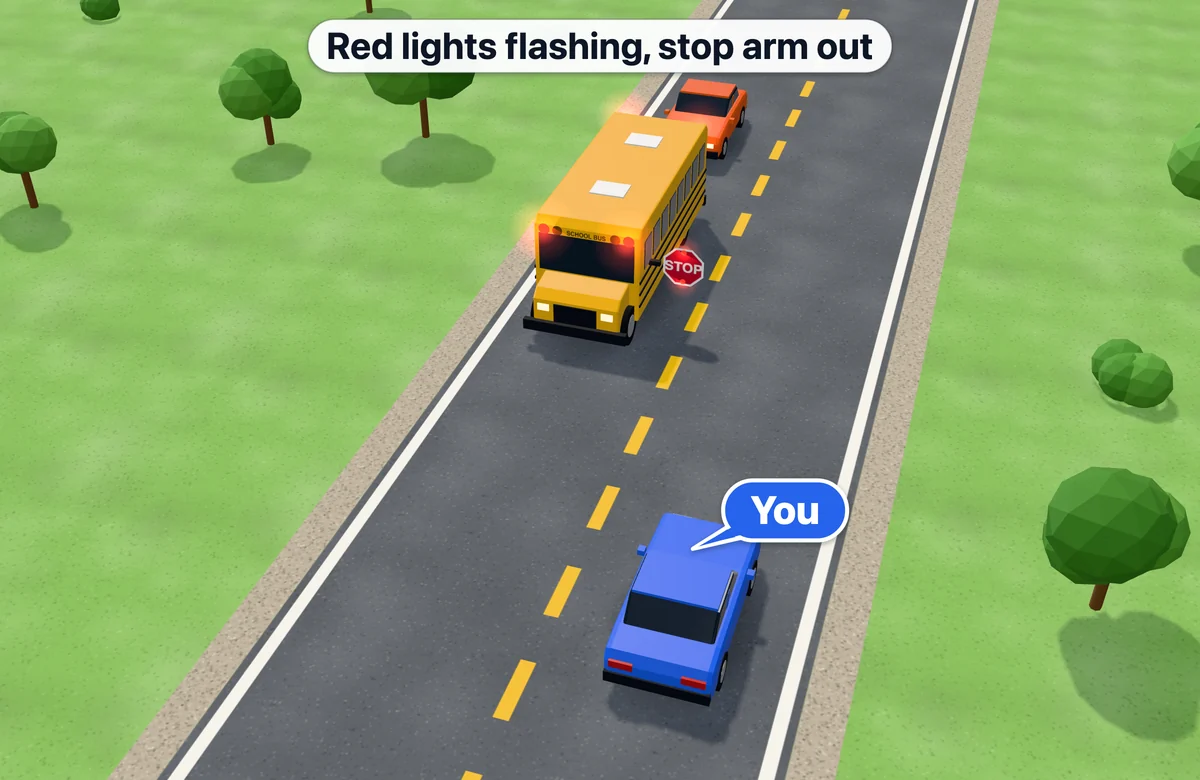
On a two-lane road, a school bus stops ahead of you coming the other way with red lights flashing and its stop sign out. What must you do?
- A Continue, since you are going the other way
- B Stop; drivers in both directions must stop
- C Slow to 20 mph and pass carefully
- D Stop only if children are in the road
Show answer
B. Stop; drivers in both directions must stop
On a 2-lane road, all vehicles must stop when the bus's red lights flash and the stop sign extends. Go only when the lights stop, the sign retracts and the arm returns to the bumper.
Source: Washington Driver Guide, page 96
On a road with several lanes going your way, which lane should you normally use?
- A The left lane, because it is fastest
- B The carpool lane, if it is moving
- C Any lane, as long as you match the speed limit
- D The right lane, using the left lane to pass
Show answer
D. The right lane, using the left lane to pass
Keep right except to pass. When there are multiple lanes in the same direction, drive in the right lane and use the left lane to pass slower traffic, still within the speed limit.
What minimum amount must Washington liability insurance pay for damage to other people's property in one collision?
- A $25,000
- B $5,000
- C $50,000
- D $10,000
Show answer
D. $10,000
Property damage coverage must be at least $10,000 per collision. Remember the three numbers together: 25 for one person, 50 for two or more, 10 for property.
Source: Washington Driver Guide, page 43

View diagram
On a two-lane road, the center has a solid yellow line on your side and a dashed yellow line on the other side. May you pass?
- A No, you may not pass while the solid line is on your side
- B Yes, if the road ahead is clear
- C Yes, if the car ahead is going under the limit
- D Yes, a dashed line lets traffic in both directions pass
Show answer
A. No, you may not pass while the solid line is on your side
When a solid and a dashed yellow line mark the center, you may not pass if the solid line is on your side. Drivers on the dashed side may pass when it is safe.