Study sheet for before your test. Notes aren’t allowed in the DMV test room. Source: Wisconsin Motorists' Handbook (2026), wisconsindot.gov · Checked September 22, 2026 · Printed Oct 11, 2026 · drivingtestpal.com/wisconsin/cheat-sheet/ |
Wisconsin · Study sheet Wisconsin permit test cheat sheetThe 45 Wisconsin rules, 12 numbers and 12 signs worth knowing cold. Page numbers point to the handbook. Test format50 questions Passing score40 of 50 correct (80%) Permit and test fees$35 total Minimum age for a permit15 years Supervised driving50 hours (10 at night) Hold your permit6 months minimum Numbers to know
Signs to know
Permits & licensing
Laws, points & insurance
School buses & emergency vehicles
Alcohol & drugs
Sharing the road
Road signs
Pavement markings
Speed limits & control
Emergencies & crashes
Distracted & drowsy driving
Traffic signals
Turning & signaling
Following distance & space
Highways & freeways
Work zones
Night, weather & hazards
Seat belts & equipment
Right of way & intersections
Lanes, passing & merging
Parking & stopping
|
Wisconsin permit test cheat sheet
Wisconsin-specific rules from our question bank, condensed to one line each with the handbook page. Read it the night before; don’t use it instead of practicing.
Study sheet for before your test. Notes aren’t allowed in the DMV test room. See the study sheets to print.
- Test format
- 50 questions
- Passing score
- 40 of 50 correct (80%)
- Permit and test fees
- $35 total
- Minimum age for a permit
- 15 years
- Supervised driving
- 50 hours (10 at night)
- Hold your permit
- 6 months minimum
Permits & licensing
- Teens can start with a Class D instruction permit at age 15 once they pass the knowledge, signs and vision tests. p. 9
- Applicants under 18 must be enrolled in a driver education program that includes the behind-the-wheel portion. p. 9
- The supervising driver must have at least two years of licensed driving experience and hold a valid regular license. p. 9
- A permit supervisor must hold a valid regular license, not a probationary or occupational one, and have two years of experience. p. 9
- During hours of darkness, a permit holder must be accompanied by a qualified instructor or a licensed person at least 25 with two years of experience. p. 9
- Anyone 21 or older can supervise, but if the permit holder is under 18 that person needs written authorization from the minor's parent or guardian before driving. p. 9
- If you are at least 16, one other licensed person 25 or older with at least two years of experience may sit in a seat other than the front seat. p. 9
- Drivers under 18 must hold the instruction permit for at least six months and be at least 16 before getting a probationary license. p. 10
- Wisconsin requires at least 50 hours of supervised practice, including 10 hours during darkness, and your sponsor must verify them. p. 10
- An applicant under 18 needs an adult sponsor to sign the MV3001. p. 7
- The GDL restrictions apply for the first nine months of a probationary license, or until you turn 18 if that happens first. p. 10
- From 5 a.m. to midnight, a probationary driver under the GDL rules may drive alone and carry any number of immediate family members. p. 10
- Between midnight and 5 a.m., a GDL driver may drive alone only between home, school and/or work, or with a qualified adult. p. 11
- A moving violation, breaking a GDL restriction, or any suspension or revocation adds six months to your GDL restrictions. p. 11
- The Class D knowledge test has 50 questions and you need 40 correct, which is 80 percent. p. 5
- The highway signs test has 15 questions and you must answer 12 correctly (80 percent). p. 5
- Car and motorcycle applicants need at least 20/40 acuity in one eye (corrected or uncorrected) and a 70-degree field of vision from the center of each eye. p. 5
- The test is free at a DMV customer service center. p. 5
- A regular Wisconsin license must be renewed every eight years, and you can renew up to a year early. p. 11
- A Class D instruction permit is valid for 18 months, which leaves time to complete the six-month holding period and 50 hours of practice. source
- Adults 18 and older must hold the instruction permit at least seven days before getting a probationary license. source
- Applicants under 18 must have received no traffic tickets for the six months before applying for a probationary license. source
- If you do not pass, you may retake the test no sooner than the next day. source
- The online test can be attempted only twice. source
Laws, points & insurance
- Your record starts at zero, and convictions add demerit points. p. 57
- If you hold a probationary license, an ID card or no license, demerit points are doubled on the second conviction and every one after. p. 57
- A habitual traffic offender has four or more major violations or 12 or more minor violations within five years. p. 57
- An occupational license lets a driver who lost their privilege drive up to 12 hours a day and 60 hours a week for work, school and household needs. p. 57
- Wisconsin requires valid liability insurance from an approved company, and you must show proof if an officer asks. p. 59
- If you drive someone else's car, it is your responsibility to make sure it is insured. p. 59
- An instruction permit is suspended for six months if the holder receives 12 or more points within 12 months. source
School buses & emergency vehicles
- Stop at least 20 feet from a school bus with flashing red lights, whether it is on your side of the road or the opposite side. p. 55
- On a divided highway, drivers on the other side of the barrier do not need to stop for a school bus. p. 55
- Stay stopped while the red lights flash and watch for children. p. 55
- Wisconsin's move-over law requires you to move into a lane away from a stopped emergency vehicle or slow down. p. 55
- Give snowplows at least 200 feet when their lights are flashing red, amber or green. p. 49
Alcohol & drugs
- Drivers under 21 may not have any alcohol in their system while driving. p. 53
- Under the Implied Consent Law, you must agree to a test when asked. p. 53
- Any amount of a controlled substance is treated the same as operating impaired. p. 53
- Wisconsin's absolute sobriety law bars anyone under the legal drinking age (21) from driving with an alcohol concentration above 0.0. source
- For a driver with two or fewer prior OWI convictions, suspensions or revocations, Wisconsin's prohibited alcohol concentration is 0.08 or more. source
Sharing the road
- Give bicyclists at least three feet when you pass, and wait for oncoming traffic to clear first. p. 56
- No-Zones are areas where truck drivers cannot see you: about 200 feet behind and 20 feet in front. p. 56
- In Wisconsin you should yield the right-of-way to livestock on or along the highway. p. 49
- No one under 16 may operate a farm tractor or self-propelled farm machinery on highways. p. 49
Road signs
Pavement markings
Speed limits & control
Emergencies & crashes
- You must report a crash to police if anyone is injured or killed, if property damage is $1,000 or more, or if government property damage is $200 or more. p. 51
- Damage to government property such as signs or guardrails must be reported to police at $200 or more. p. 51
- If you hit a deer, check your car, record the details for insurance, and call police so they can tag the deer. p. 47
Distracted & drowsy driving
Traffic signals
Right of way & intersections
Turning & signaling
Following distance & space
Highways & freeways
Work zones
Night, weather & hazards
Seat belts & equipment
Lanes, passing & merging
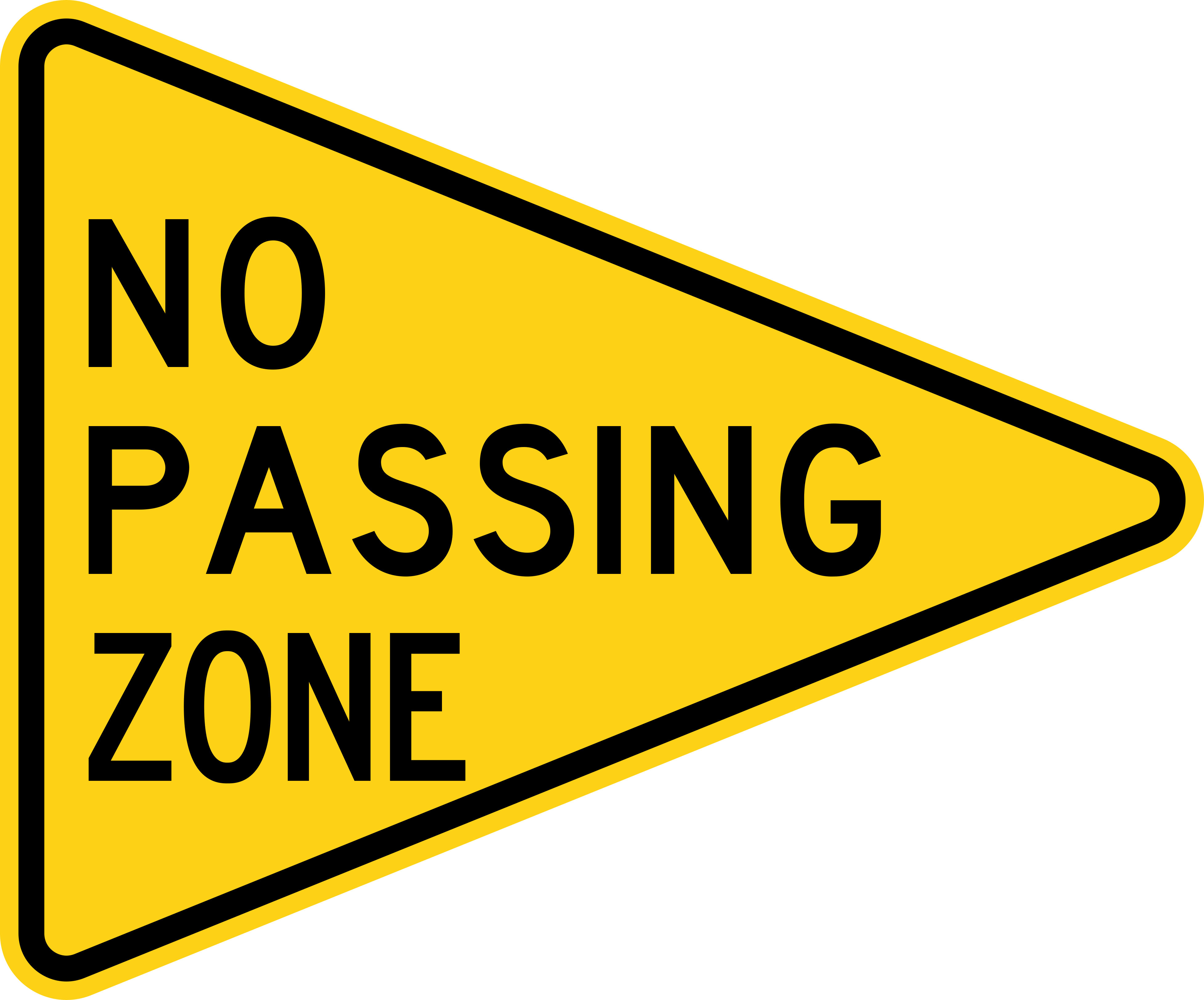
- You may use a paved shoulder to go around a vehicle only if it is stopped or turning left. p. 21
Parking & stopping
- Reserved parking spaces are only for vehicles with a valid disabled parking ID permit or disabled license plate. p. 29