Iowa permit test: railroad crossings
Crossing signs and signals, when to stop and what to do if stuck. 4 questions.
Your car stalls on railroad tracks. You get everyone out, but there is no blue ENS sign posted. Whom should you call?
Keyboard: press 1–4 or A–D to answer, Enter for the next question, S to save, R to read aloud, P to pause reading, L to listen and answer.
Sample railroad crossings questions
Your car stalls on railroad tracks. You get everyone out, but there is no blue ENS sign posted. Whom should you call?
- A 911
- B Your insurance company
- C A tow truck company
- D The nearest DOT office
Show answer
A. 911
If there is no ENS sign, call 911 so dispatchers can alert the railroad. If there is a sign, call its number and give the crossing ID. Either way, get everyone out and away first, even if you do not see a train.
A train is approaching and your car is stuck on the tracks. After getting everyone out, which way should you move?
- A Straight along the tracks, away from the train
- B At a 45-degree angle in the same direction the train is going
- C Away from the tracks at a 45-degree angle, toward the train
- D Directly across the tracks to the far side
Show answer
C. Away from the tracks at a 45-degree angle, toward the train
Get everyone out immediately and move away from the tracks at a 45-degree angle in the direction of the approaching train. Then call the number on the blue and white ENS sign, or 911 if there is no sign.
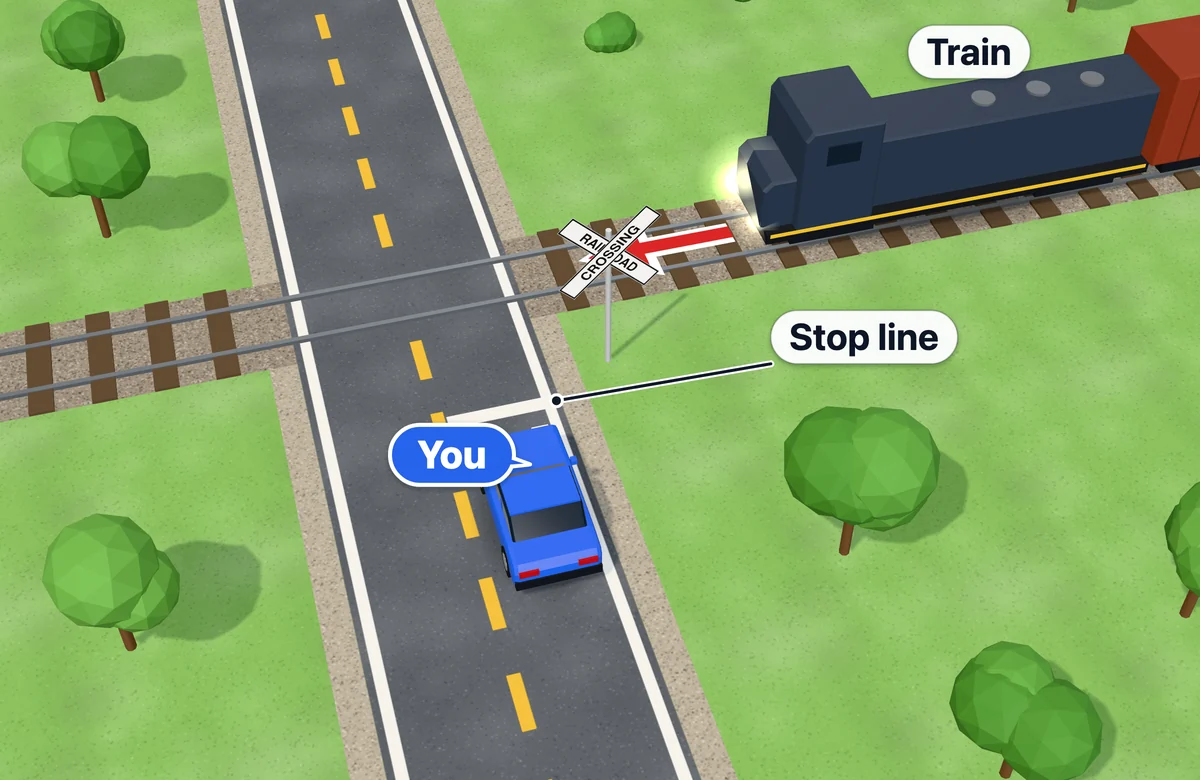
View diagram
When you stop for a train at a railroad crossing, how far should your vehicle be from the nearest rail?
- A At least 5 feet
- B At least 10 feet
- C At least 100 feet
- D At least 15 feet
Show answer
D. At least 15 feet
Leave at least 15 feet between your vehicle and the nearest rail when you stop. Trains are wider than the tracks, so stopping too close can put your car in the train's path.
Which of these drivers must always stop 15 to 50 feet before railroad tracks, unless an exemption applies?
- A A parent driving children to school in a minivan
- B A rideshare driver carrying a paying passenger
- C A farmer driving a pickup with feed sacks
- D A driver towing a small camping trailer
Show answer
B. A rideshare driver carrying a paying passenger
In Iowa, school buses, charter buses, drivers carrying passengers for hire (such as Uber or Lyft) and vehicles placarded for hazardous materials must stop 15 to 50 feet from the tracks. They need not stop if an officer or signal directs traffic through or the crossing has an EXEMPT sign.