Iowa permit test: turning & signaling
Turn lanes, turn signals, hand signals, U-turns and turns on red. 6 questions.
On a road with a 35 mph speed limit, how far before a turn does Iowa law require you to signal?
Keyboard: press 1–4 or A–D to answer, Enter for the next question, S to save, R to read aloud, P to pause reading, L to listen and answer.
Sample turning & signaling questions
On a road with a 35 mph speed limit, how far before a turn does Iowa law require you to signal?
- A At least 50 feet
- B At least 100 feet
- C At least 200 feet
- D At least 300 feet
Show answer
B. At least 100 feet
Iowa requires a turn signal at least 100 feet before the turn when the speed limit is 45 mph or less. On faster roads the distance goes up to 300 feet, because traffic needs more time to react.
You plan to turn off a highway posted at 55 mph. How far before the turn must you signal?
- A At least 100 feet
- B At least 150 feet
- C At least 500 feet
- D At least 300 feet
Show answer
D. At least 300 feet
When the speed limit is faster than 45 mph, Iowa law requires you to signal at least 300 feet before you turn. Higher speeds mean drivers behind you cover more ground before they can react.
View diagram
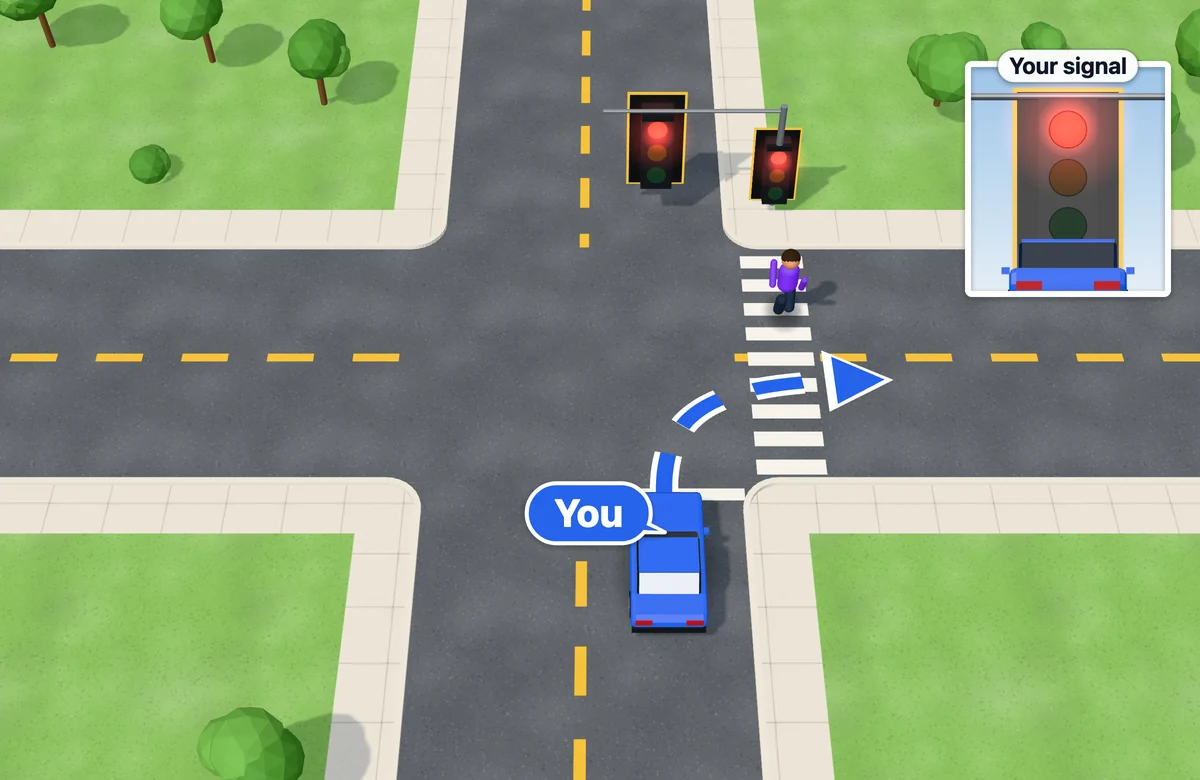
You want to turn right at a red light and there is no sign prohibiting it. What must you do?
- A Slow down and turn if no one is coming
- B Stop completely, then yield to all other traffic before turning
- C Wait for the light to turn green
- D Turn without a full stop as long as the crosswalk and lane are clear
Show answer
B. Stop completely, then yield to all other traffic before turning
Iowa allows a right turn on red unless a NO TURN ON RED sign is posted. You must first come to a complete stop and yield to all other traffic and pedestrians.
When does Iowa allow a left turn on a red light?
- A From the left lane of a one-way street onto another one-way street
- B From any left-turn lane after a complete stop
- C From a two-way street onto a one-way street
- D Never; left turns on red are always illegal
Show answer
A. From the left lane of a one-way street onto another one-way street
After a complete stop, you may turn left on red only from the left lane of a one-way street onto another one-way street. No oncoming traffic is crossed in that case, which is why it is allowed.