Louisiana Permit Practice Test 1
26 questions written from the Class D & E Driver's Guide, with an explanation and page citation for every answer.
You move to a new home in Louisiana. How soon must you correct the address on your driver's license?
Keyboard: press 1–4 or A–D to answer, Enter for the next question, S to save, R to read aloud, P to pause reading, L to listen and answer.
About this test
These questions were written from the Class D & E Driver's Guide (DPSMV2052). 13 of the 21 Louisiana questions in this test cover rules that are specific to Louisiana or differ between states. Every answer comes with an explanation and a link to the exact page it comes from, so you can check it yourself.
Your answers are saved in this browser. Questions you miss go to My mistakes so you can practice them again.
Sample questions from this test
You move to a new home in Louisiana. How soon must you correct the address on your driver's license?
- A Within 10 days
- B At your next renewal
- C Within 60 days
- D Within 30 days
Show answer
A. Within 10 days
Louisiana law requires you to update the address on your license within 10 days after moving. The same 10-day rule applies to your vehicle registration, and failing to update can earn you a ticket.
How close to a fire hydrant may you park in Louisiana?
- A No closer than 10 feet
- B No closer than 20 feet
- C No closer than 15 feet
- D No closer than 30 feet
Show answer
C. No closer than 15 feet
Louisiana's R.S. 32:143 makes it illegal to park within 15 feet of a fire hydrant. Firefighters need clear access to hook up hoses quickly.
You reach an intersection where the traffic light is completely dark because of a power failure. What does Louisiana law say to do?
- A Yield only to vehicles on your left
- B Treat it as an all-way (four-way) stop
- C Follow the main road and do not stop
- D Go through if no cars are coming
Show answer
B. Treat it as an all-way (four-way) stop
When a traffic signal is not working, the intersection reverts to an all-way or four-way stop. Stop completely, then take turns, with the driver on the left yielding to the driver on the right if you arrive together.
View diagram
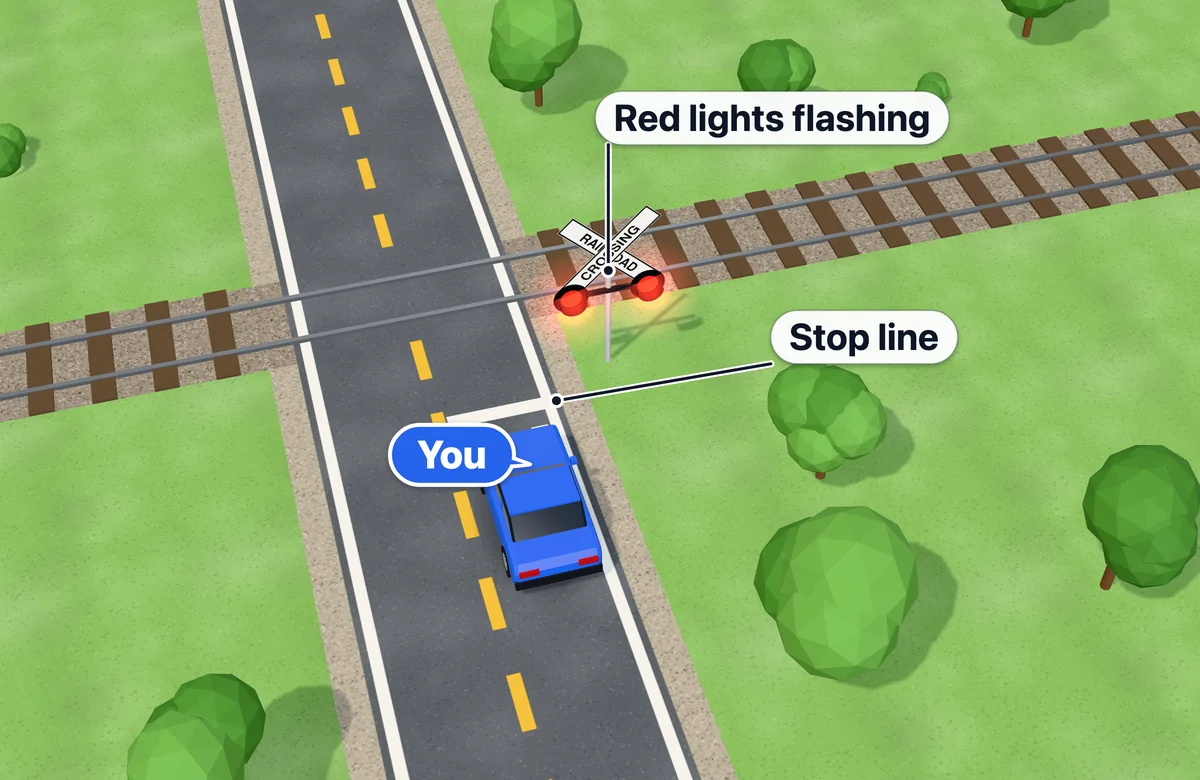
Lights are flashing at a railroad crossing as a train approaches. Under Louisiana law, where must you stop?
- A Between 5 and 10 feet from the nearest rail
- B Exactly 100 feet from the crossing
- C Right at the edge of the first rail
- D Between 15 and 50 feet from the nearest rail
Show answer
D. Between 15 and 50 feet from the nearest rail
Louisiana's R.S. 32:171 requires you to stop within 50 feet but no less than 15 feet from the nearest rail when signals flash, a gate is down or a train is close. Do not cross until it is safe.
Your gas pedal sticks while you are driving. What should you do first?
- A Pull the parking brake as hard as you can
- B Shift into neutral
- C Turn the ignition key to lock
- D Pump the gas pedal hard
Show answer
B. Shift into neutral
If the gas pedal sticks, keep your eyes on the road and shift into neutral first. Then try to free the pedal, turn off the ignition without locking the steering, brake and pull off the road.