Michigan Permit Practice Test 1
26 questions written from the What Every Driver Must Know (SOS-133), with an explanation and page citation for every answer.
How old must a Michigan teen be to start Segment 1 of driver education?
Keyboard: press 1–4 or A–D to answer, Enter for the next question, S to save, R to read aloud, P to pause reading, L to listen and answer.
About this test
These questions were written from the What Every Driver Must Know (SOS-133) (October 2025; SOS-133). 14 of the 21 Michigan questions in this test cover rules that are specific to Michigan or differ between states. Every answer comes with an explanation and a link to the exact page it comes from, so you can check it yourself.
Your answers are saved in this browser. Questions you miss go to My mistakes so you can practice them again.
Sample questions from this test
How old must a Michigan teen be to start Segment 1 of driver education?
- A 14 years, 9 months
- B 14 years, 8 months
- C 15 years
- D 16 years
Show answer
B. 14 years, 8 months
Michigan teens may begin Segment 1 at 14 years, 8 months with a parent or guardian's permission. Starting a month before Level 1 eligibility lets a teen finish the course and apply for the Learner's License right at 14 years, 9 months.
Michigan law requires how much space between your vehicle and a bicyclist when you pass?
- A At least 1 foot
- B At least 5 feet
- C At least 10 feet
- D At least 3 feet
Show answer
D. At least 3 feet
Michigan law requires at least 3 feet when passing a bicyclist; some cities require 5 feet. If that is not possible, pass at a safe distance and speed, which may mean waiting.
View diagram
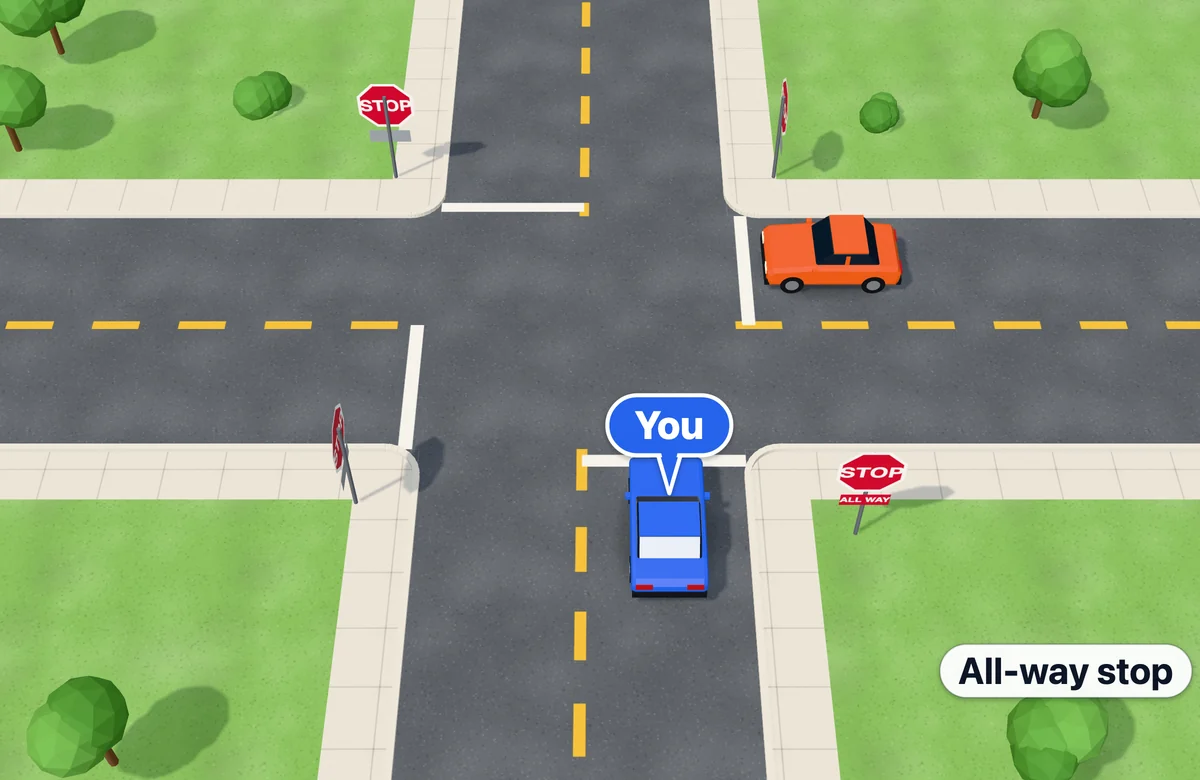
Two vehicles arrive at a four-way stop at the same time. Which one should yield?
- A The vehicle on the right yields to the vehicle on its left
- B The vehicle going straight yields to the turning vehicle
- C The larger vehicle always goes first
- D The vehicle on the left yields to the vehicle on its right
Show answer
D. The vehicle on the left yields to the vehicle on its right
At a four-way stop, the first vehicle to arrive and stop goes first. If two arrive together, the vehicle on the left yields to the one on its right.
After a crash, when must a Michigan driver immediately report it to the police?
- A Only if someone is killed
- B Only if a driver was drinking
- C If anyone is hurt or killed, or damage totals $1,000 or more
- D Only if the damage to any one vehicle exceeds $5,000
Show answer
C. If anyone is hurt or killed, or damage totals $1,000 or more
Michigan law requires the driver to report a crash immediately to the nearest police station or officer if anyone is injured or killed, or if apparent property damage totals $1,000 or more. You must also stop at the scene and exchange information with the other drivers.
Source: Michigan Department of State (Secretary of State) website
View diagram
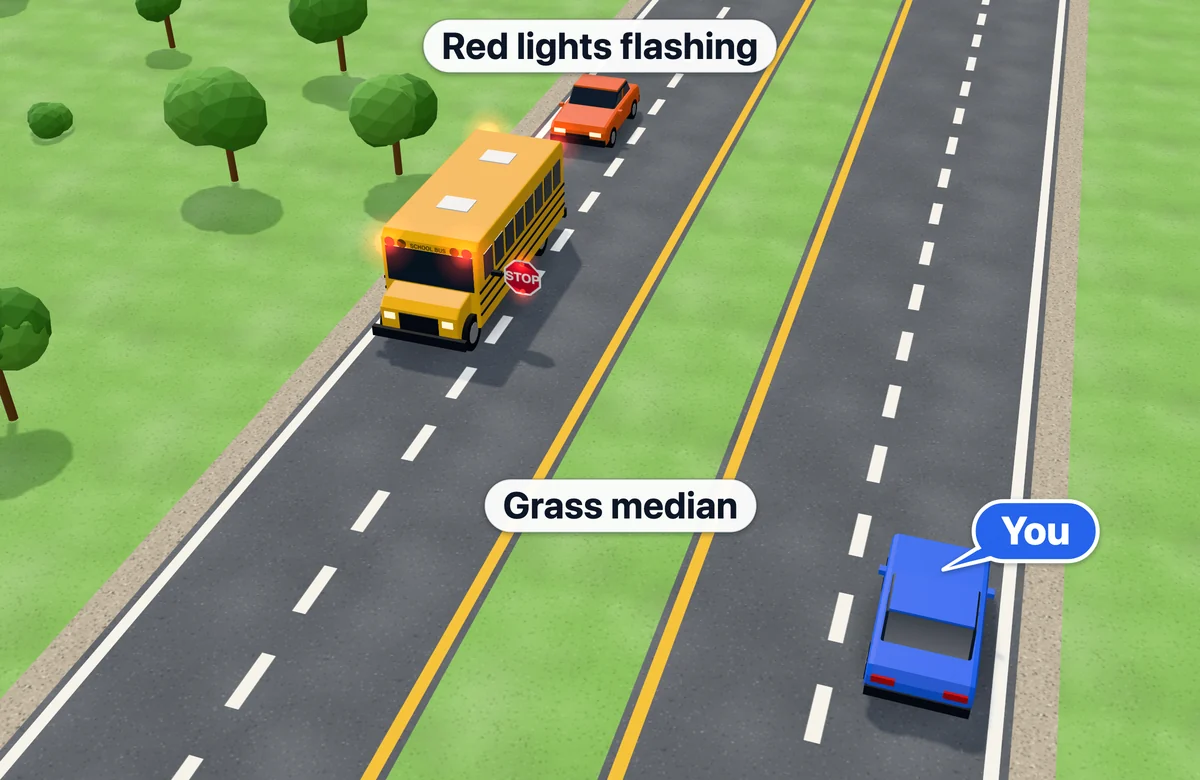
You are on a highway divided by a grass median. A school bus on the other side has its red lights flashing. What must you do?
- A Stop at least 20 feet from the bus
- B Continue with caution; you do not need to stop
- C Stop until the bus turns off its red lights
- D Slow to 15 mph until you pass the bus
Show answer
B. Continue with caution; you do not need to stop
You do not have to stop for a school bus on the other side of a highway divided by a barrier such as a concrete or grass median or an island. Traffic on the same side as the bus must still stop.