Minnesota Permit Practice Test 3
25 questions written from the Minnesota Driver's Manual, with an explanation and page citation for every answer.
What kind of insurance must Minnesota vehicle owners carry to drive on public roads?
Keyboard: press 1–4 or A–D to answer, Enter for the next question, S to save, R to read aloud, P to pause reading, L to listen and answer.
About this test
These questions were written from the Minnesota Driver's Manual (June 2026). 14 of the 20 Minnesota questions in this test cover rules that are specific to Minnesota or differ between states. Every answer comes with an explanation and a link to the exact page it comes from, so you can check it yourself.
Your answers are saved in this browser. Questions you miss go to My mistakes so you can practice them again.
Sample questions from this test
What kind of insurance must Minnesota vehicle owners carry to drive on public roads?
- A Collision and comprehensive insurance
- B No-fault and liability insurance
- C Uninsured motorist insurance only
- D Liability insurance only
Show answer
B. No-fault and liability insurance
Minnesota is a no-fault state. Owners must carry both no-fault and liability insurance and keep proof of it in the vehicle at all times.
View diagram
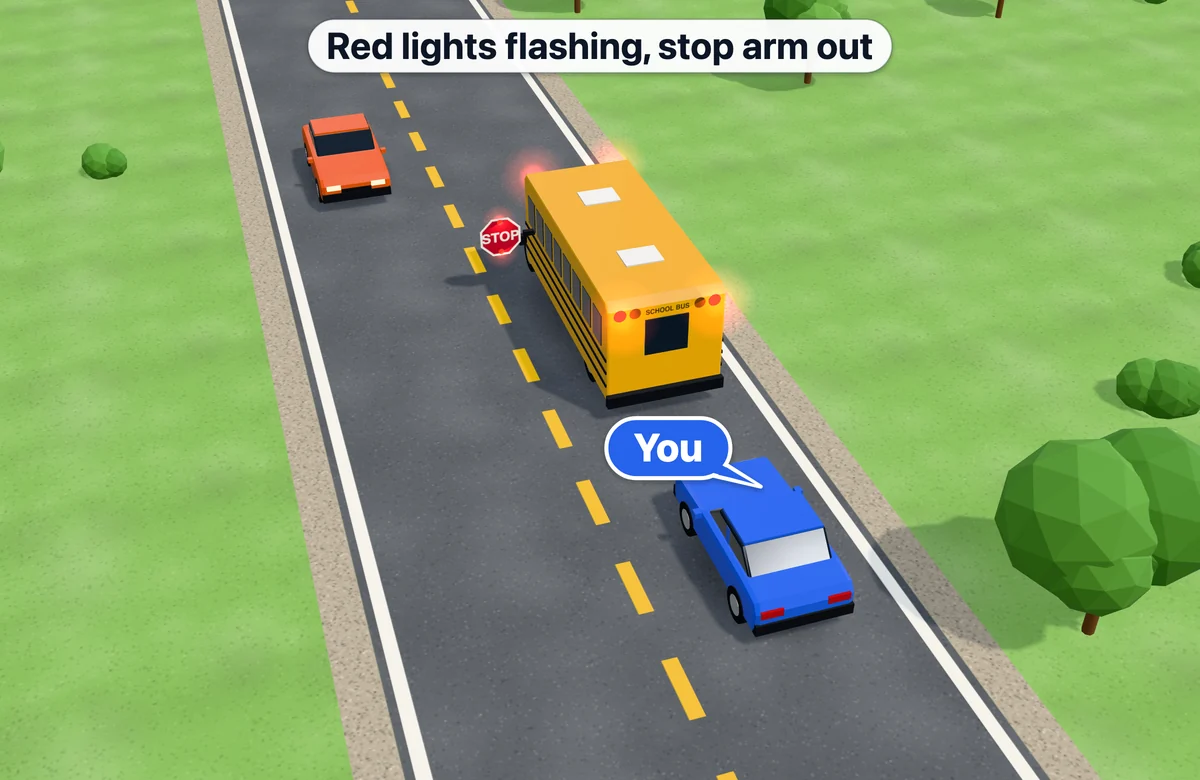
A school bus ahead of you stops with red lights flashing. How far from the bus must you stop?
- A At least 20 feet
- B At least 10 feet
- C At least 30 feet
- D At least 15 feet
Show answer
A. At least 20 feet
Stop at least 20 feet from a school bus with flashing red lights, whether you are behind it or facing it. Stay stopped until the red lights stop flashing.
You see shorter, thicker white dashes on the line next to your lane. What do they mean?
- A You may change lanes freely
- B Your lane is ending
- C Passing is allowed in either direction
- D A bike lane begins here
Show answer
B. Your lane is ending
Normal white dashes separate lanes going the same way and allow lane changes. Shorter, thicker dashes warn that your lane is about to end.
How much is the extra fine for speeding in a Minnesota work zone?
- A Double the regular ticket only
- B $25 in addition to the regular speeding ticket
- C $300 in addition to the regular speeding ticket
- D $100 in addition to the regular speeding ticket
Show answer
C. $300 in addition to the regular speeding ticket
Speeding in a work zone brings a $300 fine on top of the normal speeding ticket. Workers are close to traffic, so slow down and follow flaggers.
You are stopped waiting to turn left across traffic. How should your front wheels be pointed?
- A Straight ahead
- B Turned to the right
- C Turned to the left
- D It does not matter while stopped
Show answer
A. Straight ahead
Keep your wheels straight and your foot on the brake while waiting to turn. If a car hits you from behind, you are less likely to be pushed into oncoming traffic.