Minnesota permit test: pavement markings
Yellow and white lines, passing zones, crosswalks, stop lines and special lanes. 4 questions.
You see shorter, thicker white dashes on the line next to your lane. What do they mean?
Keyboard: press 1–4 or A–D to answer, Enter for the next question, S to save, R to read aloud, P to pause reading, L to listen and answer.
Sample pavement markings questions
You see shorter, thicker white dashes on the line next to your lane. What do they mean?
- A You may change lanes freely
- B Your lane is ending
- C Passing is allowed in either direction
- D A bike lane begins here
Show answer
B. Your lane is ending
Normal white dashes separate lanes going the same way and allow lane changes. Shorter, thicker dashes warn that your lane is about to end.

View diagram
On a two-lane road, the center line is solid yellow on your side and dashed on the other side. May you pass?
- A Yes, if no oncoming traffic is visible
- B Yes, dashes mean either side may pass
- C Only if you return within 100 feet
- D No, you must obey the solid line on your side
Show answer
D. No, you must obey the solid line on your side
When a solid line and a dashed line run together, obey the marking on your side. A solid yellow line on your side means you may not pass.
View diagram
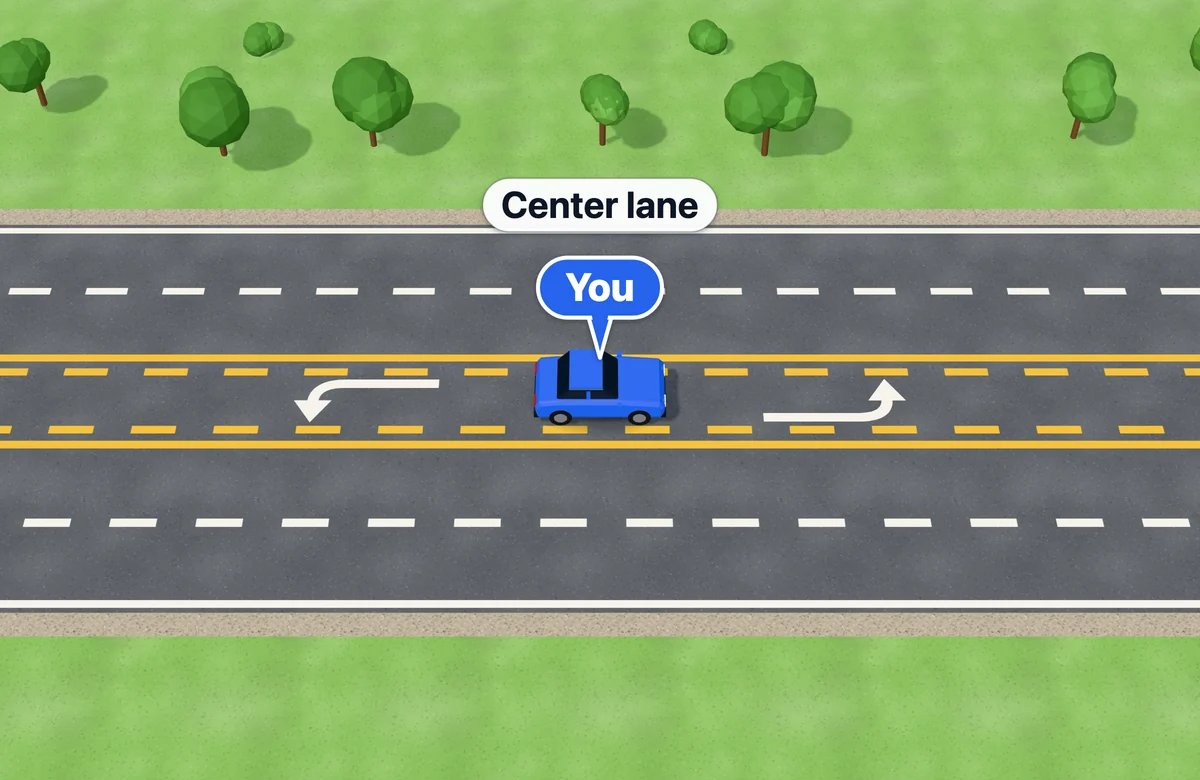
What is a center lane marked by parallel solid and dashed yellow lines used for?
- A Buses and carpools only
- B Left turns by traffic from both directions
- C Passing slower vehicles
- D Parking during rush hour
Show answer
B. Left turns by traffic from both directions
A center left-turn lane is shared by drivers in both directions to turn left into side roads or driveways. It is marked with parallel solid and dashed yellow lines.
A rush-hour reversible lane is marked by dashed double yellow lines. When may you cross into it?
- A Only to pass a slow vehicle
- B Only when an overhead green arrow or sign allows it
- C Only between 6 and 9 a.m.
- D Any time the lane looks empty
Show answer
B. Only when an overhead green arrow or sign allows it
Reversible lanes change direction during rush hour. Enter only when the overhead signal shows a green arrow or a sign allows it.