Nebraska Permit Practice Test 4
25 questions written from the Nebraska Driver's Manual (Class O), with an explanation and page citation for every answer.
On a multi-lane interstate, you approach a stopped tow truck with flashing lights on the shoulder, and its operator is working beside it. What does Nebraska's Move Over Law require?
Keyboard: press 1–4 or A–D to answer, Enter for the next question, S to save, R to read aloud, P to pause reading, L to listen and answer.
About this test
These questions were written from the Nebraska Driver's Manual (Class O) (January 2025). 12 of the 20 Nebraska questions in this test cover rules that are specific to Nebraska or differ between states. Every answer comes with an explanation and a link to the exact page it comes from, so you can check it yourself.
Your answers are saved in this browser. Questions you miss go to My mistakes so you can practice them again.
Sample questions from this test
On a multi-lane interstate, you approach a stopped tow truck with flashing lights on the shoulder, and its operator is working beside it. What does Nebraska's Move Over Law require?
- A Stop behind the tow truck until it leaves
- B Sound your horn to warn the tow operator
- C Move into a lane at least one lane away, if you can
- D Nothing, because the law covers only police cars
Show answer
C. Move into a lane at least one lane away, if you can
On a controlled-access highway such as the interstate, Nebraska's Move Over Law applies when you approach any stopped vehicle on your side of the road, unless it is empty with no one near it. Move into a lane at least one lane away from it; if you cannot, slow down and keep a safe speed. People working on the shoulder have very little protection from passing traffic.
You are following another vehicle at night with your high beams on. Within what distance must you dim them?
- A 200 feet
- B 100 feet
- C 500 feet
- D 50 feet
Show answer
A. 200 feet
Use high beams on open highways, but dim them when following within 200 feet of another vehicle and when meeting oncoming traffic. Bright lights in a mirror can blind the driver ahead.
How far ahead should you signal before turning or moving right or left?
- A At least 50 feet
- B At least 100 feet
- C At least 300 feet
- D At least 500 feet
Show answer
B. At least 100 feet
Signal at least 100 feet before you turn or move left or right. An early signal gives other drivers, cyclists and pedestrians time to react.
You hold a Nebraska Learner's Permit (LPD) and want to practise driving a car. Who must be with you?
- A Any licensed driver at least 18 years old, seated anywhere
- B A parent or guardian only, regardless of the parent's license
- C A licensed driver at least 21 who may ride in the back seat
- D A licensed driver at least 21 in the seat beside you
Show answer
D. A licensed driver at least 21 in the seat beside you
An LPD holder may drive only with a licensed driver who is at least 21 sitting in the seat beside them. Sitting beside you lets the supervisor see what you see and help right away.
View diagram
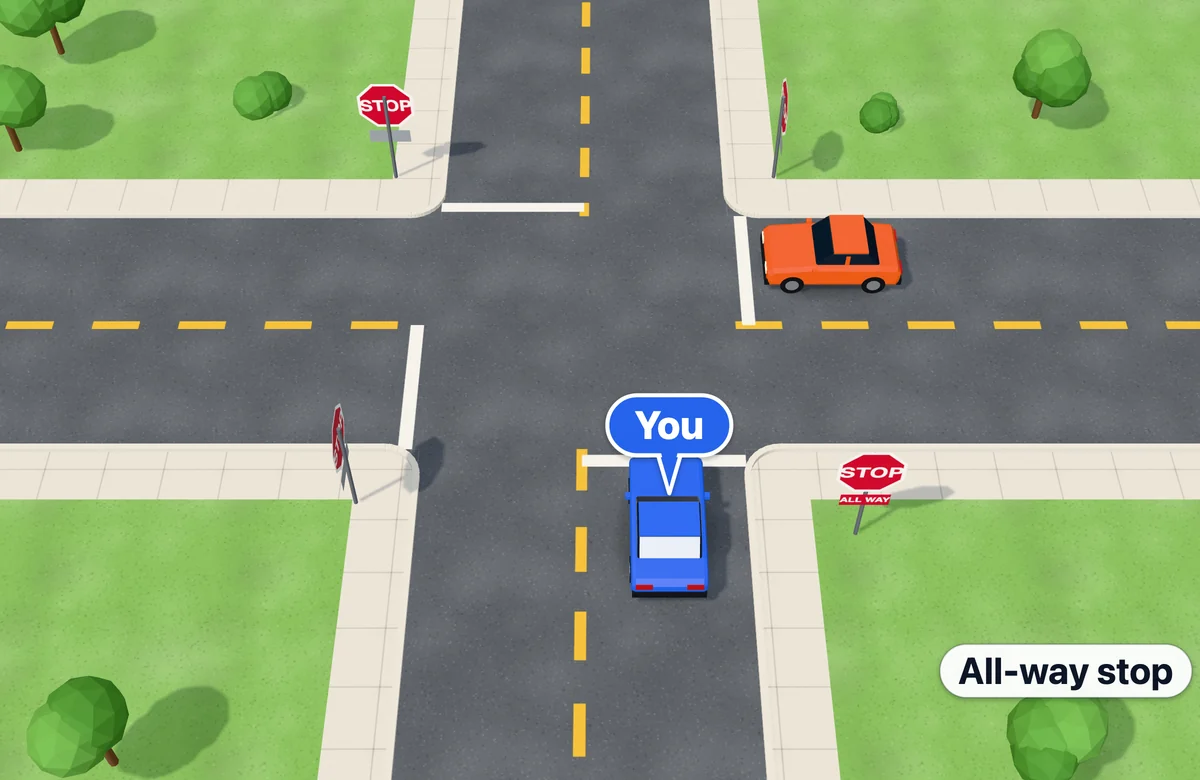
At a four-way stop, you and another driver stop at about the same time and you are not sure who should go. What does the manual advise?
- A Go first because you are turning left
- B Yield to the driver on your left
- C Yield to the driver on your right
- D Go first if your vehicle is larger
Show answer
C. Yield to the driver on your right
At a four-way stop, courtesy lets the driver who stopped first go first. If you are in doubt, yield to the driver on your right, and never insist on the right-of-way at the risk of a crash.