New Jersey permit test: lanes, passing & merging
Lane choice, changing lanes, blind spots, passing rules and merging. 4 questions.
The center of a two-lane road has two solid yellow lines. What does this mean?
Keyboard: press 1–4 or A–D to answer, Enter for the next question, S to save, R to read aloud, P to pause reading, L to listen and answer.
Sample lanes, passing & merging questions
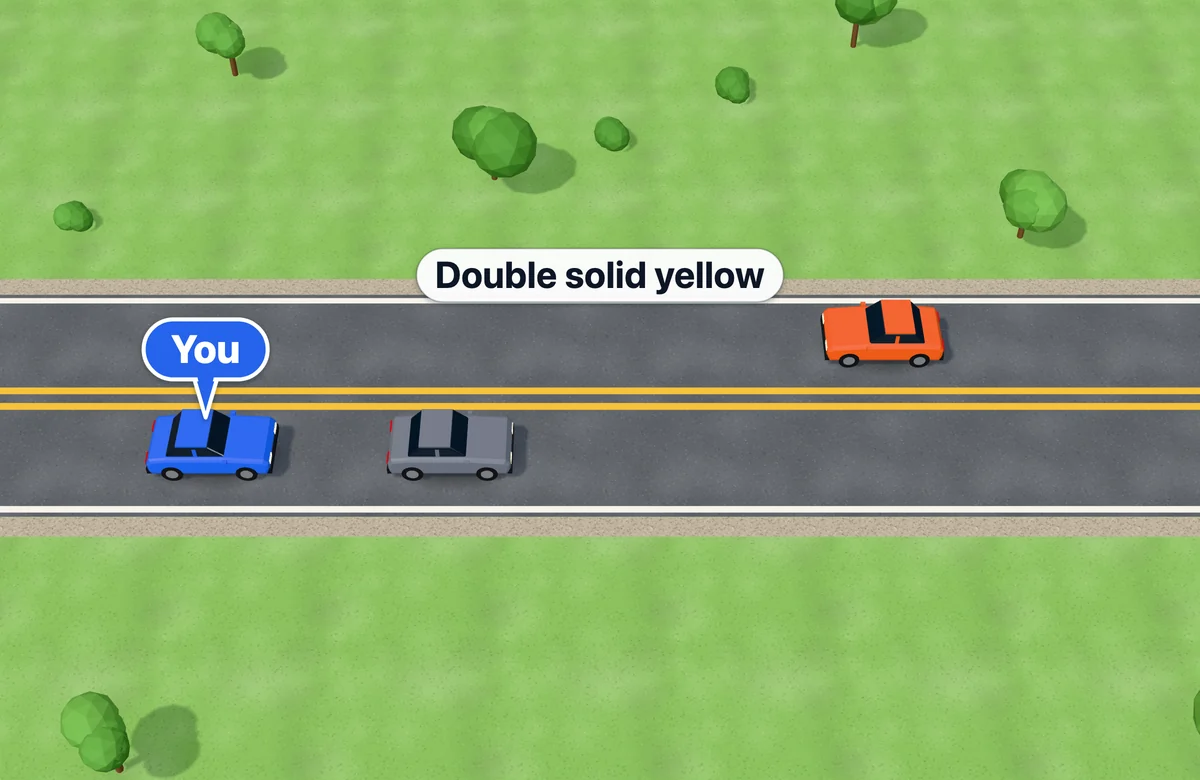
View diagram
The center of a two-lane road has two solid yellow lines. What does this mean?
- A Passing is allowed with caution
- B No passing is allowed in either direction
- C Passing is allowed only during daylight
- D Only the driver nearer the line may pass
Show answer
B. No passing is allowed in either direction
When both center lines are solid, no passing is allowed. When one line is broken, only drivers on the broken-line side may pass.
When is it legal in New Jersey to pass a vehicle using the right shoulder?
- A When the vehicle ahead is turning left
- B Never
- C When traffic is moving very slowly
- D When the shoulder is wide and paved
Show answer
B. Never
Passing on the right is allowed only on the roadway in certain cases, such as multi-lane roads or when the vehicle ahead is turning left. Passing on the right shoulder is always against the law.
After passing a car, how can you tell it is safe to return to the right lane?
- A As soon as your rear bumper clears its front bumper
- B When the other driver flashes headlights
- C After counting one second
- D When you can see the passed car in your rearview mirror
Show answer
D. When you can see the passed car in your rearview mirror
Return to the right lane when you are well ahead of the vehicle you passed. A good sign is when you can see that vehicle in your rearview mirror. Signal your return and cancel the signal.
How many points does New Jersey assess for improper passing in a no-passing zone?
- A 2 points
- B 3 points
- C 5 points
- D 4 points
Show answer
D. 4 points
Passing in a no-passing zone costs 4 points, as does improper passing on the right or off the roadway. No-passing zones mark places where you cannot see far enough ahead.