New Jersey permit test: turning & signaling
Turn lanes, turn signals, hand signals, U-turns and turns on red. 5 questions.
How far before a turn does New Jersey law require you to signal?
Keyboard: press 1–4 or A–D to answer, Enter for the next question, S to save, R to read aloud, P to pause reading, L to listen and answer.
Sample turning & signaling questions
How far before a turn does New Jersey law require you to signal?
- A At least 100 feet
- B At least 50 feet
- C At least 200 feet
- D At least 500 feet
Show answer
A. At least 100 feet
State law requires you to move into the proper lane and signal at least 100 feet before any turn, then cancel the signal after turning. Early signals let others plan around you.
Which hand signal means you are about to turn right?
- A Left hand and arm pointing straight out
- B Left hand and arm pointing upward
- C Left hand and arm pointing downward
- D Waving the left arm back and forth
Show answer
B. Left hand and arm pointing upward
Hand signals are given with the left arm out the window: straight out for left, upward for right, and downward with palm to the rear for stopping or slowing.
View diagram
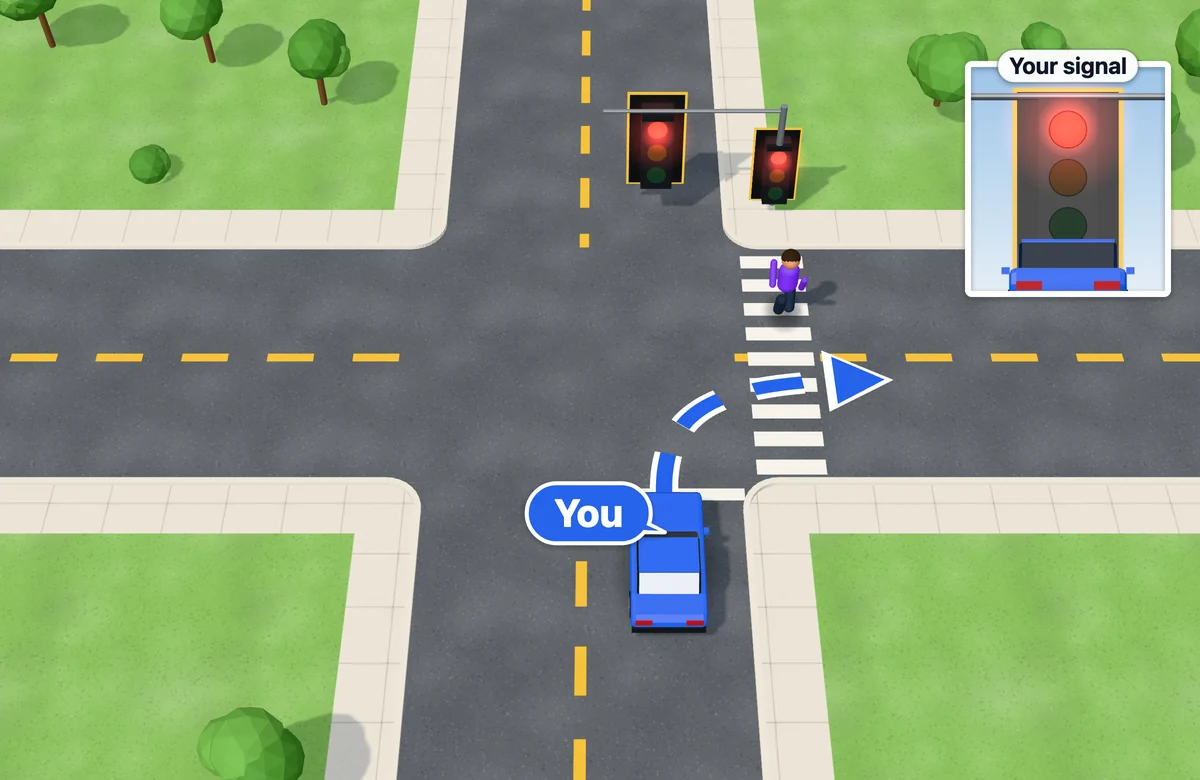
When may you turn right on a red light in New Jersey?
- A Any time, without stopping, if no one is coming
- B After a full stop, yielding to traffic and pedestrians, unless a sign prohibits it
- C Only when a green arrow is shown
- D Never; right turns on red are illegal everywhere in New Jersey, even after stopping
Show answer
B. After a full stop, yielding to traffic and pedestrians, unless a sign prohibits it
Unless a No Turn on Red sign is posted, you may turn right on red after a full stop. Yield to all oncoming traffic and pedestrians, and watch for bicycles and mopeds that may have a green light.
You are turning left from a two-way road onto a four-lane highway. Which lane should you turn into?
- A The far right lane, crossing all lanes in one move
- B Either lane, depending on which has less traffic
- C The shoulder, until traffic clears
- D The lane nearest the center line, then move right when safe
Show answer
D. The lane nearest the center line, then move right when safe
Turn into the lane nearest the center line on the right side of the new road, which is its passing lane. When traffic permits, move right out of the passing lane.