New York Permit Practice Test 3
25 questions written from the New York State Driver's Manual (MV-21), with an explanation and page citation for every answer.
In New York, a BAC above what level is legal evidence that your ability to drive is impaired (DWAI)?
Keyboard: press 1–4 or A–D to answer, Enter for the next question, S to save, R to read aloud, P to pause reading, L to listen and answer.
About this test
These questions were written from the New York State Driver's Manual (MV-21) (MV-21). 15 of the 20 New York questions in this test cover rules that are specific to New York or differ between states. Every answer comes with an explanation and a link to the exact page it comes from, so you can check it yourself.
Your answers are saved in this browser. Questions you miss go to My mistakes so you can practice them again.
Sample questions from this test
In New York, a BAC above what level is legal evidence that your ability to drive is impaired (DWAI)?
- A .02 percent
- B .08 percent
- C .05 percent
- D .10 percent
Show answer
C. .05 percent
New York has three adult alcohol levels: more than .05 is evidence of impairment (DWAI), .08 or higher is evidence of intoxication (DWI), and .18 or higher is aggravated DWI. You can be convicted of DWAI well below .08.
You approach an intersection where the traffic lights are not working. What does New York law require?
- A Drive through carefully without stopping
- B Treat it as a yield sign and slow down
- C Wait until the lights start working again
- D Stop as you would for a STOP sign, then follow right-of-way rules
Show answer
D. Stop as you would for a STOP sign, then follow right-of-way rules
If traffic lights are out of service or not working correctly, New York law requires you to stop as at a STOP sign. Then go according to right-of-way rules, unless a traffic officer directs you.
What color and shape are warning signs normally?
- A White and rectangular, with black letters
- B Green, with white letters
- C Yellow diamonds with black letters or symbols
- D Blue, with white letters
Show answer
C. Yellow diamonds with black letters or symbols
Warning signs are normally yellow diamonds with black letters or symbols, and they alert you to hazards or special rules ahead. Some carry a yellow and black recommended-speed plaque.
What happens to speeding fines in a New York work zone when no workers are present?
- A They return to normal fines
- B They are still doubled
- C They are tripled
- D They are waived if traffic is light
Show answer
B. They are still doubled
Speeding fines double in New York work zones, even when no workers or work vehicles are present. Lanes may shift or close and workers can appear suddenly.
View diagram
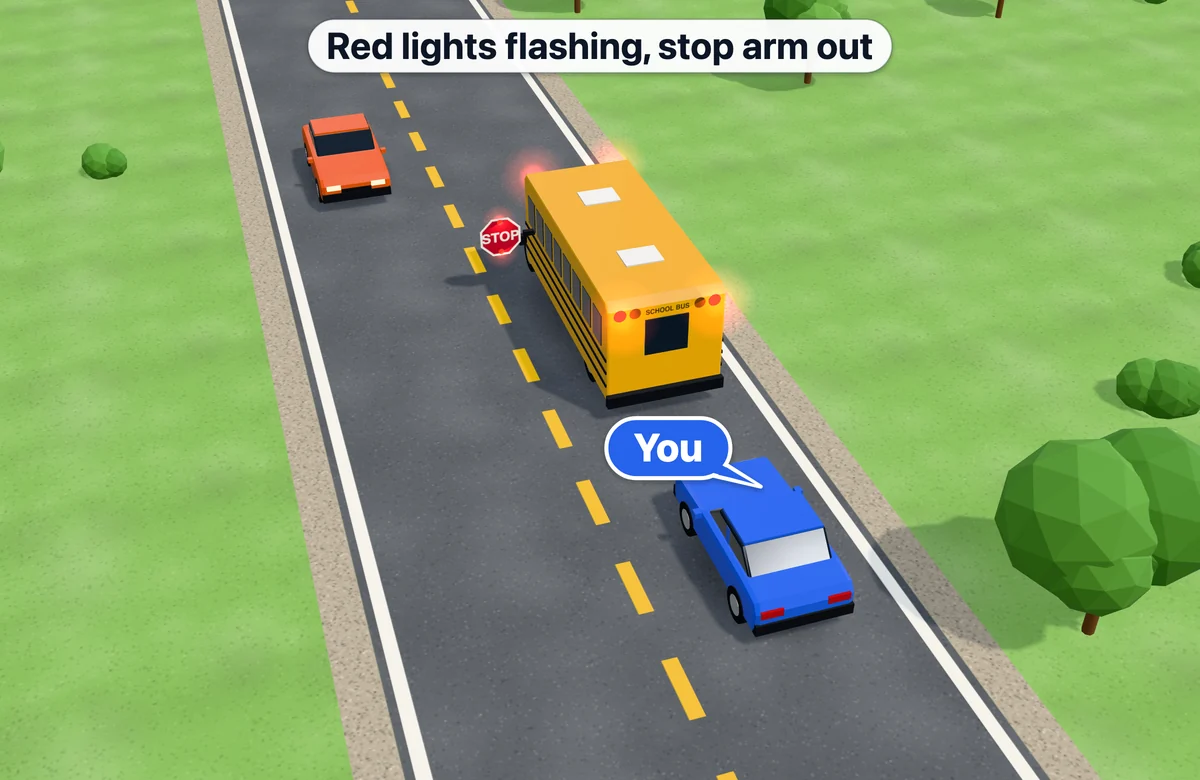
How far from a stopped school bus with flashing red lights should you stop?
- A At least 20 feet away
- B At least 10 feet away
- C At least 50 feet away
- D At least 100 feet away
Show answer
A. At least 20 feet away
Stop at least 20 feet from a school bus with flashing red lights, whether you are behind it or approaching it. Children may cross in front of the bus or along the road.