Tennessee Permit Practice Test 5
25 questions written from the Tennessee Comprehensive Driver License Manual, with an explanation and page citation for every answer.
Under Tennessee's hands-free law, which of these is illegal for an adult driver with a full Class D license?
Keyboard: press 1–4 or A–D to answer, Enter for the next question, S to save, R to read aloud, P to pause reading, L to listen and answer.
About this test
These questions were written from the Tennessee Comprehensive Driver License Manual (Information current as of July 1, 2022). 11 of the 20 Tennessee questions in this test cover rules that are specific to Tennessee or differ between states. Every answer comes with an explanation and a link to the exact page it comes from, so you can check it yourself.
Your answers are saved in this browser. Questions you miss go to My mistakes so you can practice them again.
Sample questions from this test
Under Tennessee's hands-free law, which of these is illegal for an adult driver with a full Class D license?
- A Holding a phone with any part of your body
- B Listening to the radio at low volume
- C Using a phone through a hands-free car system
- D Talking with passengers in the car
Show answer
A. Holding a phone with any part of your body
Tennessee's 2019 hands-free law makes it illegal to hold a phone with any part of your body, to write, send or read texts, to reach for a phone in a way that takes you out of your seat belt, or to watch or record video. Set things up before you drive. Drivers with a learner permit or intermediate license face a stricter rule: no cell phone use at all while driving.
Source: Tennessee Comprehensive Driver License Manual, page 6
You notice a yellow line on your right and a white line on your left. What does this mean?
- A You are driving the wrong way
- B You are in a passing zone
- C You are in a bike lane
- D You are on a one-way street or ramp
Show answer
A. You are driving the wrong way
Remember "white on your right, yellow on your left." If the yellow line is on your right, you are on the wrong side of the road and must get into the proper lane immediately.
Source: Tennessee Comprehensive Driver License Manual, page 56
Passing several cars at once is not illegal in Tennessee, but the manual says you should be able to return to your lane before coming within how far of a no-passing marking or oncoming car?
- A 300 feet
- B 25 feet
- C 50 feet
- D 100 feet
Show answer
D. 100 feet
Only consider passing more than one vehicle on a straight, level road where you can see well, and only if you can return to the right lane before coming within 100 feet of no-passing markings or oncoming traffic. When in doubt, stay in your lane.
Source: Tennessee Comprehensive Driver License Manual, page 76
A 17-year-old driver is found with a BAC of 0.02 percent. What offense is this in Tennessee?
- A Only an open-container violation
- B Underage driving while impaired
- C Only a warning, since it is a first offense
- D No offense, because it is below 0.08
Show answer
B. Underage driving while impaired
Drivers who are at least 16 but under 21 are convicted of underage driving while impaired at a BAC of just 0.02 percent. Young drivers are affected by small amounts of alcohol because of low tolerance and little experience.
Source: Tennessee Comprehensive Driver License Manual, page 97
View diagram
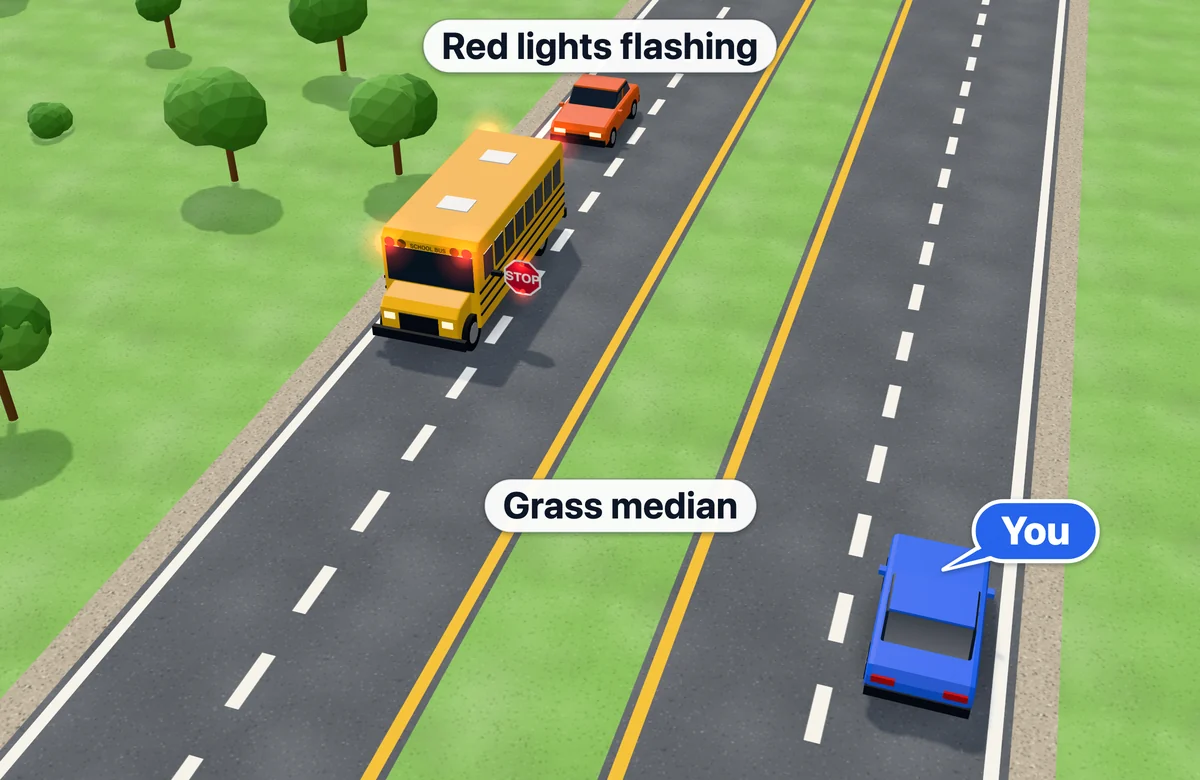
You are on a divided highway with a grass median. A school bus on the other side has stopped with red lights flashing. What must you do?
- A Pull onto the shoulder and wait
- B Stop until the bus moves again
- C You need not stop, but should proceed with caution
- D Stop only if children are visible
Show answer
C. You need not stop, but should proceed with caution
When the roadways are separated by a median or barrier not suitable for vehicles, drivers on the opposite side need not stop for a school bus, but should proceed with caution. Drivers behind the bus on its side must still stop.
Source: Tennessee Comprehensive Driver License Manual, page 65